

Search for what a medical answering service costs and you get the same three ranges repeated from one article to the next, none of them linked to a price list. So we did the dull version: opened the pricing pages and terms of service of the answering services that publish them, and wrote down what they say. The per-minute rate turns out to be the least informative number on the page. What decides a clinic's bill is how a minute is defined and how it is rounded. We sell a flat-rate AI alternative, which is a reason to check our arithmetic - every figure below links to the vendor's own page.
Our articles are still written by humans!
Get human written articles in your Google feed.
The short answer
A medical answering service for a small practice costs somewhere between $150 and $1,700 a month on published rate cards, and that range is not a hedge - it is the real gap between the cheapest and most expensive vendor for the same number of minutes. A realistic after-hours line for a small practice, a few hundred billed minutes, lands at roughly $450 to $600 a month on the lower-priced cards and around $900 on the higher-priced ones. Per-call services and AI services price differently and are covered further down.
If you want the general picture for any kind of business, our answering service cost guide covers the pricing models. This article is narrower: the lines on the invoice that are specific to a clinic - on-call dispatch, HIPAA, holidays - and what vendors put in writing about each.
The published rate cards
These are the live-agent prices each company showed on its own pricing page on October 1, 2026. We have included only vendors whose page we could read directly. The effective rate column is our arithmetic: plan price divided by included minutes.
Live-agent plans as published by each vendor (checked October 1, 2026)
| Service | About 100 minutes | About 500 minutes | Overage per minute | Effective rate, 100 / 500 min |
|---|---|---|---|---|
| AMBS Call Center | $149 | $600 | $1.29 / $1.22 | $1.49 / $1.20 |
| Specialty Answering Service | $159 | $649 | $1.44 / $1.34 | $1.59 / $1.30 |
| Signius | $170 (125 minutes) | No 500-minute plan published; $280 for 225 minutes | $1.25 | $1.36 at 125 min |
| PATLive | $189 | $759 | $2.09 / $1.79 | $1.89 / $1.52 |
| Moneypenny US | $265 | $985 | $2.12 / $1.67 | $2.65 / $1.97 |
| Abby Connect | $329 | $1,380 | Billed at the plan's per-minute rate; no dollar figure published | $3.29 / $2.76 |
| Ruby | $395 | $1,725 | Not published on the pricing page | $3.95 / $3.45 |
VoiceNation, which appears in many older comparisons, now redirects to Moneypenny's US pricing page, so the two are one row. Smith.ai bills per call rather than per minute and is in its own section below. Nexa publishes plan sizes but no prices. AnswerConnect and AnswerForce show a quote form instead of a US price list, so they are not in the table - any figure you see for them elsewhere comes from a third party.
What counts as a billable minute
A per-minute rate means nothing until you know what a minute contains. The services that define it in writing do not agree with each other.
How vendors define billable time, in their own documents
| Service | What is billed | Source |
|---|---|---|
| PATLive | Only the time receptionists are on the phone with your callers | Billing help page |
| AMBS Call Center | “Work time”: answering and taking messages, calling your staff or customers, sending email and text messages, paging, entering on-call information, transferring calls, account changes | Pricing page |
| Moneypenny US | Operator time from connection, outbound dialling, wrap-up time capped at 180 seconds per call, and the entire time agents spend attempting to dispatch a call to you or your staff | Terms |
| Nexa | From the moment a receptionist receives the call, including hold time and outbound ringing, plus time spent “completing information about the call after the caller has hung up” | Terms |
The row to read twice, if you run a medical practice, is dispatch. An ordinary business gets a message by email. A clinic gets a message, and then the service tries to reach the on-call physician, waits, tries again, and tries the backup. Under a work-time definition all of that is billable. A two-minute patient call can become a five-minute line item without anyone doing anything wrong.

That timing comes from a research letter in the Journal of General Internal Medicine covering 2,208 after-hours calls over 15 months at a single practice. It is one practice, not a national benchmark - we could not find a national one that is not a vendor's own number - but it is a useful warning against sizing a plan from a quiet weekday.
The increment decides the invoice
Every service rounds call time to some unit. The published units range from one second to one minute.
Billing increments as published
| Service | Increment | Source |
|---|---|---|
| Specialty Answering Service | By the second | Pricing page |
| PATLive | First minute in full, then 6-second increments | FAQ |
| AMBS Call Center | 30 seconds, rounded up | Pricing page |
| Moneypenny US | 30 seconds, rounded up, after adding wrap-up and dispatch time | Terms |
| Nexa | Whole minutes; partial minutes rounded up | Terms |
| Smith.ai | Per call, not per minute | Pricing page |
| Signius, Abby Connect | Not published on the pricing page | - |
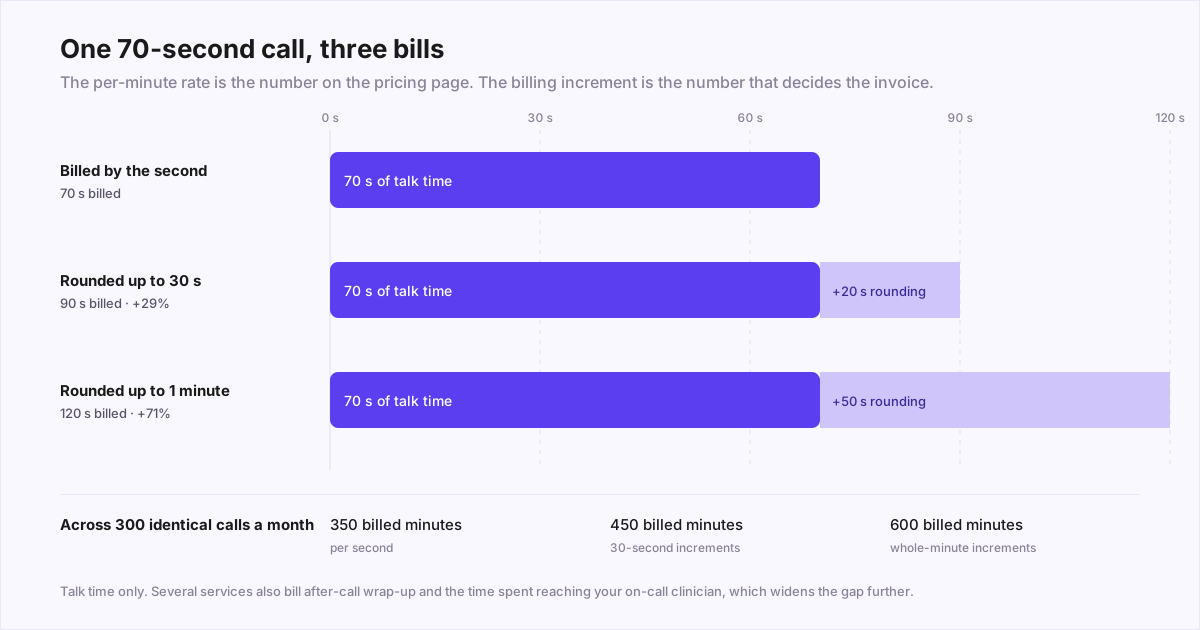
Moneypenny's terms give their own example, which is worth quoting because it is unusually candid: a call that lasts 62 seconds with 8 seconds of wrap-up time "will be billed at 90 seconds". That is a 45% uplift on the talk time, disclosed in the contract and invisible on the pricing page.
Fees: which are real
Guides in this space list a dozen "hidden fees" without saying who charges them. Here is what we found in writing.
Fees and surcharges as published
| Fee | Who states it | Who states they do not charge it |
|---|---|---|
| Set-up | AMBS Call Center: a flat $85 one-time set-up fee, plus $85 per added location. Nexa: a non-refundable set-up fee, amount not published | Specialty Answering Service ($0), Abby Connect, Smith.ai, Ruby |
| Holidays | Nexa: a holiday-related fee on eight named holidays, from New Year's Day to Christmas | Specialty Answering Service (no holiday or weekend fees), AMBS Call Center, Ruby |
| Call patching | Specialty Answering Service: $0.10 per minute, from connect to disconnect. AMBS Call Center: 6 cents per minute | - |
| Per-call add-ons | Smith.ai: appointment booking $1.50 per call, call recording and transcription $0.25, SMS or Slack notifications $0.50 | - |
| Compliance and messaging | Nexa's terms allow compliance fees and encrypted SMS messaging fees, with no amounts published | No vendor we read publishes a BAA fee |
| Taxes and telecom | PATLive: prices do not include taxes and fees | - |
Patching deserves a note. It is the fee for connecting a caller straight through to your on-call clinician and keeping the line up while they talk. Pennies per minute, but for a practice that takes its urgent calls live it is a recurring cost that a retailer or a law firm never sees.
Does a BAA cost extra?
First the legal position, stated carefully. 45 CFR 160.103 defines a business associate as a person who, on behalf of a covered entity, "creates, receives, maintains, or transmits protected health information" for a regulated function. HHS does not name answering services in that definition or in its business associates guidance. That an answering service taking patient calls falls within it is an inference - a safe one, and one the vendors make about themselves: Specialty Answering Service writes that it "falls under the category of a Business Associate" and offers a BAA that both parties sign. Under 45 CFR 164.502(e), the assurances you obtain from a business associate must be documented in a written contract.
Now the money. Several articles state that a BAA "typically adds 10 to 30 percent" to an answering service bill. We could not find a source for that figure, and we could not find a vendor that publishes any BAA fee at all. Specialty Answering Service, Signius and Ruby list HIPAA-compliant service on their pricing pages at the published prices. That is not proof that nobody charges for it - quote-only vendors can price however they like - but it means you should treat a compliance surcharge as something to negotiate, not as an industry norm.
Where HIPAA does change the cost is in the workflow:
- Message delivery. Specialty Answering Service states that email, voicemail and SMS are not treated as secure, so its messages tell you to log in to a secure portal. That is a behaviour change for an on-call physician, and some services charge for the secure channel.
- Human-only compliance.Abby Connect's pricing page lists HIPAA compliance options as "human only", which matters if you were counting on its cheaper AI minutes.
- The price of getting it wrong. HIPAA civil penalties are adjusted for inflation each year. The current table at 45 CFR 102.3 runs from $145 per violation at the lowest tier to $73,011, with a calendar-year maximum of $2,190,294 for identical violations. Against that, the difference between two rate cards is small.
None of this is legal advice. Your compliance officer or counsel decides what is adequate; the medical answering service guide lists the data-handling questions to put to any vendor, ours included.
One practice, five invoices
To show how the pieces interact, take one assumed practice and run it through the cards that publish everything needed. The assumption is ours, not a benchmark: 300 answered calls a month, each with 70 seconds of talk time. We count talk time only, which flatters the services that also bill wrap-up and dispatch.
300 calls of 70 seconds each, priced from published rate cards (our calculation)
| Service | Increment applied | Billed minutes | Cheapest plan plus overage | Monthly total |
|---|---|---|---|---|
| Specialty Answering Service | Per second | 350 | 220-minute plan at $269 + 130 minutes at $1.44 | $456.20 |
| AMBS Call Center | 30 seconds, rounded up (70 s becomes 90 s) | 450 | 250-minute plan at $330 + 200 minutes at $1.23 | $576.00, plus $85 once |
| PATLive | First minute, then 6 seconds (70 s becomes 72 s) | 360 | 300-minute plan at $479 + 60 minutes at $1.89 | $592.40 |
| Moneypenny US | 30 seconds, rounded up | 450 | 200-minute plan at $422 + 250 minutes at $1.91 | $899.50 |
| Signius | Not published | 350 to 600 | 225-minute plan at $280 + overage at $1.25 | $436.25 to $748.75 |
Three things fall out of that table.
- The headline rate misleads. AMBS has the lowest per-minute rate in the set and a higher total than Specialty Answering Service, because 30-second rounding turns 350 minutes into 450.
- An unpublished increment is a $300 question. The Signius range is that wide purely because we do not know how it rounds. One email answers it.
- The totals are a floor. Add wrap-up at the services that bill it, dispatch time for calls that go to the on-call clinician, patching, and tax, and expect the real invoice to be higher. By how much depends on your escalation rate, which only your own call log can tell you.
Per-call and AI pricing
Per call
Smith.ai prices by the call: 30 calls for $300 a month, 90 for $810, 300 for $2,100, with overage of $11.50, $10.50 and $8.50 per call. It states that spam and unsolicited sales calls are not charged when caller ID is passed. For the 300-call practice above that is $2,100 before add-ons - far above the per-minute cards, because per-call pricing is built for long intake conversations, not 70-second messages. Its pricing page says nothing about HIPAA or a BAA, so ask before sending patient calls.
AI
Published AI rates, for scale:
- AMBS Call Center lists an AI tier at $19 a month with AI minutes at $0.79 each.
- Moneypenny US lists AI answering per call, from $69 a month.
- Abby Connect counts one plan minute as two AI minutes, and lists its HIPAA options as human only.
- Ours is flat: the Solo plan is 99 euros a month including 1,000 minutes, with extra minutes at 9 cents (pricing page). We bill in euros.
The 300-call practice would use 350 minutes with us and stay inside the flat fee. That is a large saving, and we would be doing you a disservice to stop there. A medical practice should not choose an AI service on price. Ask us, and any other AI vendor, the same three things before a single patient call is routed: will you sign a BAA, where are recordings and transcripts stored and for how long, and what exactly happens when a caller describes a symptom. If the answers are not in writing, the price is irrelevant. And keep a human path for clinical calls - how to build one is in our emergency call escalation guide.
Against an in-house hire
The usual comparison is misleading in both directions, so here are the primary numbers. The Bureau of Labor Statistics' May 2025 occupational wage data puts the median wage for medical secretaries and administrative assistants at $22.08 an hour, or $45,930 a year, before benefits and payroll taxes. That buys roughly 2,000 hours of one person during the day.
An answering service does not replace that person. It covers the roughly 6,700 hours a year the office is closed, plus the minutes during the day when every line is busy. Those are different purchases. The honest comparison for an after-hours line is not against a salary but against the alternative you would actually use: the physicians' own cell phones, a voicemail box, or nothing. Phone access is not a niche concern - in an MGMA poll of 236 practice leaders in December 2025, 22% named it their top patient-access priority for 2026, close behind no-shows and online scheduling.
Eight questions to send before you sign
Copy these into an email. A vendor that answers all eight in writing has told you what your invoice will be. A vendor that will not has also told you something.
- What is your billing increment, and is the first minute billed in full?
- What is included in billable time? Specifically: hold, after-call wrap-up, outbound dialling, and time spent reaching our on-call clinician.
- Is there a cap on wrap-up time per call?
- Which holidays carry a surcharge, and how much?
- Will you sign our BAA or provide yours, and is there any fee attached to HIPAA-compliant service or secure messaging?
- How are messages delivered - secure portal, encrypted text, app - and what does each cost?
- What is the set-up fee, the notice period and the billing cycle? A 28-day cycle is thirteen invoices a year.
- Can we see a sample invoice with call-level detail, so we can audit billed time against call duration?
Then run a trial and audit it. Specialty Answering Service offers two weeks or 200 minutes without a credit card, and PATLive offers a 14-day trial. Compare ten billed calls against the recordings. It takes twenty minutes and it is the only test that matters.
What we could not verify
A pricing article should say where its evidence ends.
- Quote-only vendors. AnswerConnect, AnswerForce, Always Answer and Call 4 Health show no US price list. We have not repeated third-party figures for them.
- Pages that blocked us. We could not read the current pricing pages of MAP Communications, Answering Service Care or MedConnectUSA directly, so they are left out rather than quoted second-hand.
- National call statistics. We found no non-vendor national figure for how many calls a medical practice misses or what share arrive after hours. The numbers that circulate trace back to vendor blogs, so we have not used them.
- Prices change.Everything here was read on October 1, 2026. Moneypenny's page labels its figures as original prices, which suggests promotions run on top. Follow the links.
Frequently asked questions
How much does a medical answering service cost per month?
On the rate cards we could read in October 2026, a 100-minute live-agent plan costs between $149 and $395 a month and a 500-minute plan between $600 and $1,725. Budget bureaus such as AMBS Call Center and Specialty Answering Service sit at the low end; receptionist-style brands such as Abby Connect and Ruby sit at the high end. An after-hours line for a small practice typically uses a few hundred minutes, which on the cheaper cards works out to roughly $450 to $600 a month once billing increments are accounted for.
What is the per-minute rate for a medical answering service?
Published overage rates for live agents run from about $1.20 to $2.99 per minute. AMBS Call Center lists $1.21 to $1.29, Specialty Answering Service $1.09 to $1.54, Signius $1.25 to $1.35, PATLive $1.49 to $2.99 and Moneypenny $1.67 to $2.28, depending on plan size. The effective rate inside a plan is often higher than the overage rate - Ruby's 100-minute plan at $395 is $3.95 a minute - so compare the total for your expected usage, not the headline rate.
Does HIPAA compliance or a BAA cost extra?
We did not find a single answering service that publishes a separate fee for a business associate agreement. Specialty Answering Service states it offers a BAA and lists HIPAA compliance as a plan feature, and Signius and Ruby list HIPAA-compliant service on their pricing pages at the published prices. The cost shows up elsewhere: Nexa's terms allow compliance fees and encrypted SMS messaging fees, and secure message delivery can change how your staff receive messages. Ask for the BAA and the fee schedule in writing.
What is the difference between talk time and work time?
Talk time is the time an agent is on the line with your caller. Work time adds everything else done on your account. AMBS Call Center defines it to include taking messages, calling your staff, sending emails and texts, paging and entering on-call information. Nexa's terms count hold time, outbound ringing and the time a receptionist spends completing information after the caller hangs up. Moneypenny's terms bill wrap-up time up to a cap of 180 seconds per call. Two services at the same per-minute rate can produce very different invoices.
Are there holiday or after-hours surcharges?
Sometimes, and it is stated in writing when it applies. Nexa's terms list a holiday-related fee for eight named holidays. Specialty Answering Service shows no holiday or weekend fees on its pricing table, AMBS Call Center states no holiday charges, and Ruby states there are no additional fees for coverage during certain periods. For a medical practice, whose heaviest answering-service use is nights, weekends and holidays, this line matters more than it does for most businesses.
Is an AI medical answering service cheaper?
On price alone, yes. Published AI rates include $0.79 per AI minute at AMBS Call Center on a $19 monthly plan, and per-call AI plans from $69 a month at Moneypenny. Our own plans are flat: 99 euros a month including 1,000 minutes. The savings are real but they are not the decision for a medical practice. The decision is whether the vendor will sign a BAA, where recordings are stored, and whether clinical calls reach your on-call clinician reliably. Price a human escalation path into any AI setup.
How many minutes does a medical practice need?
Count calls, not guesses. Pull one month of after-hours and overflow calls from your phone system, multiply by your average call length, and then apply the vendor's billing increment - a 70-second call is 70 billed seconds at one service and 120 at another. Published research from one academic primary care practice found that 63% of its after-hours calls came on weekends or holidays and 14% between 5 and 7 p.m. on weekdays, so a weekday-only sample will understate your volume.
Sources
- Specialty Answering Service: pricing (rate card, billing by the second, fees)
- Specialty Answering Service: HIPAA compliant answering service (BAA and secure message delivery)
- AMBS Call Center: answering service pricing (rate card, set-up fee, work time, 30-second increments)
- Signius: pricing
- PATLive: pricing
- PATLive: FAQs (billing increment)
- PATLive help center: billing (what time is billed)
- Moneypenny US (VoiceNation LLC): pricing
- Moneypenny US terms and conditions (billable operator minutes, wrap-up cap, rounding)
- Abby Connect: pricing
- Ruby: plans and pricing
- Smith.ai: receptionist pricing (per-call billing and add-ons)
- Nexa: terms and conditions (billing increments, billable time, holiday and other fees)
- 45 CFR 160.103 - definitions of covered entity and business associate (eCFR)
- 45 CFR 164.502(e) - disclosures to business associates and the written contract requirement (eCFR)
- 45 CFR 102.3 - civil monetary penalty amounts as adjusted for inflation, including HIPAA tiers (eCFR)
- HHS Office for Civil Rights: Business Associates guidance
- After-hours telephone calls in an adult primary care practice, Journal of General Internal Medicine 2024 (PMC12119426)
- MGMA Stat: patient access priorities for 2026 (December 9, 2025 poll)
- U.S. Bureau of Labor Statistics: Occupational Employment and Wages, 43-6013 Medical Secretaries and Administrative Assistants