
A clinic's phone is a strange instrument: the same line carries a routine reschedule, a nervous new patient, a refill request, and - occasionally - a genuine emergency, and the front desk is supposed to sort them while checking in the person standing at the counter. Then the office closes and the calls keep coming. This guide is how medical offices, clinics, surgical centers and therapy practices put an AI receptionist on that line: what it handles, the triage and HIPAA questions that decide everything, and what stays human. We build AI phone agents, so read us critically - especially in the compliance section, where we tell you exactly what to demand from any vendor, including us.
Our articles are still written by humans!
Get human written articles in your Google feed.
The short answer
A medical answering service makes sure patient calls get handled when your staff can't answer - and for a modern practice the strongest version is an AI receptionist that books appointments, answers routine questions, routes refill requests, and escalates urgent calls to your on-call provider, 24/7 at a flat rate. Two things are non-negotiable before any of that: the vendor signs a Business Associate Agreement, and the emergency-routing rules are configured and tested before the first live patient call. Get those two right and the rest is ordinary phone automation; get them wrong and no feature list matters.
Why medical phones are the hardest phones
Most industries lose money on missed calls; clinics lose money and trust. Three things make the medical front desk uniquely loaded:
- The stakes are mixed into the volume. Most calls are logistics - scheduling, directions, insurance, refills - but the occasional call is genuinely urgent, so everything must be answered as if it might be.
- Patients call when they're off work - so are you. The evening booking window lands after close, and the lead-response research in Harvard Business Review says intent decays in minutes. A new patient who reaches voicemail at 7 p.m. is often another practice's patient by 7:15.
- The desk is double-booked by design. The same person answering the phone is checking patients in, so at your busiest hour the phone loses - it rings out precisely when the waiting room proves demand is high. Surgical centers and multi-provider clinics feel this worst, because pre-op questions and day-of logistics spike outside office hours by nature.
What an AI receptionist handles for a clinic
The medical call mix, and where each call goes
| Call type | Share of volume | AI receptionist's job |
|---|---|---|
| Scheduling: book, reschedule, confirm | The bulk | Books in real time against your calendar, day or night |
| Routine questions: hours, location, prep, insurance accepted | Large | Answers from your knowledge base, consistently |
| Refill and records requests | Steady | Takes a structured message and routes it to the right queue for staff review |
| Urgent but not 911: worsening symptoms, post-op concerns | Small | Escalates to the on-call provider by transfer or immediate page |
| Emergencies | Rare | Instructs the caller to hang up and dial 911 - immediately, every time |
Note what's absent from that table: medical advice. The AI answers about the practice, never about the condition- the boundary that keeps the tool useful and the clinic safe. And because patient populations are multilingual, it's worth knowing an AI receptionist can take the call in the caller's language - we've covered how that works in our bilingual answering service guide.
The non-negotiable: emergency triage
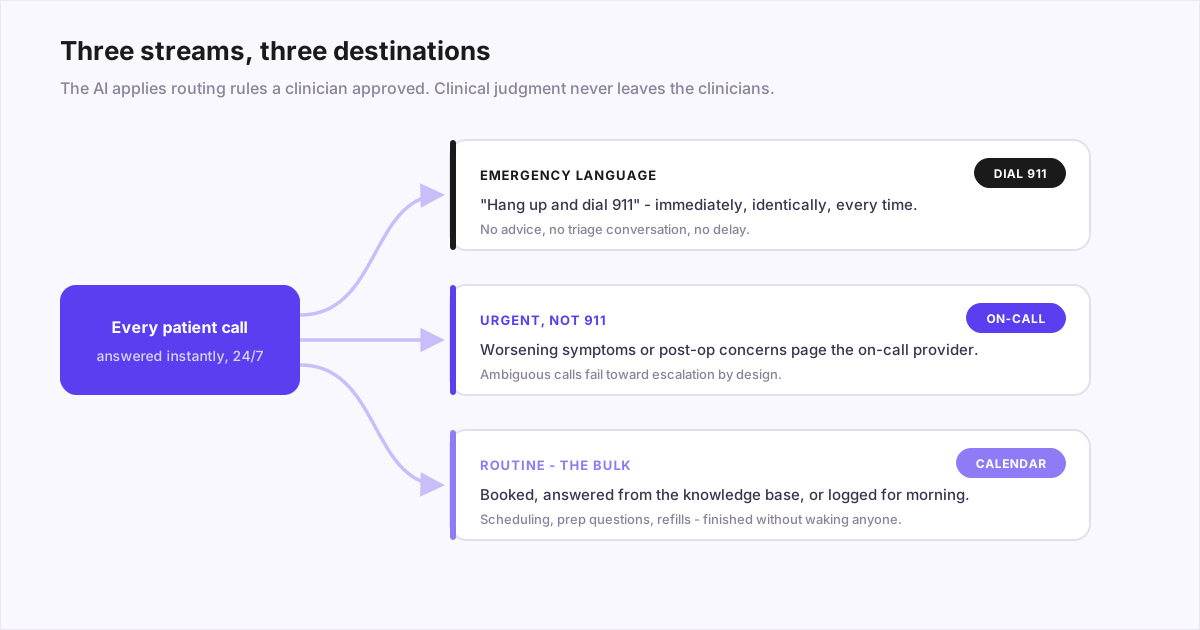
Everything hinges on this flow, so configure it explicitly rather than accepting defaults. You define the trigger phrases and situations for each stream; the AI applies them identically on every call, without fatigue and without improvising. The design rule we recommend is fail toward escalation: when a call is ambiguous between routine and urgent, it should reach the on-call provider - a false alarm costs minutes, the opposite mistake costs far more. The transfer mechanics are covered in how an AI receptionist hands a call to a human, and before going live you should test all three streams yourself, at night, from your own phone.
HIPAA, PHI, and the BAA question
Here's the section that filters your vendor list fastest. A patient saying "this is Jane Doe, I need to move my cardiology appointment" has just put protected health information into the call. Under the HIPAA Privacy Rule, a service that creates, receives, or stores PHI on your behalf is a business associate, and HHS guidance is plain that this requires a signed Business Associate Agreement before the vendor touches patient data. Answering services - human or AI - sit squarely inside that definition.
So the vendor conversation for a medical practice starts here:
- "Will you sign a BAA?" A yes in writing, before any patient call is routed. Hesitation here ends the evaluation.
- "Where do recordings and transcripts live?" Encrypted in transit and at rest, with a stated retention period you can shorten.
- "Who can access call data?" Access controls and audit logs on the vendor side, not just promises.
- "Is patient data used for model training?" The answer you want for PHI is no, contractually.
Therapy and behavioral health practices
A private therapy practice has the same compliance gate as a clinic and a different phone. The person who would answer is in session fifty minutes of every hour, the callers are often having a hard week, and the act of calling is itself sensitive. An answering service - live or AI - is worth having here for the administrative half of the line: new-client enquiries, scheduling, and practical questions about fees, location, telehealth and paperwork. Three rules come before any of that.
Crisis calls leave the script in the first sentence
Some callers to a therapy practice are in crisis, and that is not a case to be handled elegantly. The 988 Suicide & Crisis Lifeline is free, confidential and available around the clock by call, text or chat, staffed by trained crisis counselors, with Spanish-language service and interpretation in more than 240 languages. A caller who needs that is not helped by an appointment slot.
There is a quieter reason to design this deliberately. A caller in distress who reaches an obviously automated system experiences it as being turned away by their own therapist's office. The fix is a fast, warm, unmistakable handoff, not a longer script.
Intake is administrative, never clinical
What rings a therapy practice, and who should handle it
| Caller | Right handling |
|---|---|
| Prospective client | Administrative intake only: contact details, whether it is safe to leave a message, insurance or self-pay, availability. Book a consultation, or say plainly that you are full |
| Current client, scheduling | Move, cancel or confirm a session. The highest-volume call and the easiest to automate well |
| Current client, distressed | Not a script's call. Risk indicators route immediately; anything else is a message flagged urgent, with an honest statement of when you will call back |
| Insurance, billing, EAP | Capture and route to whoever does your billing. Never improvise coverage answers |
| Third party asking about a client | Neither confirm nor deny. Message taken, nothing disclosed |
Two scripts are worth writing carefully. If you are not accepting new clients, the line should say so in the first thirty seconds, offer the waitlist only if you genuinely keep one, and name where else to look - a directory, a colleague, a community mental health service - rather than collecting a full intake from someone you will never see. And on "do you take my insurance?" the line states the panels you are on and your self-pay fee, but never confirms coverage, benefits or a copay: that depends on the caller's plan, and the right sentence points them to the behavioral health number on their card. What the line should never collect is a clinical history - their story belongs in the room, not in a transcript.
Privacy: who may know someone called
Whether a person is your client is itself protected information. A spouse checking attendance, a parent, an employer, an attorney asking for records: the script neither confirms nor denies, says the practice cannot discuss whether anyone is a client, takes a message and routes it to the therapist. Records requests and subpoenas are never handled by a phone service, and calls from a parent of an adolescent client depend on your state's minor consent law - a therapist decision, not a script decision. Test the boundary by calling your own line and asking whether a friend has an appointment.
Callbacks carry their own risk: a message on the wrong phone can disclose that someone is in therapy. HHS guidance allows providers to leave messages, including on an answering machine, but says to limit the amount of information disclosed. So a therapy intake asks two questions most answering services never do: is it safe to leave a message at this number, and is it safe to say the name of the practice- plus the preferred contact method and times. On the vendor side, consider turning call recording off and keeping only structured fields, and configure notifications to say a message is waiting rather than reproducing its contents on a lock screen. Your licensing board's confidentiality rules may go beyond HIPAA; none of this is legal advice.
Your options, compared
Patient call coverage options for a practice
| Option | Strengths | Weaknesses | Cost behaviour |
|---|---|---|---|
| Front desk only + voicemail | Human warmth during open hours | Closed 70%+ of the week; voicemail loses bookings silently | Salary; after-hours 'free' but leaky |
| Human medical answering service | Live voice; established in healthcare; BAAs standard | Per-minute costs spike at night; mostly takes messages rather than booking | Per-minute with night/weekend premiums |
| On-call staff rotation | Clinical judgment on every call | Burnout, and most 2 a.m. calls don't need a clinician | Overtime and goodwill, both finite |
| AI receptionist (with BAA) | Answers instantly 24/7, books in real time, triages by your rules | No clinical judgment - must be paired with an on-call path | Flat monthly; midnight equals noon |
The practical answer for most practices is a stack, not a choice: AI answers everything and finishes the routine calls, the on-call provider receives only what the triage rules escalate, and the front desk owns the in-person experience. It's the same division of labour we've seen work in dental practices - a vertical with the identical structure of high call volume, HIPAA constraints, and an overloaded desk. If your clinicians work in patients' homes rather than in a building you own, the home care answering service guide covers the version of this problem where caregiver call-offs, not patient calls, are the after-hours volume.
Setting it up in a medical practice
- Clear the compliance gate. BAA signed, data handling documented, retention set. Nothing else starts first.
- Write the triage rules with a clinician. The emergency phrases, the urgent categories, the on-call escalation path - reviewed by someone with clinical authority, not just the office manager.
- Load the practice knowledge. Providers, services, hours, locations, insurance accepted, prep instructions, refill procedure - the questions your desk answers forty times a week.
- Connect scheduling. Real-time booking against your calendar is where the return concentrates; a message-taking-only setup forfeits the evening booking window.
- Start after-hours, then expand. Let the AI take the calls voicemail was losing, review transcripts for a week or two, then add daytime overflow when the front desk is buried - the gradual rollout we detail in our 24-hour answering service guide.
- Test the streams monthly. Call your own line. Routine, urgent, emergency. Confirm each lands where it should - especially after any change to providers or hours.
The bottom line
A medical practice's phone carries the widest range of stakes of any small-business line, which is exactly why the sorting shouldn't depend on whether a human happens to be free. An AI receptionist with a signed BAA, clinician-approved triage rules, and real-time scheduling answers every patient instantly, fills the evening booking window, and reserves human attention - the front desk's and the on-call provider's - for the calls that genuinely need it. The same capture-and-route rule carries over to animal care, where our veterinary answering service guide covers emergency referral and vet-tech triage lines.
On cost, we read the published rate cards of the human answering services line by line in medical answering service pricing; and if you run a chiropractic office, the chiropractic answering service guide covers the red-flag calls specific to that practice.
If you want to evaluate one against the standards in this guide, you can hear our AI receptionist take a call right now and see the flat monthly pricing- then ask us the four HIPAA questions above and hold us to them. And if you're sizing the problem first, our cost of a missed call breakdown puts numbers on what the unanswered evening line is already costing.
Frequently asked questions
What is a medical answering service?
It's a service that answers a medical practice's phone when staff can't - after hours, during the lunch rush, or when the front desk is with patients. Traditionally that meant a human call centre taking messages and paging the on-call provider. Increasingly it means an AI receptionist that answers instantly, books and reschedules appointments, answers routine questions about hours and preparation, routes refill requests, and escalates urgent calls to the on-call clinician - around the clock, without per-minute billing.
Is an AI receptionist HIPAA compliant for a medical office?
It can be, but compliance is a property of the vendor and the agreement, not the technology. A patient call routinely contains protected health information, so under HIPAA any answering vendor handling PHI acts as a business associate and must sign a Business Associate Agreement (BAA) with your practice. Before connecting any AI service to your phone line, ask directly: will you sign a BAA, how is call data encrypted and stored, and who can access transcripts. A vendor that hesitates on the BAA question is not a vendor for a medical practice.
Can an AI receptionist handle medical emergencies?
No - and it shouldn't try. The correct behaviour, which you configure, is instant redirection: a caller describing an emergency is told to hang up and call 911, and urgent-but-not-911 situations ring the on-call provider directly. The AI's value in an emergency is speed and consistency of routing, never clinical judgment. Everything that isn't urgent - the bulk of after-hours calls - gets booked, answered, or logged for the morning without waking anyone.
Can an AI receptionist schedule patient appointments?
Yes - real-time scheduling is the core use case. Connected to your calendar or practice management system, it books new patients, reschedules existing ones, and sends confirmations during the call, including at 9 p.m. when many patients finally have time to phone. That evening window matters: patients who reach voicemail frequently book with the next practice that answers, which makes the booking calls a clinic misses after hours some of the most expensive calls it loses.
How much does a medical answering service cost?
Human medical answering services typically bill per minute or per call, often with premiums for nights, weekends and holidays - precisely when medical coverage is needed most. We read the published rate cards line by line in our medical answering service pricing guide. AI receptionists usually charge a flat monthly subscription with no after-hours premium; ours is 99 euros a month including 1,000 talk minutes. Whatever you choose must clear the HIPAA bar first: a signed BAA, documented data handling, and a tested route to your on-call clinician.
Should a therapy practice use an AI answering service?
For the administrative half of the phone, it works well: new-client enquiries, scheduling and rescheduling, practical questions about location, fees, telehealth and paperwork, and taking a message properly. For anything clinical it should not be involved at all, and for anything resembling a crisis it must do exactly one thing - direct the caller to 988 or 911 and get a human involved. If a vendor sells you clinical triage for a therapy practice, end the conversation.
What should happen when someone in crisis calls a therapy practice?
They should hear the 988 Suicide and Crisis Lifeline named clearly, be told to call 911 if there is immediate danger, and be escalated to a person. 988 is free, confidential and available around the clock by call, text or chat, staffed by trained crisis counselors. An automated line's entire job on that call is to recognize it early, say that plainly, and stop trying to be helpful in any other way. Configure and test this out loud before anything else.
Can an answering service confirm whether someone is a client of my practice?
No. A spouse, a parent, an employer or an attorney may call asking whether a person is seeing you. Whether that person is a client is itself protected information, and confirming it can be a disclosure however reasonable the caller sounds. The correct script neither confirms nor denies, says the practice cannot discuss whether anyone is a client, takes a message and stops. Custody disputes and separations are exactly where this goes wrong.
Sources
- U.S. Department of Health and Human Services: Summary of the HIPAA Privacy Rule
- U.S. Department of Health and Human Services: Business Associates guidance (when a BAA is required)
- US HHS OCR FAQ 198: leaving messages for patients, and limiting the information disclosed
- 988 Suicide & Crisis Lifeline: free, confidential support by call, text and chat, 24/7
- SAMHSA: 988 Suicide & Crisis Lifeline overview and frequently asked questions
- Harvard Business Review: The Short Life of Online Sales Leads (lead response-time research by James Oldroyd)