
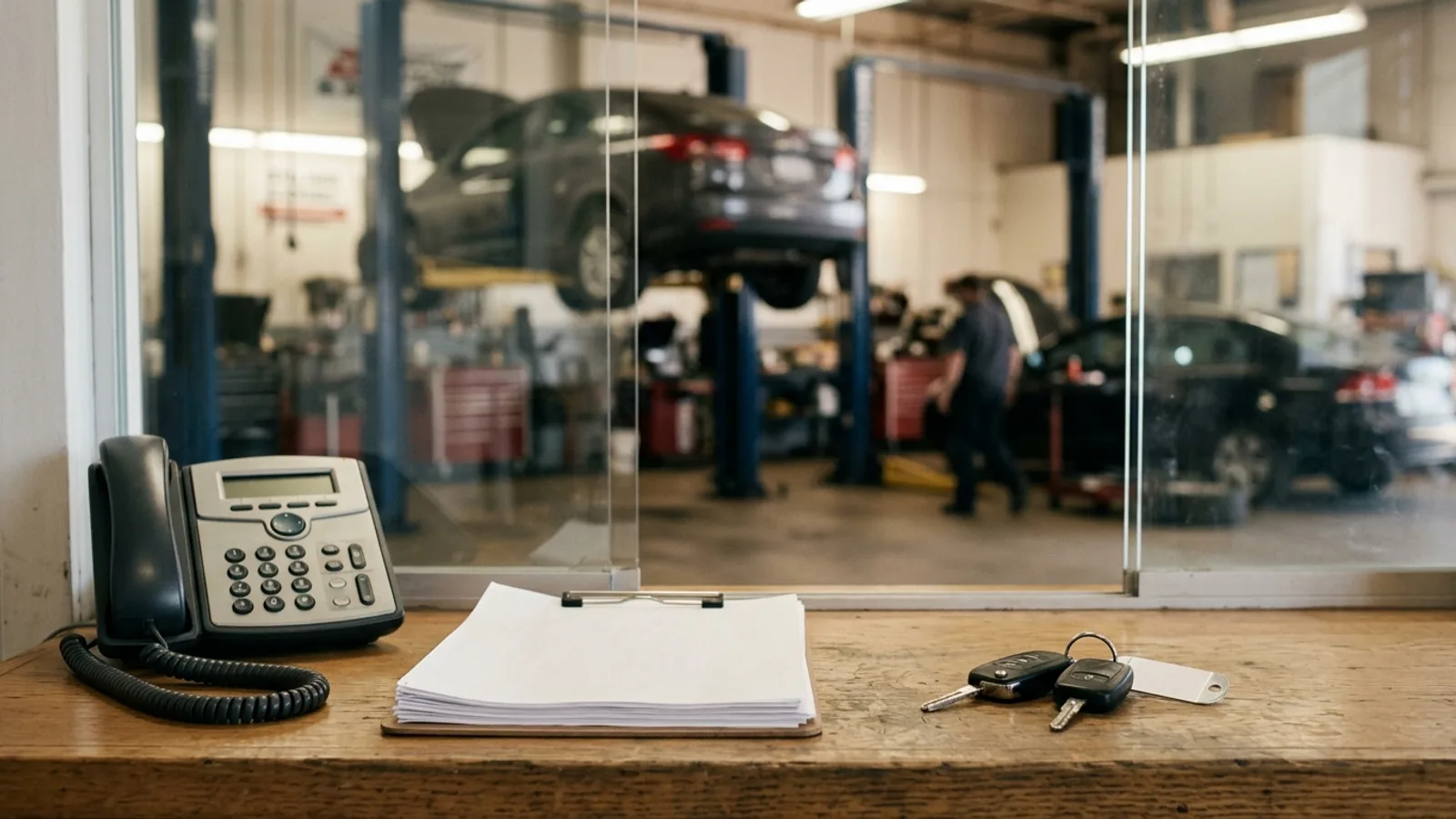
In most independent shops the same person writes the repair orders, greets the customer at the counter, calls the parts house, and answers the phone. Those four jobs collide constantly, and the phone loses every time - which is why the caller who wanted a Tuesday appointment gets voicemail while your advisor is mid-sentence with a customer about a control arm. We build AI receptionists, so read this skeptically: here is what actually rings a shop line, which of it a script should handle, and the one call where letting software be helpful can cost you the repair order.
Our articles are still written by humans!
Get human written articles in your Google feed.
The short answer
An auto repair answering service covers the shop phone when your service advisor is with a customer, on the parts line, out in the bay, or gone for the day. It books appointments against your real schedule, reads back the status of vehicles already in the shop, captures tow-ins and breakdowns properly, answers the standing questions (hours, address, what you work on, do you do diagnostics, do you take drop-offs), gives price information you have already published, and hands anything involving authorizing work or disputing an invoice to a person.
It can be a live bureau, an AI receptionist, or a hybrid. The useful framing is not which is better in the abstract but which one is free at 10:40 on a Tuesday morning, when your advisor is three deep at the counter and the phone has rung four times.
Six callers, one service counter
The call mix on an independent repair shop's line
| Caller | What they need | Right handling |
|---|---|---|
| New customer with a problem | To describe a noise and get booked in | Capture vehicle, symptom and urgency, book against the real schedule, set expectations about diagnostic time and fee |
| Existing customer checking status | Is it ready, what did you find, how much | Read back the current status and the promised update time. Escalate anything about findings or cost |
| Price shopper | A number for brakes, a clutch, an AC recharge | Your published range, the diagnostic explanation, and an appointment offered in the same breath |
| Breakdown or tow-in | Help, now, possibly from a shoulder | Safety first, then location, vehicle, drivable or not, tow needed - and a human, not a slot in three days |
| Fleet, warranty and insurance | Approvals, POs, adjusters, account terms | Recognized and routed to whoever owns the account. Never improvised |
| Parts vendors and sales calls | Your advisor's attention | Real suppliers routed or messaged; cold sales filtered before anybody in the shop hears about it |
Two rows there make money and four of them consume it. The design question for any answering setup is not "can it handle everything" but "does it protect the two rows that matter from the four that do not." Spam filtering alone is worth more than it sounds - what that actually looks like is a separate question worth reading before you buy.
The status call is eating your shop
Ask any service advisor what they do all day and the honest answer includes a large, unbilled block of telling people that their car is not ready yet. It is the most common call in the trade and almost all of it is self-inflicted.
There are three fixes, in order of how much work they are:
- Promise a time at drop-off, not an event.A named hour that you honor - including when the update is "no news yet" - removes most of the anxiety that produces the call.
- Push the update instead of waiting for the pull. A text when the vehicle moves stage - checked in, diagnosed, parts ordered, ready - costs nothing and pre-empts the call that would have interrupted a repair order.
- Let the phone answer the simple version."It is in the shop, the technician has it now, and your advisor will call you by two" is a factual status read, not an opinion about the repair. That much a script can safely give, and it is what most of these callers actually want.
Note the boundary in point three. Reading a stage is safe. Discussing findings, cost or what needs doing is not, and that line is the subject of the next section.
Authorization: the call that becomes a legal record
This is the section that should decide which service you buy, and no vendor page mentions it.
The phone call in which a customer approves additional work is not customer service. In California it is a regulated act with documentation requirements attached, and most states have some version of the same idea. The Bureau of Automotive Repair's Write It Right guidance is explicit: an estimate must describe the specific job and the estimated price for parts and labor, and authorization must be obtained and recorded on the estimate before any repairs begin. When a customer approves additional repairs orally, the shop has to record the date and time of that authorization, the name of the person who gave it, the number or email contacted, the additional parts and labor, the cost, and the new total.
Read that list again with an answering service in mind. It says the record has to name who authorized what, when, and on which number. That is not a message a third party takes and passes along.
Authorization calls: what a script may and may not do
| Situation | Correct behavior |
|---|---|
| Customer calls back after a voicemail about extra work | Get them to the advisor - transfer live if possible, otherwise a firm callback window. Do not take the approval |
| Customer asks what the extra work will cost | The advisor's number, or the callback. A script quoting a repair it has not seen creates an estimate you did not write |
| Customer says 'just do whatever it needs' | Sounds like consent and is not documented consent. Route to the advisor, who records it properly |
| Customer disputes the invoice | Straight to the owner or advisor, logged with time and number. Never negotiated on the phone by anyone else |
| Customer asks for the estimate in writing | Always yes, immediately, by text or email. This protects both sides |
There is an upside worth naming. Every call an automated system handles produces a timestamped transcript, which is a considerably better record of what a customer was told than anyone's memory of a Tuesday. Used properly that is a genuine advantage over a note on a repair order - provided the script never crosses the line above.
The price shopper is not the enemy
"How much for brakes on a 2014 Civic?" is the call every advisor is tired of, and it is a booking wearing a disguise. Somebody with a car that needs work is dialing shops. They are not going to keep dialing forever.
The version of this call that converts has four beats:
- Give a real number, from what you publish.A range you have written down - pads and rotors, front, on a common vehicle - not a refusal and not an invention. "It depends" is the answer that sends them to the next shop.
- Explain what the diagnostic buys.Not "we charge $X to look at it" but "that gets it on a lift, the pads measured and the rotors checked, and we tell you what it actually needs before you spend anything."
- Say what makes the number move. Rotors versus pads only, seized caliper, European versus domestic. Customers do not resent a range with reasons; they resent evasion.
- Ask for the appointment in the same breath."I have Thursday morning or Friday afternoon" converts far more of these than "come by any time."
This is also the call that most benefits from being answered at all. Vehicles on the road are older than they have ever been - S&P Global Mobility puts the average age of a U.S. light vehicle at 12.8 years, with passenger cars at 14.5, across a fleet of 289 million. An aging fleet is a repair-order pipeline that arrives by telephone, and it goes to whoever picks up. The arithmetic on that is in the cost of a missed call and the calculator will run it with your own average RO, which for a shop is the only version worth trusting.
Tow-ins, night drops and the 6 a.m. caller
Three call types sit outside business hours and they are the ones most likely to be lost entirely.
After-hours calls a shop line has to survive
| Call | What it needs | What usually happens instead |
|---|---|---|
| Breakdown, roadside | Safety check first, then location, vehicle, drivable or not, tow arranged, human escalation | Voicemail. The car gets towed to whoever answered, and that shop keeps the customer |
| Tow arriving tonight | Where to leave it, where the keys go, what to write on the envelope, when someone will call | The driver phones three times and dumps it in the street |
| 6 a.m. before-work drop-off | Confirmation the shop takes early drops, night-drop instructions, expectation for the callback | The customer drives to work with the car still broken |
| Sunday booking for Monday | The Tuesday slot booked while they are thinking about it | They book with a chain that has an online scheduler |
None of these need a mechanic at 2 a.m. They need instructions and a booking. Our after-hours guide covers the general shape, and for the genuinely urgent subset - somebody standing on a shoulder in the dark - the ladder that gets a human involved is in our guide to emergency call escalation. The one rule specific to this trade: an automated system never tries to call 911 for a caller. If anyone is unsafe or in traffic, the script says hang up and call 911 now and stops.
Live answering vs AI vs hybrid
Ways to cover a repair shop's phone
| Model | Best fit | Watch out for |
|---|---|---|
| The advisor, plus voicemail | One-bay shops with low call volume and a loyal book | The invisible loss: every caller who tried you mid-morning and booked elsewhere leaves no trace |
| Generalist answering bureau | Shops wanting a human voice and message-taking after hours only | Per-call pricing at shop volumes; agents who cannot book your schedule and will not know a CV axle from a control arm |
| AI receptionist | Shops losing bookings during the day and wanting after-hours coverage in the same system | The scheduler integration is the value. Without it you have a message-taker. The authorization boundary must be explicit |
| Hybrid (AI first, advisor escalation) | Most independents: AI takes bookings, status reads, price questions and spam; the advisor takes authorization, findings and disputes | Write the always-human list before launch. It is short, and it is the entire risk surface |
Cross-market pricing is in our answering service cost guide and our own flat plans are on the pricing page. You keep the number on your sign and your listings - forwarding takes about eight minutes, and busy-line overflow is the sensible thing to point at it first.
What good calls sound like
Tuesday 10:41 a.m., price shopper
The status call, handled without crossing the line
The sentence that stops the script
Where AI loses (keep a human here)
- Authorization and anything about cost of work in progress. Covered above. This is the line.
- Diagnosis from a description. A caller imitating a noise is not diagnostic input, and a guess on the phone becomes an expectation at the counter. Book the diagnostic instead.
- Comebacks and complaints. A customer whose repair did not hold is a retention conversation with a warranty attached. Owner or advisor, from the first sentence.
- Insurance adjusters, fleet accounts and warranty administrators. These run on account terms and approval codes. Recognize the caller and route; never improvise.
- Anything with a safety implication."Is it safe to drive it to you?" is a question with liability attached. Escalate, or the script says plainly that it cannot advise on that and arranges a tow.
Setting it up
- Connect the scheduler first. Real slots, real writes, real confirmations. Without it, everything in this article collapses into message-taking.
- Write the authorization boundary. One paragraph: the script may read stage, never findings or cost, and any approval goes to a named person. Have your advisor read it and try to break it.
- Publish your numbers internally. Diagnostic fee, menu-priced services, honest ranges for your five most-asked jobs. The script can only be as useful as this list.
- Load the shop facts. Hours, early drop-off, night drop location and key envelope instructions, what makes you do and do not work on, loaner or shuttle policy, whether you do state inspections, payment methods, warranty terms.
- Decide the tow-in flow. Where a car goes at 11 p.m., where the keys go, who gets notified, and who calls the customer in the morning.
- Run overflow first, then after-hours, then read the transcripts. A week of reading will show you the two questions the script fumbles and the one your advisor answers without thinking.
The way to size this before spending anything: for one week, tally the calls that went to voicemail during business hours. Not the after-hours ones - the mid-morning ones, while somebody was standing at your counter. Each of those was a person with a vehicle and a problem, and the shop that answered got the repair order. If you want to hear the script yourself, our plans run month-to-month, and how the booking actually works is the part worth checking before you commit to anyone, including us.
Frequently asked questions
What is an auto repair answering service?
It answers the shop phone when your service advisor cannot - which in most shops is most of the day, because the same person writing repair orders is also standing at the counter with a customer. It books appointments against your real schedule, gives status on vehicles already in the shop, captures tow-ins and breakdowns, answers hours, location and what you work on, handles price questions without guessing at a final number, and routes anything involving authorizing work or arguing about an invoice to a person.
Can an answering service authorize repairs over the phone?
No, and no reputable one will try. In California, for example, the Bureau of Automotive Repair requires the customer's authorization to be recorded before work begins, and when a customer approves additional repairs orally the shop must document the date and time, the name of the person who authorized it, the number or email contacted, the additional parts and labor, and the total. That is a conversation between your shop and your customer with a paper trail behind it. An answering service's role is to reach the customer and connect them, or to schedule the callback - never to collect the approval itself.
How do I stop status calls from taking over the day?
Answer them before they happen. Most 'is my car ready' calls exist because the customer was told 'we'll call you' with no time attached. A promised update window at drop-off, a proactive text when the vehicle moves to the next stage, and a phone line that can read the current status back without interrupting the advisor removes the majority of them. The calls that remain are usually real - a ride needed, a deadline changed - and those are worth a person.
Should an AI quote prices for repairs?
It should quote what you have written down and nothing else. A published diagnostic fee, a menu-priced oil service, a brake job range for a common vehicle - all fine, because you set them. What it must never do is estimate an unfamiliar job from the caller's description of a noise. The right move on a price shopper is to give the honest range you already publish, explain what the diagnostic buys them, and book the appointment, because the caller who wants a number is usually a caller who wants a shop.
How much does an auto repair answering service cost?
Live answering bureaus generally bill per call or per minute, and a busy shop's call volume makes that add up quickly - $200 to $600 a month is common once minimums are counted. AI answering is usually flat, in the $50 to $300 a month range per line. Compare either against one repair order: a single job captured that would otherwise have gone to the shop down the road tends to cover the month, and the arithmetic gets easier the higher your average RO.
Can it handle a customer broken down on the side of the road?
It should recognize the situation and change behavior immediately, which is mostly about not running the normal script. The first question is whether everybody is safe and out of traffic, and if there is any doubt the answer is to call 911 or roadside assistance first and the shop second. After that it captures location, vehicle, whether it drives, and whether they need a tow, then escalates to a real person rather than booking a slot three days out for somebody standing on a shoulder.
Will it stop the parts and marketing calls?
Most of them. Vendor and sales calls are a meaningful share of a shop's inbound volume and almost none of it needs your advisor. A script that identifies the caller's purpose, takes a message for the parts manager and declines cold sales pitches politely removes the interruption without you having to be rude to anyone. Your real parts suppliers should get a direct line and be recognized on it.
Sources
- California Bureau of Automotive Repair, Write It Right: documentation and authorization requirements for automotive repair dealers
- California Bureau of Automotive Repair: consumer guidance on estimates, authorization and additional repairs
- S&P Global Mobility: average age of U.S. light vehicles rises to 12.8 years in 2025