

The call that could make your week rarely comes at 11 a.m. on a Tuesday. It comes at 9 p.m. when a pipe bursts, on a Saturday when someone finally has time to book, or at 2 a.m. when a tenant is locked out. We build AI phone agents, so treat this as a partial view - but the pattern under it is real and easy to check against your own phone log: most businesses do their missing after they've gone home.
The short answer
An after-hours answering service is anything that picks up your business calls when you're closed, so the caller reaches a voice instead of dead air. The models range from a live call centre taking messages, to a virtual receptionist on a night shift, to an AI voice agent that answers, books, and triages on its own. The right choice comes down to two questions: how urgent are your after-hours calls, and can whatever answers actually finish the job- book the appointment, or correctly decide whether to wake someone up. Voicemail answers neither, which is why it's the option that quietly costs the most.
Why after-hours calls matter more, not less
There's a temptation to treat the closed hours as the low-value tail of the week. It's usually the opposite. Two things make an after-hours caller worth more than a mid-morning one.
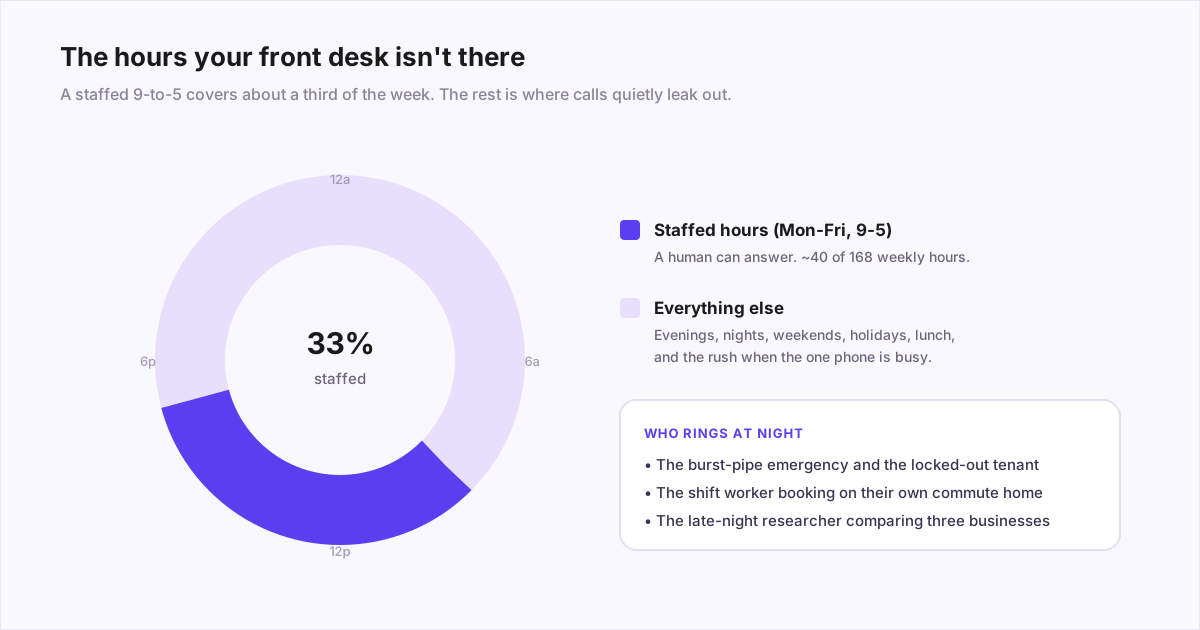
First, intent.Someone calling a plumber at night has a problem that won't wait; someone calling a clinic on Sunday has finally found a moment to deal with something they've been putting off. These aren't idle enquiries. They're the calls most likely to convert - and most likely to be abandoned the instant they hit voicemail, because the need is immediate.
Second, speed wins the caller. Classic research on inbound leads, captured in Harvard Business Review's write-up of the lead-response study, found that the odds of qualifying a lead fall off sharply within minutes of first contact. After hours, "we'll call you back Monday" isn't a slow response - it's a forfeit, because by Monday the caller has already found someone who answered on Saturday night. The window closes fastest exactly when you're least likely to be watching it.
What an after-hours service actually does
Underneath the label, an after-hours service does some combination of four jobs. What separates the cheap from the useful is how many of these it can actually complete rather than punt to you the next morning:
- Answer.The baseline - a live voice picks up so the caller feels heard and doesn't immediately redial a competitor.
- Inform.Answers the routine questions that don't need you - hours, location, whether you handle their kind of problem, rough pricing.
- Book or capture.Puts the appointment on your calendar or takes a structured message with the details you'd actually need, not just "call this person back."
- Triage and escalate.The hard one - deciding, in the moment, whether this is a 3 a.m. emergency that warrants waking your on-call person, or a routine call that can wait until you open.
Your four options, compared
Four ways to make sure a night or weekend call gets answered, with the trade-offs stated plainly:
After-hours coverage options
| Option | Can it book / triage? | After-hours cost behaviour | Best for |
|---|---|---|---|
| Voicemail | No - just records a message most people won't leave | Free | Businesses whose after-hours callers have nowhere else to go (few do) |
| Live answering service | Takes messages; rarely books; basic emergency dispatch | Per-minute, often with night/holiday premiums | Low after-hours volume where a human voice is required by policy |
| Overnight staff / on-call human | Yes, fully - a real person handles everything | Highest - overtime, night differentials, or a retainer | High-stakes, emotional, or complex emergency calls |
| AI receptionist | Yes - answers, books, triages, escalates on rules you set | Flat monthly fee; 2 a.m. costs the same as 2 p.m. | Routine volume, overflow, and the bulk of after-hours calls |
For the full three-way breakdown of the human options and where each one genuinely wins, we've written a separate AI vs. virtual receptionist vs. answering service comparison. The short version for nights specifically: per-minute human services are the ones that hurt most after hours, because that's exactly when their premium rates kick in.
Who actually needs after-hours coverage
Not every business does, and it's worth being honest about that. After-hours coverage earns its keep when your calls are urgent, time-sensitive, or come from people who can only call outside their own working day.
How urgent are your after-hours calls?
| Business type | Why the phone rings after hours | Coverage payoff |
|---|---|---|
| Home services (plumbing, HVAC, locksmith) | Genuine emergencies that can't wait for morning | Very high - the call is often the job |
| Property management | Locked-out tenants, leaks, no heat, on weekends | High - and it saves you personally being woken |
| Legal (criminal, family, personal injury) | Arrests and crises happen at night; first firm to answer often wins the client | High - a single client can be worth thousands |
| Clinics, dental, salons, trades booking | Customers book after their own 9-5 ends, or on weekends | Medium-high - captures bookings you'd lose to voicemail |
| Standard 9-5 office with no urgency | Occasional stray call; nothing time-sensitive | Low - a good voicemail-to-text may be enough |
The part that actually matters: escalation
Everything hinges on triage, so it deserves its own section. The failure mode of after-hours coverage isn't missing calls - it's a system that can't tell an emergency from a routine question, and so either wakes you constantly or sleeps through the one call that mattered.
A good after-hours setup runs on rules you define. You decide what counts as an emergency - "no heat," "active leak," "can't get into the property" - and what those calls do: ring your on-call phone, warm-transfer immediately, or fire a priority text. Everything else gets answered, booked or logged, and queued for the morning without disturbing anyone. This is where an AI agent's consistency is an advantage: it applies your escalation rules identically every single time, at 3 a.m., without judgment fatigue. For the mechanics of how a call gets passed to a person mid-conversation, we cover it in how an AI receptionist transfers calls to a human, and the full specification - triggers, acknowledgement timers, the on-call ladder and the 911 boundary - is in how to set up emergency call escalation.
How to set it up without wrecking your nights
The goal isn't to answer every call yourself at midnight - it's to make sure every call is handled while you sleep. A sane rollout:
- Find your after-hours pattern. Pull a month of call logs and mark which came in outside business hours. Owners are almost always surprised by the volume and by how many never called back.
- Write your emergency definition. Be specific about the two or three situations that justify waking a human. Everything not on that list waits until morning by default.
- Decide what routine calls should accomplish. Book onto the calendar? Capture a callback with details? Answer FAQs? The more it can finish, the less morning cleanup you inherit.
- Set the escalation path. Which phone rings, whose, and how - transfer, call, or text - when the emergency rule fires.
- Test it at night.Call your own line at 10 p.m. Play the routine caller, then the emergency. Make sure the right one reaches you and the wrong one doesn't.
The bottom line
After-hours calls aren't the leftovers of your week - for a lot of businesses they're the most motivated callers you'll ever get, and the easiest to lose. Voicemail loses them by default. Human overnight coverage catches them at the highest price, exactly when premium rates bite. The middle path most owners land on is simple: let something answer every after-hours call, book or triage what it can, and reserve the human - you - for the genuine 2 a.m. emergency.
One scope note: after-hours coverage is the narrow version of the problem. If you also drop calls at midday - the second simultaneous ring, the lunch rush - what you actually want is always-on answering, and we've written a separate guide to what a true 24/7 AI receptionist requires, including how to test any vendor's claim.
If nights and weekends are where your phone is leaking, that's also the easiest slice to plug first - and the keypad work is one conditional forwarding code, which we walk through in how to forward calls to an answering service. You can hear our AI receptionist handle a call and set an escalation rule, then check the flat monthly pricing- the one that doesn't change whether the call comes at noon or midnight. And if you want to put a dollar figure on what those missed nights are already costing, run the numbers in our cost of a missed call breakdown first.
Frequently asked questions
What is an after-hours answering service?
It's a service that answers your business calls when your office is closed - evenings, nights, weekends, and holidays - so callers reach a real voice (human or AI) instead of voicemail. Depending on the type, it can take a message, answer common questions, book an appointment, or decide whether to wake someone up for a genuine emergency. The goal is simple: never let an after-hours call ring out to nothing, because that caller is often the most motivated one you'll get all week.
Do I really need someone answering the phone after hours?
If a meaningful share of your revenue is time-sensitive or emergency-driven, yes. A burst pipe, a locked-out tenant, a car that won't start, a legal arrest - none of those wait until 9 a.m., and the caller will keep dialling until someone picks up. Even for non-emergency businesses, plenty of people can only call to book after their own workday ends. If your competitors answer at night and you don't, the after-hours caller simply becomes their customer.
How much does after-hours call answering cost?
It depends on the model. Live answering services bill per minute (roughly $1-$2/minute), and after-hours and holiday minutes often bill at premium rates, so a busy night can produce a surprising invoice. An AI receptionist charges a flat monthly fee (commonly $30-$300) and treats 2 a.m. exactly like 2 p.m. - no overtime, no holiday surcharge. Hiring humans for overnight shifts is the most expensive option by far, which is why after-hours coverage is usually the first job businesses hand to software.
Can an AI receptionist handle calls at night?
Yes - this is arguably what AI answering is best at. Software has no nights, weekends, or holidays; it answers the first call and the fifth simultaneous call identically at 3 a.m. It can triage the call, answer routine questions, book the appointment, take a structured message, and - crucially - escalate a genuine emergency to your on-call person while letting the non-urgent calls wait politely until morning. That triage is the difference between useful after-hours coverage and a phone that wakes you for nothing.
Should after-hours calls go to voicemail instead?
Voicemail is the cheapest option and the weakest. Most callers won't leave a message - especially at night, when the need is often urgent and they'll simply call the next business that answers. Voicemail gives you a record of the calls you lost, not a way to keep them. Anything that actually answers - even just to triage and take a proper message - will out-earn voicemail quickly for any business whose after-hours callers have somewhere else to go.