

"A missed call is just a missed call" is the quiet assumption that costs local businesses the most money. It treats a ring-out as a zero, when in reality it's a customer with their wallet open who just dialled someone else. We build AI phone agents, so read us as an interested party - but the math below is yours to run, with your own numbers, and it usually lands somewhere that stings.
Our articles are still written by humans!
Get human written articles in your Google feed.
The short answer
There is no universal dollar figure, and any vendor who gives you one without asking about your business is selling, not calculating. The honest answer is a formula: a missed call costs you your average customer value, discounted by how likely that call was to book and how likely the caller was to simply give up and go elsewhere. For a barber, one missed call might be a $30 haircut. For a law firm or an HVAC contractor, a single missed new-client call can be hundreds or thousands of dollars in lifetime value. The mistake almost everyone makes is filing the whole thing under "$0, they'll call back" - because a good share of them won't.
The formula to price your own miss
Skip the scary industry averages and price your missed call. You need four numbers, and you can pull all of them from things you already know:
The four inputs to your cost-per-missed-call
| Input | What it means | How to estimate it |
|---|---|---|
| Average customer value | What a new customer is worth to you - ideally over their lifetime, not just the first visit | First-sale value x how many times a typical customer returns |
| Booking rate | The share of answered new-customer calls that turn into a booking or sale | Gut-check it, or count a week of answered calls and how many booked |
| Missed calls / month | Calls that rang out, hit voicemail, or were abandoned | Pull your phone or carrier call log for the last 30 days |
| No-callback share | The share of missed callers who never try you again | Conservative default: assume at least half never call back |
Multiply them together and you get a monthly number: average customer value x booking rate x missed calls x no-callback share. That's your monthly missed-call bleed - the revenue that walked because nobody picked up. It is almost always a bigger number than the cost of fixing it, which is the entire point of this article.
If you'd rather not do the arithmetic by hand, the missed call calculator runs exactly this formula with your numbers in it, and shows each step so you can see where the figure comes from rather than taking it on faith.
A worked example
Numbers make it concrete. Take a two-van plumbing company. Say an average new job is worth $450, and a typical customer comes back and refers enough that lifetime value is closer to $1,200. Of the new-customer calls they actually answer, about 60%turn into a booked job. They're a small team, so they miss roughly 30 calls a month- the phone rings while they're under a sink, at lunch, or after 6 p.m. Assume, conservatively, that half of those missed callers never call backbecause a burst pipe won't wait.
One plumbing company's monthly missed-call cost, two ways to count it
| Method | Calculation | Monthly cost |
|---|---|---|
| First-job value | $450 x 60% x 30 x 50% | ~$4,050 |
| Lifetime value | $1,200 x 60% x 30 x 50% | ~$10,800 |
Even the conservative, first-job-only version is over $4,000 a monthwalking out the door - and that's before you count the referrals those customers would have brought. Run the same formula for a business where the first ticket is $30 and the answer is much smaller; run it for one where a new client is worth $5,000 and it becomes an emergency. The formula doesn't care about industry averages. It cares about your numbers, and yours are the only ones that matter.
Why a missed call isn't a zero
The whole cost hinges on one behaviour: what people do when you don't answer. And the uncomfortable truth is that a modern caller, looking at a screen full of search results, treats an unanswered ring as a reason to tap the next listing. They are not personally invested in you yet. You were a search result, and one ring-out demoted you.
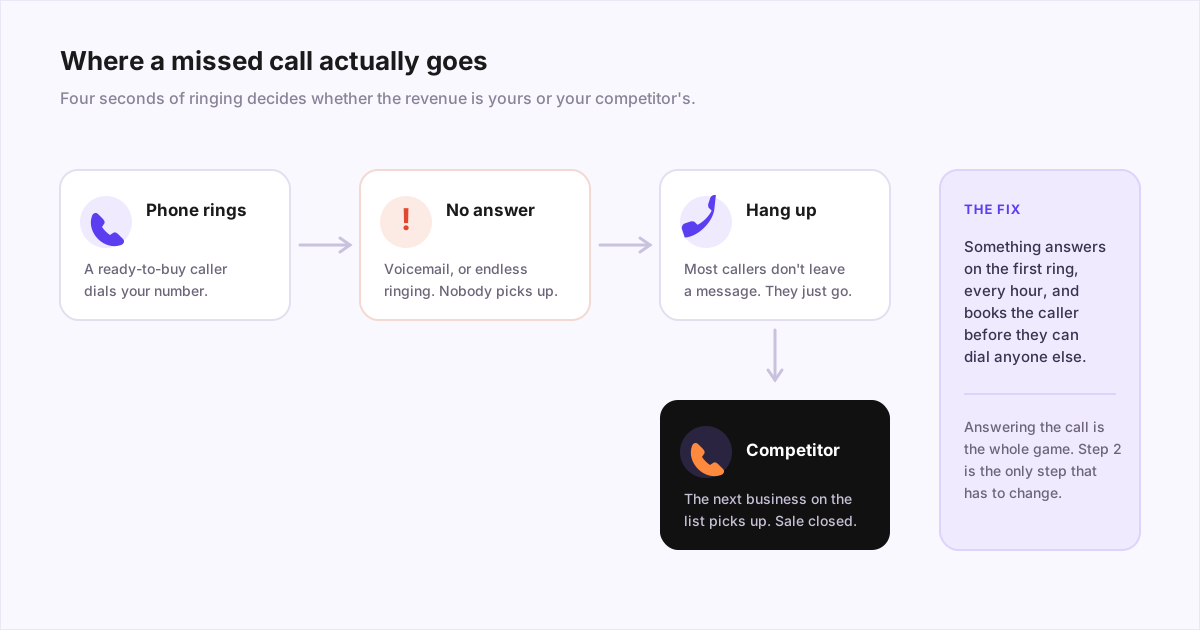
Two forces make this worse than it sounds. First, most people don't leave voicemails anymore. A voicemail is a callback you have to wait for; dialling the next business is an answer you get now. So the miss usually doesn't even leave you a trace to follow up on - it just vanishes.
Second, speed decides everything, and "we'll ring them back later" loses to whoever picks up first. Classic research on inbound sales leads, popularised by Harvard Business Review's write-up of James Oldroyd's study, found that the odds of qualifying a lead drop off dramatically when the response comes in an hour rather than within minutes - the contact gets far harder to reach and far less interested with every passing minute. A phone call is the most time-sensitive lead there is: the person is holding the phone right now. Miss that moment and you aren't deferring the revenue, you're usually forfeiting it.
The costs that don't show on the P&L
The lost booking is the obvious line item. Three quieter costs ride along with it, and together they often exceed the first sale:
- Lifetime value, not one ticket. Every missed first-time caller is a relationship that never started - the repeat visits, the upsells, and the word-of-mouth referrals all evaporate with the one call.
- Wasted marketing spend.You paid for that ring. Ads, SEO, the truck wrap, the sign - all of it exists to make the phone ring, and a missed call is that budget landing in a competitor's pocket. It quietly wrecks your true cost-per-lead.
- Reputation and reviews.A caller who can never reach you doesn't just leave - some of them say so publicly. "Tried calling three times, no one answered" is a review that costs you the next caller too.
- Your own attention.The missed call you do notice becomes a nagging callback task, usually attempted too late, that pulls you off the job you're actually being paid for.
Where your missed calls are actually hiding
Before you fix anything, find out when you're bleeding. Missed calls cluster in predictable places, and most owners underestimate every one of them:
The usual sources of missed calls
| When | Why the call gets missed | How often it's underestimated |
|---|---|---|
| After hours & weekends | The office is closed; the call goes to voicemail or nothing | Badly - a large share of consumer calls come outside 9-5 |
| The Monday / lunchtime rush | Every line is busy; the one person answering is already on a call | Badly - your busiest hour is when you drop the most calls |
| On the job / with a customer | The person who answers is a plumber, dentist, or stylist mid-task | Constantly - you literally can't hear it ring |
| Second simultaneous call | Two people call at once; one wins, one rings out | Invisible - it never shows as a 'missed call' to a human |
The fix for the after-hours slice specifically is its own topic - we go deep on it in the after-hours answering guide - but the pattern is the same everywhere: the calls you miss are the ones a busy human was never going to catch.
The cheapest way to stop missing them
Once you've priced the miss, the fix has to be measured against that number, not against zero. There are four honest options, roughly in order of cost:
- Voicemail.Free, and the weakest option. It only "catches" a call if the person leaves a message, and most won't. It's a record of lost revenue, not a recovery of it.
- An answering service.A call centre takes a message in your name. Better than voicemail, but it usually can't book your calendar, and per-minute pricing gets expensive fast. We compared it to the alternatives in our answering service vs. receptionist breakdown, and what twelve services actually charge in our answering service pricing comparison.
- Hire another person. The gold standard for daytime, relationship-heavy calls, and the most expensive - a full-time receptionist runs about $37,000 a year before benefits, per the Bureau of Labor Statistics, and still only covers staffed hours. You're paying a salary to sit idle through the quiet stretches.
- An AI receptionist.Software answers every call on the first ring, books directly on your calendar, takes a structured message, and texts you a summary - 24/7, in parallel, for a flat monthly fee that doesn't spike when you get busy. It's the natural fit for exactly the overflow, after-hours, and second-line calls that were being missed, which is the whole cost we just calculated.
Whatever you pick, judge it against your missed-call bleed. If the plumbing company above spends a flat monthly fee to recover even a third of that $4,000, the maths isn't close. For a fuller buyer's checklist - integrations, escalation, and the pricing traps to avoid - see our guide to choosing an AI receptionist, or, if you are still deciding between live and AI, the best small business answering services compared.
The bottom line
The cost of a missed call isn't a mystery and it isn't zero. It's a number you can calculate tonight from your own phone log and your own customer value, and for most appointment-based businesses it's uncomfortably large - because a missed call isn't a deferred sale, it's usually a sale that went to whoever answered. The good news is that it's also one of the most fixable problems a business has. You don't need more leads; you need to stop dropping the ones already dialling your number.
Run the formula on your last thirty days. If the answer bothers you, the cheapest response is simply to make sure something always picks up. You can hear our AI receptionist answer a call right now and check the flat monthly pricing against the number you just calculated - that comparison is the only sales pitch that matters.
Frequently asked questions
How much does a missed call cost a small business?
There's no single number - it depends entirely on what one new customer is worth to you. The honest way to calculate it: multiply your average customer value by your booking rate by the share of missed calls that never call back. A dental practice where a new patient is worth $600 loses far more per missed call than a coffee shop. For many appointment-based local businesses, a single missed new-customer call works out to somewhere between $100 and $1,000+ in expected lost revenue once you account for lifetime value. The point isn't the exact figure; it's that a missed call is almost never worth $0.
Do people call back if you miss their call?
Often they don't. A caller who reaches voicemail or endless ringing will frequently just hang up and dial the next business on their search results, especially for urgent or commodity services where any provider will do. Some regulars and high-intent buyers will try again, but a large share of first-time callers treat one unanswered ring as a signal to move on. That's why the real cost of a missed call is driven by callers who never give you a second chance.
What percentage of calls do small businesses miss?
It varies widely by industry and staffing, but many small businesses miss a meaningful chunk of inbound calls - the phone rings during another call, at lunch, after hours, on weekends, or while the one person who answers is with a customer. Rather than trust a generic percentage, pull your own phone records for a month and count the calls that went unanswered or straight to voicemail. Most owners are surprised by how many there are, and by how many came from numbers they never heard from again.
Is it cheaper to hire someone or use an AI receptionist to catch missed calls?
For catching overflow, after-hours, and weekend calls, an AI receptionist is almost always cheaper, because you're not paying a salary to sit idle during quiet stretches. A full-time receptionist runs tens of thousands of dollars a year and still only covers staffed hours; AI answering runs a flat monthly fee (commonly $30-$300) and covers every hour. Many businesses keep their human for daytime, relationship-heavy calls and use AI for exactly the overflow and after-hours calls that were being missed.
How do I calculate the ROI of answering more calls?
Start with the cost of the miss: (average customer value) x (your booking rate) x (missed calls per month) x (share that never call back). That's your monthly bleed. Then compare it to the flat cost of answering those calls. If you're a home-services business missing even a handful of new-job calls a month, the recovered revenue usually dwarfs the cost of an answering solution by an order of magnitude - which is why 'just answer the phone' is one of the highest-ROI fixes a local business has.