
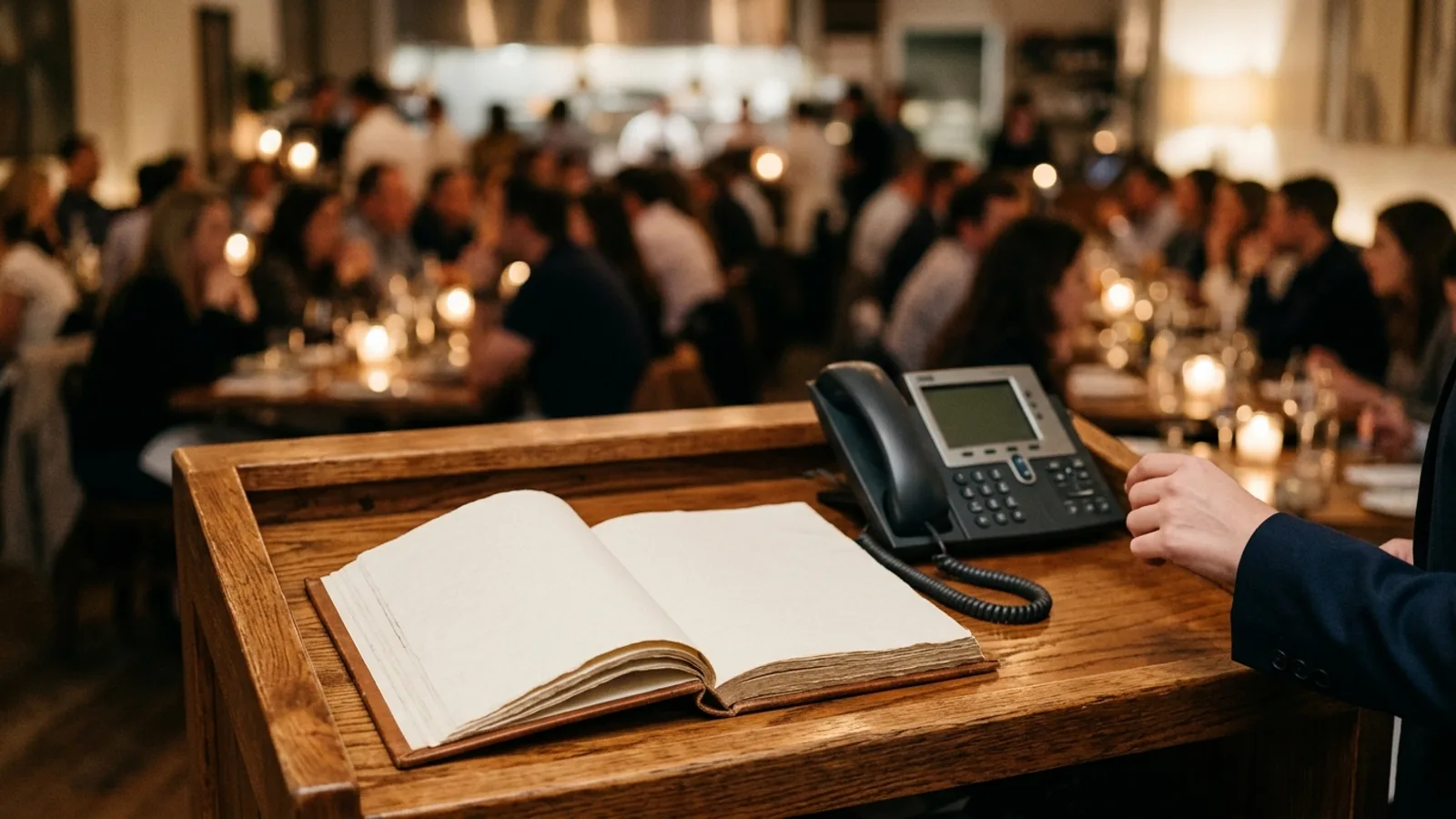
The restaurant phone rings hardest at 7:40 p.m. on a Friday, which is the exact minute nobody in the building can answer it. The host is seating a four-top, the servers are carrying plates, and the manager is in the walk-in. So the line rings out, and the person on the other end - who wanted to place a $90 pickup order, or book a table for eight next Thursday - calls the place down the street instead. We build AI receptionists, so treat this skeptically: here is what each caller on a restaurant line actually needs, and the one question a script must never answer on its own.
Our articles are still written by humans!
Get human written articles in your Google feed.
The short answer
A restaurant answering service covers the dining room line when your team physically cannot - mid-rush, mid-shift, before open, after close, and on the Monday you are dark but people are still booking Saturday. It takes or routes takeout orders, books and changes reservations, answers the twenty questions every restaurant gets asked (hours, parking, patio, kids, dogs, corkage, dress code, where the entrance is), captures large-party and catering inquiries in enough detail to quote, and escalates complaints, allergy assurances and refunds to a human.
It can be a live answering bureau, an AI receptionist, or a hybrid. The interesting question is not which one is "better" in the abstract - it is which one is awake and free at 7:40 p.m., and which one knows that the short rib is 86'd.
Seven callers, one line
The call mix on a restaurant's main number
| Caller | What they need | Right handling |
|---|---|---|
| Takeout or pickup order | To order food, now, and know when it will be ready | Take it against a live menu with 86'd items, quote a real time, confirm by text - or send your direct ordering link, quickly |
| Reservation, new or changed | A table, a time, a party size - or to move or cancel one | Straight into the booking system, with the cancellation handled as willingly as the booking |
| The twenty questions | Hours, parking, patio, kids, dogs, corkage, dress code, private room, gift cards | Answered instantly from a facts sheet you own. This is most of your call volume and none of your staff's attention |
| Large party or catering | To feed 30 people on a date, and to be taken seriously | Full capture - date, headcount, budget, dietary needs, contact - and a same-day callback from a manager. Never a voicemail |
| Allergy or dietary question | To know whether they can eat safely at your restaurant | State the ingredient facts, never an assurance. Flag the reservation and route to a manager or chef |
| Delivery driver, vendor, or the guest who is lost | A door, a dock, a person, a direction | Resolved in ten seconds with the right facts, or routed to the one person who can help |
| Sales calls and spam | Your time | Filtered before anyone in an apron hears about it |
Look at the middle rows. The bulk of a restaurant's call volume is questions with fixed answers - the sort of thing a well-written facts sheet resolves without judgment. That is the part worth automating first, because it is what currently interrupts a host mid-seating twenty times a night.
Why the phone is still the profitable channel
The National Restaurant Association's off-premises research puts a number on something operators already feel: roughly three of every four restaurant transactions now happen off-premises - takeout, drive-thru, curbside and delivery. Off-premises stopped being a side channel some years ago and became the main one.
Which makes the routing question a margin question. Every off-premises order arrives through one of three doors, and they are not commercially equal:
Where an off-premises order can come from
| Channel | What it costs you | What you learn about the guest |
|---|---|---|
| Third-party marketplace | A commission on every order, on top of card fees | Very little - the marketplace owns the relationship |
| Your own online ordering | Payment processing, plus whatever the platform charges | Everything, and you can market to them again |
| The phone | A minute of somebody's attention - or nothing, if it rings out | Everything, plus a phone number that answers next time |
A phone order is the cheapest order you will take all night, and it is the one most likely to evaporate. That is the whole argument for taking the line seriously. The general version of this arithmetic is in the cost of a missed call, and our calculator will run it with your average ticket instead of ours - which for a restaurant is the honest way to do it, because a $28 pickup order and a twelve-person Saturday booking are not the same missed call.
The rush is the whole problem
Most answering-service marketing is about after-hours coverage. For restaurants that framing is slightly wrong. Your problem hours are not 3 a.m. - they are the two hours a night when the room is full, which is also when the phone rings most and when your staff has the least capacity to answer it.
That concurrency limit is the structural difference. Software answers the ninth simultaneous call the same way it answers the first, which is why handling calls in parallel matters more here than in almost any other trade. A plumber gets three calls in an afternoon. A restaurant gets nine in a minute and then none for an hour.
The practical consequence: do not start by pointing your after-hours calls at a service. Start by pointing the overflow at it - the calls that arrive while your line is already busy - and read the transcripts for a week. Most operators are surprised twice: by how many there are, and by how many were about parking.
The allergy call: the one boundary that is not negotiable
This is the section that should decide which service you buy, and no vendor page mentions it.
A caller asks whether the pasta is gluten-free, or whether the fryer touches shellfish, or whether the dessert has sesame. There is a helpful answer and a correct answer, and they are not the same. The FDA recognizes nine major food allergens - milk, eggs, fish, crustacean shellfish, tree nuts, peanuts, wheat, soybeans and sesame, with sesame added most recently and folded into the 2022 Food Code. Whether a specific plate reaching a specific guest is free of one of them is a question about the kitchen at that moment - shared fryers, shared boards, a cook who changed gloves or did not. Nobody on a phone can know it.
So the script has exactly three permitted moves:
- State ingredients, from the recipe."The romesco has almonds in it" is a fact you control and can put in writing.
- State the policy, verbatim. Whatever your kitchen actually does about cross-contact - a dedicated fryer or not, a separate prep area or not - written once, said the same way every time.
- Escalate, and flag the booking. Offer a callback from a manager or chef before the guest arrives, and put the allergen on the reservation so the floor is not learning about it when the plate goes down.
This is not a reason to keep humans on the phone, incidentally - an underslept host improvises reassurance far more often than a script does. It is a reason to write the boundary down and test it, whoever is answering. The general craft of writing that kind of bounded instruction is in our guide to AI receptionist prompts.
Reservations, waitlists and no-shows
Reservation calls look like the easy category and quietly are not, because three of the four things a caller wants are edits rather than bookings.
- Take the cancellation as gladly as the booking. A table released at 4 p.m. is a table you resell. A cancellation that hits a voicemail box becomes a no-show, and the difference between those two outcomes is one script line: make cancelling easy, not slightly embarrassing.
- Confirm in writing, always.Time, party size, date, name, and the one detail that ruins evenings - which location. A text confirmation costs nothing and eliminates most of the "we had a reservation" conversations at the door.
- Waitlist calls are conversion calls."How long is the wait right now?" is somebody deciding between you and another restaurant while parked outside. An honest number, said fast, wins more of those than an optimistic one.
- Special occasions belong in the record. Birthday, anniversary, proposal, high chair, wheelchair access, a regular who always sits at 12. This is the cheap detail that turns a booking into a memorable service, and it is lost every time a call is a scribble on a pad.
- Deposit and cancellation policies get said out loud. If you hold a card for parties over six, the caller hears it during the booking, not in a dispute afterwards.
Mechanically this is the same job as any other booking flow - check real availability, write to the real calendar, confirm. How that works end to end is worth reading if you are evaluating vendors, because "we book" can mean anything from a live API write to an email somebody retypes.
Large parties and catering: the call worth the most
A twelve-top, a rehearsal dinner, an office order for 40 - these are the highest-value calls a restaurant receives and the ones most likely to be handled worst, because they arrive at the same bad moment as everything else and cannot be resolved in ninety seconds.
The wrong answer is "can you email us?" The person planning an office lunch is calling three restaurants and will book with whichever one takes them seriously first. The right answer is a full capture and a fast callback:
What a large-party or catering call must capture before it ends
| Field | Why it matters |
|---|---|
| Date, time, headcount | Decides feasibility before a manager spends a minute on it |
| Occasion and format | Seated dinner, buffet, drop-off catering and a private room are four different quotes |
| Budget per head, if they will say | Separates a real inquiry from a price check, without making anyone feel screened |
| Dietary requirements and allergens | The one thing that changes the menu, and the one thing nobody remembers to ask |
| Decision deadline | Tells you whether this is a callback in an hour or a callback tomorrow |
| Name, mobile, email | Two channels, because this callback actually has to land |
Then set a hard internal rule: large-party inquiries get a human callback the same day, with a name attached. Everything else on this page is about handling volume; this row is about not fumbling the one call that was worth ten covers.
Live answering vs AI vs online-only
Ways to cover a restaurant line
| Model | Best fit | Watch out for |
|---|---|---|
| Nobody - let it ring, push people online | Counter-service spots with genuinely simple menus and no reservations | The lost orders are invisible. You never see the caller who tried you at 7:40 and ate elsewhere |
| Generalist answering bureau | Fine dining wanting a human voice on every call, at low volume | Per-call pricing at restaurant volumes; agents who do not know your menu, your 86 list or your neighborhood |
| Restaurant voice AI | Anyone with a real rush, phone takeout, or reservations by phone | The integrations are the value - POS, menu, 86 list, booking system. Without them it is a message-taker with a nice voice |
| Hybrid (AI first, staff escalation) | Most independents: AI takes questions, orders and bookings; staff take complaints, large parties and anything odd | Write the always-human list before you launch, not after the first bad transcript |
Cross-market pricing is in our answering service cost guide and our own flat plans are on the pricing page. You keep the number that is on your listings and your window - forwarding takes about eight minutes, and you can point only the busy-line overflow at it to start.
What good calls sound like
Friday 7:41 p.m., pickup order, third simultaneous caller
The allergy call, handled correctly
The sentence that stops the script
Where AI loses (keep a human here)
- Any allergy assurance. Covered above and worth repeating: state ingredients, never state safety.
- Complaints, illness reports and refunds. These are reputation events and sometimes documents. A person owns them from the first sentence.
- Press, health department, licensing. Rare, and catastrophic to improvise. Straight to the owner.
- Anything requiring the kitchen's real-time state. If your 86 list lives in a chef's head rather than the POS, no phone system can quote it. Fix the list before you blame the software.
- The regular who wants their table. Some relationships are the product. Route known numbers to a person on purpose.
Setting it up
- Write the facts sheet first. Hours by day, holiday hours, address and what the entrance looks like, parking, patio, dogs, kids, high chairs, corkage, dress code, private room capacity, gift cards, accessibility. This one document answers most of your calls and takes an afternoon.
- Decide what "taking an order" means. Live into the POS, or captured and read back, or a text with your ordering link. All three are defensible. Ambiguity is not, because the caller acts on whatever they think happened.
- Connect the booking system, not a spreadsheet. Real availability, real writes, real confirmations - including cancellations.
- Write the allergen boundary and test it.Call your own line and try to get the script to say "safe." If it does, fix it before launch.
- Route overflow first, then after-hours. Busy-line overflow during service is where the lost revenue is. After-hours is the easy second step.
- Read a week of transcripts. You will find two questions your script fumbles and one you did not know guests asked. Both are ten-minute fixes.
The cheapest way to size this before spending anything: pull last month's call log and count the calls that came in while another call was already connected. Each one heard a busy tone during your best hour. If you want to hear the script yourself, our plans run month-to-month, and the restaurants page covers the wider setup. If you run several rooms, multi-location handling is the part to get right before you launch, not after.
Frequently asked questions
What is a restaurant answering service?
It is whatever picks up your dining room line when your staff cannot - a live answering bureau, an AI receptionist, or a hybrid of the two. For a restaurant the job is narrower and more specific than in most trades: take or route takeout orders, book and modify reservations, answer hours, parking, patio, kids and dietary questions, capture large-party and catering inquiries with enough detail that a manager can quote them, and hand off anything involving a complaint, an allergy assurance or a refund to a person.
Can an AI answer the phone for a restaurant during a dinner rush?
That is the only hour that matters. The rush is exactly when every server is carrying plates and the host is seating a four-top, and it is also when the highest-intent calls arrive. Software answers on the first ring whether it is fielding one call or nine at the same moment, which is the structural difference between it and a host stand: a host can hold one line, and every other caller hears a busy tone or a voicemail box they will not use.
Should an answering service take phone orders directly into the POS?
Only if the integration is real and the menu is live. An order typed into a system that does not know the kitchen is 86'd on short rib is worse than no order at all, because the customer finds out at pickup. Where the integration exists, phone orders are the most profitable orders you take - no marketplace commission, your own customer data. Where it does not, the honest configuration is to capture the order and read it back to the kitchen line, or to text the caller your direct ordering link and stop pretending.
Can an AI receptionist answer allergy questions?
It can state what is on the recipe or ingredient list and it must stop there. It must never say a dish is safe, allergen-free, or gluten-free, because that is a kitchen fact about cross-contact that no phone script can know at 7:40 p.m. on a Friday. The correct behavior is to name the allergen policy, offer to have a manager or chef call back before the guest arrives, and flag it on the reservation. The FDA's nine major allergens - milk, eggs, fish, crustacean shellfish, tree nuts, peanuts, wheat, soybeans and sesame - are the list your script should recognize and escalate on.
How much does a restaurant answering service cost?
Live answering bureaus bill per call or per minute and generally land between $1 and $3 a call once you account for minimums, which gets expensive fast at restaurant call volumes. Restaurant-specific voice AI is usually a flat monthly fee in the $50 to $400 range per location, sometimes with a per-order component. Judge either against the arithmetic that actually matters: a phone order you take yourself carries no third-party commission, and one recovered four-top on a Friday covers most of a month.
Will callers be annoyed that a restaurant uses AI to answer?
Far less than they are annoyed by ringing out. The complaint people actually make about restaurant phones is that nobody picks up, or that they were put on hold and forgotten mid-order. A voice that answers on the first ring, knows the hours and can book the table beats a busy signal by a wide margin. Where it does grate is when a caller wants a person and cannot get one, so the script has to hand off cleanly the moment anyone asks.
Can it handle multiple locations on one number?
Yes, and it is one of the better reasons to use software rather than a host stand. A single line can identify which location the caller wants - by asking, by the number they dialed, or by the area they name - and then answer with that location's hours, menu, parking and reservation book. What it must not do is guess: sending a caller to the wrong location for a 7 p.m. booking is a worse outcome than asking one extra question.