
The phone in a restaurant rings hardest at exactly the moment nobody can pick it up, which is why this category exists and why so much of it is sold badly. Search for the best AI phone answering for restaurants and you will find lists that compare voices, personalities and setup times - none of which is the decision. The decision is whether the call has to end as a message, a reservation, or an order sitting in your POS, because those are three genuinely different products at three genuinely different prices. We make one of the five things on this list, the simplest one, which places us last. Here is the ranking anyway, with every published price sourced and every missing one named as missing.
Our articles are still written by humans!
Get human written articles in your Google feed.
The ranking, in one table
Ordered for the restaurant most likely to be reading this: one to three locations, independent or small group, losing calls during service. A forty-unit franchise group should read this table bottom-up.
Five restaurant phone products, ranked for an independent (August 2026)
| # | Product | Best when the call ends in | Published price? |
|---|---|---|---|
| 1 | Loman | An order inside your POS - Toast, Square, Clover, SpotOn, Olo | No |
| 2 | Slang.ai | A reservation or a question - OpenTable, SevenRooms, Yelp, Tripleseat | Yes - $399 and $599/mo per location |
| 3 | ConverseNow | A high-volume QSR order, at franchise scale | No |
| 4 | PolyAI | A custom enterprise flow across more than the phone | No - per-minute, quoted |
| 5 | A general packaged AI receptionist | A message, an answer, or a callback | Yes - typically €99-€299/mo |
Where does the call end?
This is the whole comparison, and it takes about ninety seconds to answer for your own restaurant. Pull up last week and ask what the phone was actually for.
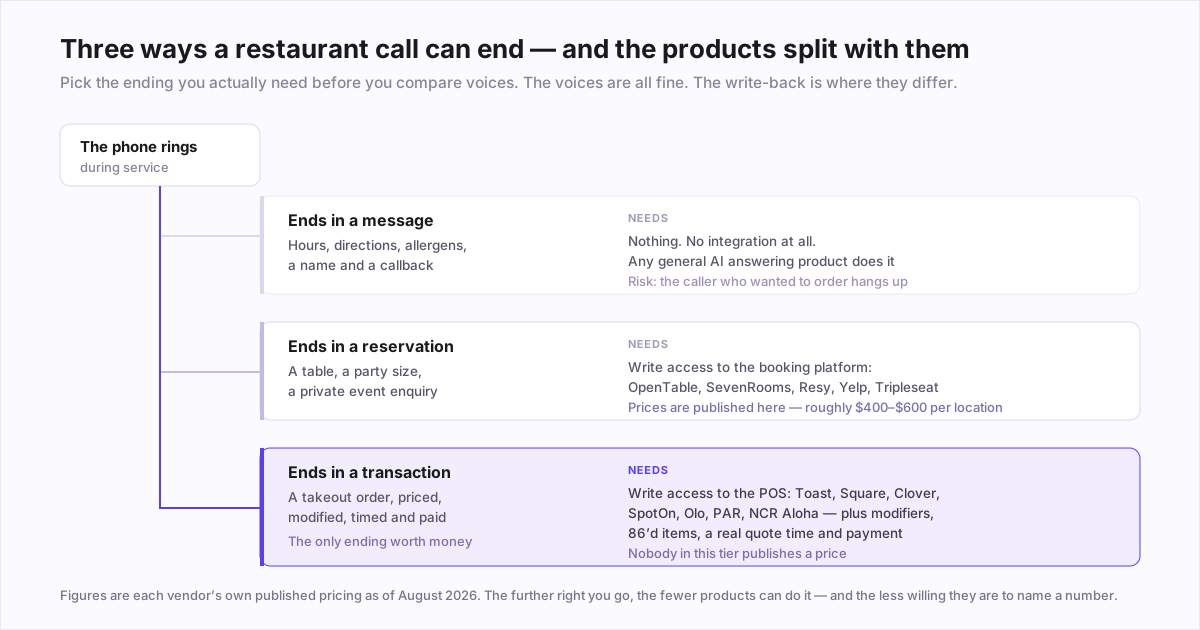
A full-service restaurant with a booking platform sits on the middle branch, and most of its phone volume is questions it has answered ten thousand times: are you open Monday, do you have parking, can we bring a cake, is there a gluten-free option. A pizzeria, a taqueria or a wing place sits on the right branch, where every unanswered call is a basket that went to the competitor two streets over. Those two restaurants should not buy the same product, and both of them will be shown the same five names by every listicle on this results page.
Seven callers, one line - and the rush
Whatever picks up your line - a live answering bureau, an AI, or a hybrid - is fielding the same seven kinds of caller. Sorting last week's calls into these rows is the fastest way to see which branch of the fork you are really on.
The call mix on a restaurant's main number
| Caller | What they need | Right handling |
|---|---|---|
| Takeout or pickup order | To order food, now, and know when it will be ready | Take it against a live menu with 86'd items, quote a real time, confirm by text - or send your direct ordering link, quickly |
| Reservation, new or changed | A table, a time, a party size - or to move or cancel one | Straight into the booking system, with the cancellation handled as willingly as the booking |
| The twenty questions | Hours, parking, patio, kids, dogs, corkage, dress code, private room, gift cards | Answered instantly from a facts sheet you own. Most of your call volume and none of your staff's attention |
| Large party or catering | To feed 30 people on a date, and to be taken seriously | Full capture and a same-day callback from a manager. Never a voicemail |
| Allergy or dietary question | To know whether they can eat safely at your restaurant | State the ingredient facts, never an assurance. Flag the reservation and route to a manager or chef |
| Delivery driver, vendor, or the guest who is lost | A door, a dock, a person, a direction | Resolved in ten seconds with the right facts, or routed to the one person who can help |
| Sales calls and spam | Your time | Filtered before anyone in an apron hears about it |
The commercial weight sits in the first row. The National Restaurant Association's off-premises research found that roughly three of every four restaurant transactions now happen off-premises - takeout, drive-thru, curbside and delivery. Of the doors an off-premises order can come through, the phone is the one with no marketplace commission and the one where you keep the guest's number. It is the cheapest order you will take all night, and the one most likely to evaporate.
That is why most after-hours framing is slightly wrong for restaurants. The problem hours are the two a night when the room is full, and the structural advantage of software is concurrency - answering calls in parallel matters more here than in almost any other trade. Whichever product you choose, start by pointing the busy-line overflow at it during service, not your after-hours calls, and read a week of transcripts. Most operators are surprised twice: by how many there are, and by how many were about parking.
How we ranked these - and who we are
- First-party sources only.Every figure below is from the vendor's own pricing page, product page or integrations page, read in August 2026. Where a vendor does not publish a number, we say so instead of borrowing one from another blog. A striking amount of the pricing circulating for this category traces back to nobody.
- Ranked by fit for an independent, not by size. ConverseNow is arguably the most capable product here and it sits third, because a two-location bistro cannot buy it and would not want to. Fit beats capability every time in a purchase this small.
- Write-back outranks voice. A product that puts an order on the kitchen printer removes work. One that emails you a transcript creates a to-do list. Both are marketed with the same sentence about never missing a call.
- We disclose our own position. We sell a general packaged AI receptionist. It does not write into a POS or a booking platform. That places us fifth, and if you need either, four other products here beat ours.
Why phone ordering is the hard one
It is worth being precise about this, because "takes orders" on a feature list conceals five separate engineering problems, each with its own way of ruining a Friday.
- The menu is not a document, it is a live state. Prices change, specials appear, a category gets renamed at 4 p.m. An agent working from a PDF someone uploaded in March will confidently quote a price you no longer charge.
- Modifiers are where accuracy actually dies. No onions, extra cheese, sub fries for salad, half-and-half on a large. A plain order is a demo. Three modifiers on one item is the product.
- The 86 list changes faster than any integration. The salmon goes at 7:15. If the agent is still selling it at 7:20, you have converted a missed call into a refund and a bad review. Loman lists out-of-stock AI menu updates as its own line item on the upper tier, which tells you it is a distinct thing that has to be built.
- Quote times are a promise, not a field. Twenty minutes on a Tuesday is fifty on a Friday. Ask whether the number is static, rule-based or reading real kitchen state, and set it pessimistically if it is the first.
- Payment drags in a second compliance surface.Taking a card over the phone through a voice agent is a different product decision from taking a name and charging at pickup. Loman's upper tier lists secure payment over the phone as a separate feature for exactly this reason.
Reservations, large parties and catering
Reservation calls look like the easy branch and quietly are not, because many of them are edits rather than bookings. Whether the agent writes into OpenTable or SevenRooms or just takes details, these are the behaviours to configure and test:
- Take the cancellation as gladly as the booking. A table released at 4 p.m. is a table you resell. A cancellation that hits a voicemail box becomes a no-show.
- Confirm in writing, always. Time, party size, date, name, and the one detail that ruins evenings - which location.
- Waitlist calls are conversion calls."How long is the wait right now?" is somebody deciding between you and another restaurant while parked outside. An honest number, said fast, wins more of those than an optimistic one.
- Special occasions belong in the record. Birthday, anniversary, high chair, wheelchair access, the regular who always sits at 12 - lost every time a call is a scribble on a pad.
- Deposit and cancellation policies get said out loud. If you hold a card for parties over six, the caller hears it during the booking, not in a dispute afterwards.
Large parties and catering are the highest-value calls a restaurant receives and the ones most often fumbled, because they arrive at the same bad moment as everything else and cannot be resolved in ninety seconds. "Can you email us?" loses them: the person planning an office lunch is calling three restaurants and books with whoever takes them seriously first. No product on this list should quote one - but every one of them, including the cheapest, can capture it properly:
What a large-party or catering call must capture before it ends
| Field | Why it matters |
|---|---|
| Date, time, headcount | Decides feasibility before a manager spends a minute on it |
| Occasion and format | Seated dinner, buffet, drop-off catering and a private room are four different quotes |
| Budget per head, if they will say | Separates a real inquiry from a price check, without making anyone feel screened |
| Dietary requirements and allergens | The one thing that changes the menu, and the one thing nobody remembers to ask |
| Decision deadline | Tells you whether this is a callback in an hour or tomorrow |
| Name, mobile, email | Two channels, because this callback actually has to land |
Then set a hard internal rule: large-party enquiries get a human callback the same day, with a name attached. Mechanically the booking side is the same job as any other appointment flow - how that works end to end is worth reading, because "we book" can mean anything from a live API write to an email somebody retypes.
The five, one at a time
1. Loman - built for the branch where the money is
Loman is the clearest independent-focused answer to the transaction branch. Its integration list is POS-first and specific - Toast, Square, Clover, SpotOn, Shift4, Aloha by NCR, Olo and Stream - with OpenTable and Resy alongside, so it reaches both endings rather than picking one. Its pricing page states plainly: no per minute fees, no hidden costs.
The tier split tells you more than the marketing does. Starter is described as being for basic call management. Premium is for ordering and reservations, and the features that appear only there are the hard ones: takeout and delivery ordering, complete POS integration, secure payment over the phone, out-of-stock AI menu updates, a dynamic upsell engine. That is an accurate map of where the difficulty lives.
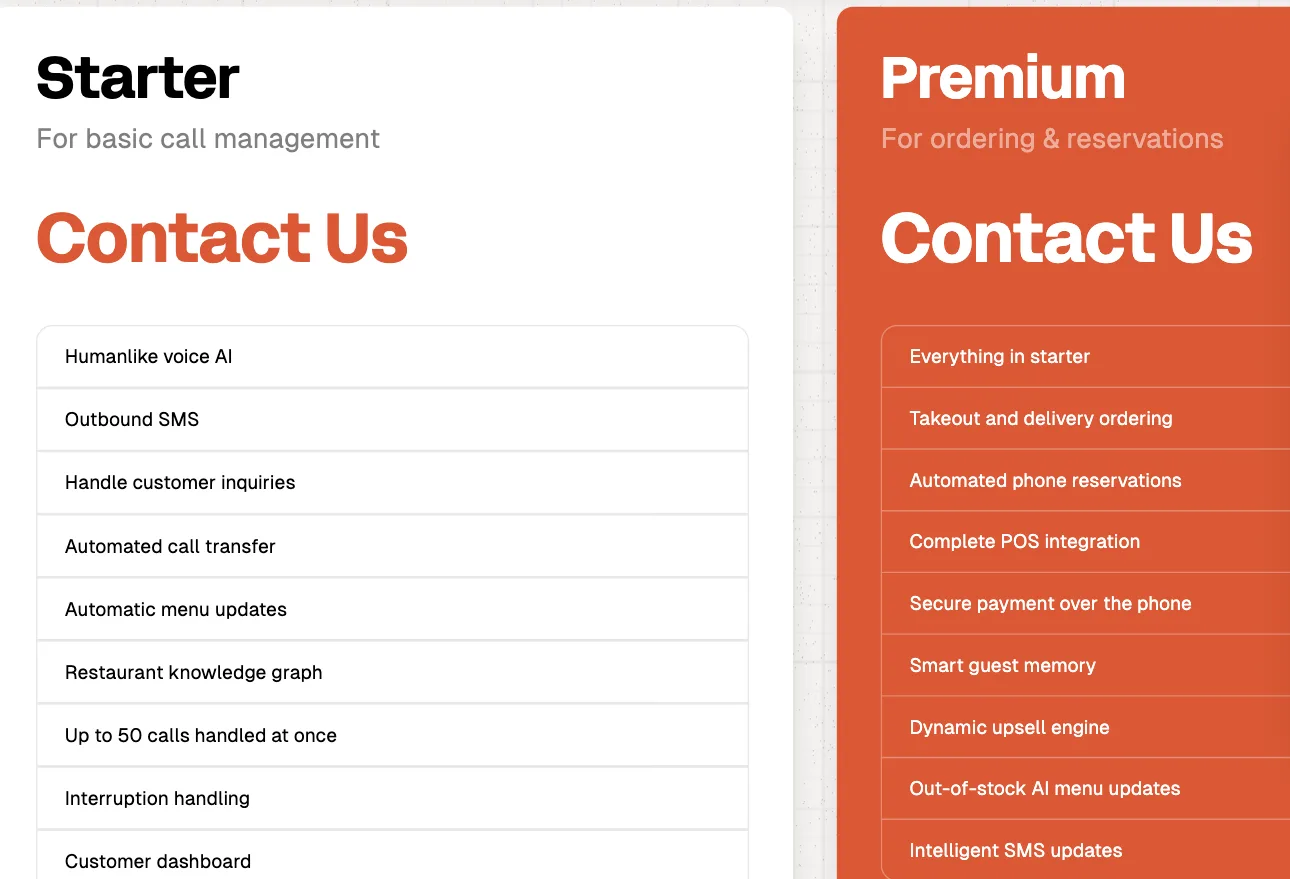
The critical read:neither tier publishes a price, including the basic one, which is a choice. For a single-site restaurant that means a sales call before you can even size the decision. And treat every accuracy percentage in this category - Loman's pricing page claims 99.6% order accuracy - as a vendor metric measured by the vendor on their own definition of an error. It is not a lie; it is simply not something you can compare across vendors. Your Tuesday test is worth more than the number.
2. Slang.ai - the transparent one, for the other branch
Slang.ai is the only product in this comparison that will tell you what it costs without a meeting: Core starting at $399 per month per location and Premium at $599, with enterprise quoted, and a claim that setup takes less than thirty minutes. In a category this coy, publishing is worth something on its own.
It is also unusually clear about what it is for. Its own description covers everything from hours and directions to reservations, promos and allergy information, and its integrations page is four logos deep: OpenTable, SevenRooms, Tripleseat and Yelp.
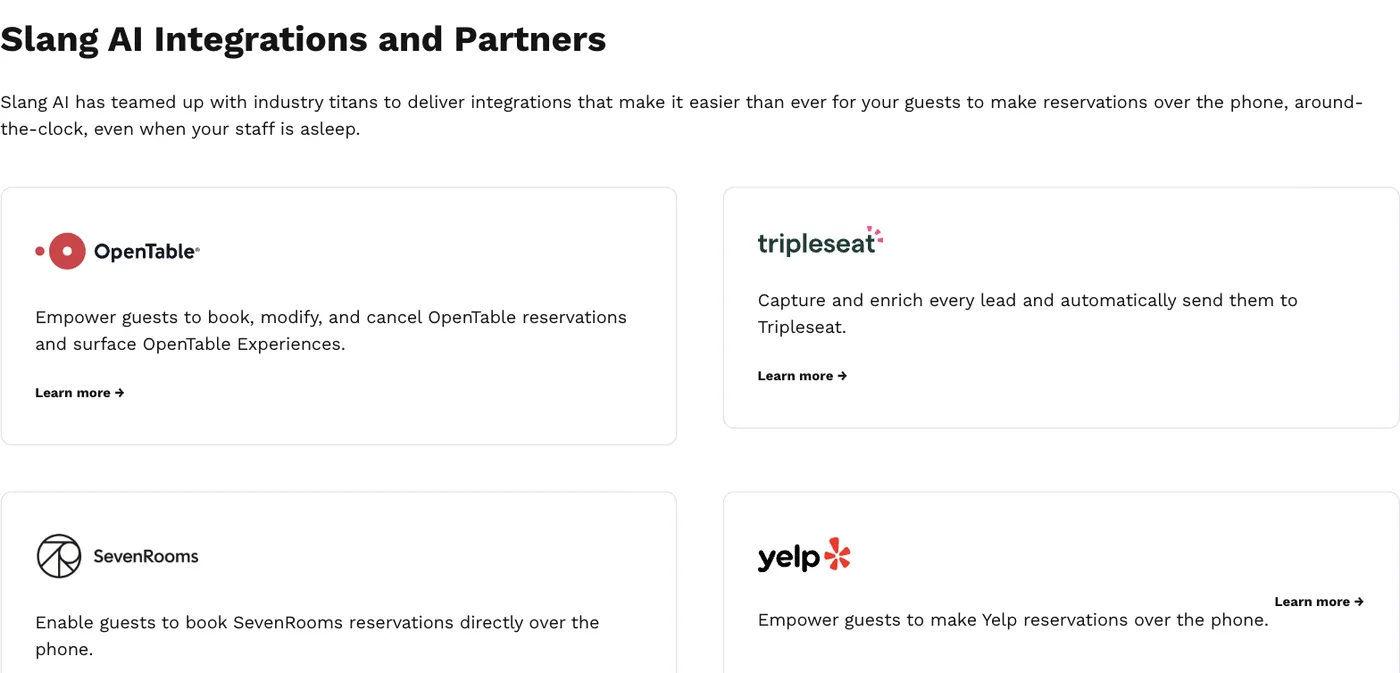
The critical read: $399 per location per month is real money for an independent, and you are paying it to deflect questions and capture bookings rather than to generate revenue directly. That maths works comfortably for a busy full-service room with an expensive host stand and a hundred calls a day. It works badly for a forty-cover neighbourhood restaurant that gets nine. Count your calls before you count the features.
3. ConverseNow - the one built for scale you probably do not have
ConverseNow sells voice AI for restaurant ordering to the top of the market, and it is not shy about who it works with: its site names Blake's Lotaburger, Denny's, Domino's Pizza, Fazoli's, Hardee's, Jets Pizza and Wingstop. The POS partner list reads like a franchise procurement document - Brink POS, Fiserv, Focus, ItsaCheckmate, NCR Aloha, Olo, PAR, Qu and Xpient.
If you run twenty units with a drive-thru and a franchisor with opinions about your tech stack, this is the shape of vendor you want: one that has already been through that integration and that certification, and that prices per unit at a volume where a point of order accuracy is worth seven figures.
The critical read: everything that makes ConverseNow right for Wingstop makes it wrong for one restaurant. No published price, an enterprise sales motion, and a deployment model that assumes a standardised menu across units. A single independent asking for a quote here is asking for a procurement cycle in exchange for capability it has no way to consume.
4. PolyAI - a platform that also does restaurants
PolyAI is a horizontal enterprise voice-agent company covering ten verticals - consumer services, financial services, healthcare, hospitality, insurance, restaurants, retail, telecoms, travel, utilities - with use cases spanning authentication, billing, routing and order management as well as bookings. Its pricing page is explicit about the model: ongoing use of the voice agent is priced on a per-minute basis, inclusive of maintenance, performance improvements and 24/7 support.
Per-minute is an honest meter and a demanding one. It means a busy month costs more, which is correct in principle and unpleasant when it arrives in a quarter you already budgeted. It also means the vendor is exposed to their own inefficiency, which is a good incentive.
The critical read: a hospitality group with a contact centre and a brand voice worth designing should absolutely talk to them. A restaurant should not, for the same reason it should not hire an architect to hang a shelf. The build-versus-buy version of this argument, with the platform vendors, is in Twilio vs Dialpad vs Freshworks vs EliseAI.
5. A general packaged AI receptionist - including ours
Last, and honestly last: a general AI receptionist answers with your greeting, knows your hours, menu highlights, allergen policy, parking and booking policy, handles large-party and private-hire enquiries by taking details, transfers a complaint to a human, and puts a transcript of every call in your inbox. Flat monthly - ours is €99 or €299 a month - live the same day, cancellable.
For a large share of independents this is the correctly sized purchase, because their phone problem is not lost orders. It is that four people a night ring during service to ask something already on the website, and one of them was a twelve-top. Deflect the four, capture the one, and stop paying a per-location fee for a POS integration you were never going to use.
The critical read, on ourselves:if your calls are orders, we are the wrong product and so is any other general receptionist, whatever its home page implies about restaurants. An order that arrives as an email is not an order - it is a second job for whoever reads the email. Buy Loman, or check your POS directory first. Toast's own listing for Incept AI describes the arrangement precisely: your Toast menu is ingested into Incept AI, and when it takes an order it is automatically pushed to the Toast POS and any KDSes. That is what a real POS integration reads like, in the POS vendor's own words, and going through the directory is usually the cheapest route to one.
What each one actually costs
Published pricing as of August 2026 - confirm before buying
| Product | What the vendor publishes | What to expect |
|---|---|---|
| Slang.ai | Core from $399/mo, Premium from $599/mo per location; Enterprise custom. CAD and AUD rates listed. | Per location, monthly, with named reservation integrations. No POS. |
| Loman | Nothing. Starter and Premium both say Contact Us. States no per-minute fees. | A sales call before a number. Ordering features sit on the upper tier. |
| ConverseNow | Nothing. | Enterprise, per-unit, franchise procurement. Not sold to single sites. |
| PolyAI | Per-minute for ongoing use; rate quoted after a demo. | Usage meter, so the bill moves with your volume. Enterprise motion. |
| General packaged AI receptionist | Flat monthly, publicly listed. Ours is €99 (1,000 min) or €299 (3,000 min), €0.09 per extra minute. | Month to month, same-day setup, no POS or booking write-back. |
Before comparing any of these to each other, compare them to the thing they replace. A missed call at a restaurant is not a lost enquiry, it is a lost basket with a known average value, and it is one of the few industries where the arithmetic is genuinely easy to do - the method is here. Run it on last month before you read another feature list.
The two sentences that must never be automated
Restaurants carry a specific liability that dentists and plumbers do not, and it is worth writing the rule down before you configure anything.
An AI must never confirm that a dish is safe for an allergy.Not "it's gluten-free", not "there's no nuts in that". Kitchens cross-contaminate, recipes change, and a model repeating a menu tag as a safety assurance is the worst possible failure mode this software has. The correct behaviour is to state what the menu says, then hand the call to a person or take a number for the manager. Slang.ai's own product description mentions handling allergy information, which is fine as information and dangerous as assurance - make sure your configuration knows the difference.
The list the script should recognise and escalate on is the FDA's nine major food allergens - milk, eggs, fish, crustacean shellfish, tree nuts, peanuts, wheat, soybeans and sesame, with sesame the most recent addition, folded into the 2022 Food Code. Within that, the script has exactly three permitted moves:
- State ingredients, from the recipe."The romesco has almonds in it" is a fact you control and can put in writing.
- State the policy, verbatim. Whatever your kitchen actually does about cross-contact - a dedicated fryer or not, a separate prep area or not - written once, said the same way every time.
- Escalate, and flag the booking. Offer a callback from a manager or chef before the guest arrives, and put the allergen on the reservation so the floor is not learning about it when the plate goes down.
An AI must never promise a time it cannot see. That applies to a table at 8 and to a pickup at 7:30 equally. If the agent cannot read live state, it should quote a range, err long, and say it is approximate.
Alongside those two: have the agent say it is AI in its first sentence. Guests forgive a robot that says it is a robot and they do not forgive one that pretends. And route complaints to a human immediately - nobody who is already annoyed wants to explain themselves twice.
What good calls sound like
Three calls worth modelling, whichever product you buy. Keep them short; long scripts are where agents and tired hosts both go wrong.
Friday 7:41 p.m., pickup order, third simultaneous caller
If your system cannot take that order into the POS, the honest alternatives are capturing it and reading it back to the kitchen line, or texting the caller your direct ordering link. All three are defensible; ambiguity is not, because the caller acts on whatever they think happened.
The allergy call, handled correctly
The sentence that stops the script
Illness reports sit on a short always-human list with complaints, refunds, press, health department and licensing calls, and the regular whose relationship is the product - route known numbers to a person on purpose. Write that list before launch, not after the first bad transcript. The craft of writing bounded instructions like these is in our guide to AI receptionist prompts.
A test you can run during a slow Tuesday
- Order your most-modified item. Three changes, minimum. Then change your mind about one of them mid-sentence.
- Order something you know is 86'd. If it takes the order, the demo is over.
- Ask how long for pickup. Then ask where that number came from. The vendor should be able to answer even if the agent cannot.
- Ask an allergy question. Anything other than careful deferral is a fail, no matter how confident it sounds.
- Ask for a table for fourteen on Saturday. Large parties are a human decision in almost every restaurant. Does it know that?
- Talk over it. Interrupt the greeting the way a real caller in a car does.
- Then go and look. Did the ticket print? Did the booking appear in OpenTable? Everything before this step is theatre.
We run the same ranking for two other trades where the system of record is completely different - dental practices, where it is Dentrix or Open Dental, and home services, where the platform vendors now ship their own agent.
When none of these is the answer
- Your POS already offers one. Check before you shop. The vendor holding your live menu and your ticket flow starts with an advantage no third party can buy, and the same pattern has already played out in the trades, where Jobber, Housecall Pro and ServiceTitan all now ship their own.
- Your phone volume is nine calls a day. At that level almost any of these is more expensive than the problem. An answering machine with a good message and a text-back does most of the work.
- Your real problem is online ordering adoption. If eighty per cent of your phone orders would happily have been placed online, a QR code on the door and a link in your Google profile is a cheaper fix than a voice agent.
- Nobody owns the menu updates.Every product here is exactly as accurate as what you last loaded. If your specials change weekly and nobody has fifteen minutes to keep it current, you are buying a machine that will confidently sell last week's menu.
If what you need is the simple version - the phone answered properly during service, questions handled, the twelve-top captured, a transcript in your inbox - that is the narrow problem we built for. Write the facts sheet first (hours by day, holiday hours, entrance, parking, patio, dogs, kids, corkage, dress code, private room capacity, accessibility), use the scripts above as the starting point, and keep the number on your listings - forwarding takes minutes. If you run several rooms, multi-location handling is the part to get right before launch, and the restaurants page covers our setup.
Frequently asked questions
What is the best AI phone answering system for a restaurant?
It depends entirely on where you need the call to end. If it has to end as an order in your POS, Loman is the strongest independent-focused option and names Toast, Square, Clover, SpotOn, Shift4, Aloha and Olo. If it has to end as a reservation, Slang.ai is the most transparent, publishing $399 and $599 per location per month and integrating with OpenTable, SevenRooms, Tripleseat and Yelp. If you run a high-volume QSR group, ConverseNow is built for that scale. And if the call only needs answering - hours, directions, a callback - a general packaged AI receptionist does it for a fraction of any of them.
Can an AI take phone orders straight into Toast or Square?
Products in this category do claim it, and it is the single hardest thing any of them do. Taking an order means reading a live menu, applying modifiers correctly, knowing what has been 86'd in the last twenty minutes, quoting a pickup time that survives contact with a full kitchen, and in most cases handling payment. Loman's upper tier lists complete POS integration, secure payment over the phone and out-of-stock menu updates as distinct features, which tells you those are distinct problems. Ask any vendor to demo an 86'd item and a three-modifier order rather than a plain cheeseburger.
How much does AI phone answering for a restaurant cost?
Slang.ai is the only vendor in this comparison publishing figures: Core starting at $399 per month per location and Premium at $599, with enterprise quoted. Loman, ConverseNow and PolyAI all sell through a demo, though PolyAI states its ongoing pricing is per minute. A general packaged AI receptionist that answers questions and takes messages without touching a POS runs roughly €99-€299 per month. The spread is not margin - order-taking into a POS is materially harder to build and to support than answering a question about parking.
Does Slang.ai take takeout orders?
Not into a point-of-sale system, on the evidence of its own site. Slang.ai's integrations page lists OpenTable, SevenRooms, Tripleseat and Yelp - reservation and event platforms - and names no POS at all. Its own description of the product centres on answering guest enquiries and managing reservations, covering everything from hours and directions to promos and allergy information. That is a coherent product for a full-service restaurant taking bookings. It is the wrong product for a pizzeria whose phone volume is orders.
Can an AI answer the phone for a restaurant during a dinner rush?
That is the hour that matters most. The rush is when every server is carrying plates and the host is seating a four-top, and it is also when the highest-intent calls arrive. A host stand can hold one line, so the second simultaneous caller hears a busy tone or a voicemail box they will not use. Software answers the ninth simultaneous call the same way it answers the first. The practical way to start is to point only the busy-line overflow at it during service and read a week of transcripts before adding after-hours.
Can an AI receptionist answer allergy questions?
It can state what is in a dish from the recipe and your written cross-contact policy, and it must stop there. It must never say a dish is safe, allergen-free or gluten-free, because whether a specific plate is free of an allergen is a question about the kitchen at that moment - shared fryers, shared boards - that no phone script can know. The correct behaviour is to state the ingredients and the policy, offer a callback from a manager or chef before the guest arrives, and flag the allergen on the reservation. The FDA's nine major allergens - milk, eggs, fish, crustacean shellfish, tree nuts, peanuts, wheat, soybeans and sesame - are the list a script should recognise and escalate on.
Will an AI answering the phone annoy my regulars?
Some of them, yes, and the mitigation is structural rather than cosmetic. Have the agent identify itself as AI in the first sentence - a fake human is what actually generates complaints. Make the route to a person short and reliable, and route large parties, private events and complaints straight to a human without argument. Then run it only during service and after hours for a month and read your reviews. If a name shows up twice, that is data, not noise.
What happens when the AI gets a quote time wrong on a Friday night?
You get an angry guest at the counter at 7:40, which is worse than a missed call. This is the sharpest limitation of phone ordering and the question fewest demos will answer well. Ask the vendor precisely where the quote time comes from: a static number you configured, a rule based on order count, or something reading live kitchen state. If it is static, set it pessimistically and change it manually on your busiest nights - and treat that fifteen seconds of work as part of the cost of the system.
Can it handle multiple locations on one number?
Yes, and it is one of the better reasons to use software rather than a host stand. A single line can identify which location the caller wants - by asking, by the number they dialled, or by the area they name - and then answer with that location's hours, menu, parking and reservation book. What it must not do is guess: sending a caller to the wrong location for a 7 p.m. booking is worse than asking one extra question, and the location belongs in every written confirmation.
Should I use my POS's own AI instead of a third-party voice agent?
Check first, because the answer changes fast. Point-of-sale vendors are actively adding voice ordering partners and native capability, and a product that already holds your live menu, your 86 list and your ticket flow starts with an advantage no third party can buy. The pattern is playing out identically in other trades - in home services, Jobber, Housecall Pro and ServiceTitan all now ship their own AI receptionists. If your POS offers one, evaluate it first: it will be cheaper to integrate and it is one fewer vendor between the phone and the kitchen.
Sources
- Slang.ai: pricing (Core, Premium, Enterprise)
- Slang.ai: integrations and partners (OpenTable, SevenRooms, Tripleseat, Yelp)
- Loman: pricing tiers and POS integrations
- ConverseNow: product site, named brands and POS partners
- PolyAI: pricing model (per-minute, quoted)
- Toast: partner directory listing for Incept AI
- National Restaurant Association: off-premises dining is now essential for restaurant consumers and operators
- FDA: Food Allergies - the nine major food allergens
- FDA: sesame added as a major food allergen, 2022 Food Code addition