
You searched this because three vendors used three different labels for what sounds like the same thing, and at least one of them was being slippery about it. Fair warning: we sell one of the three (the AI kind), so read us as a biased party showing its work. The three services are genuinely different products with different price tags, and picking the wrong one wastes real money. Here's the clean version of what each one is, what it costs, and which sentence-long description of your business points at which option.
Our articles are still written by humans!
Get human written articles in your Google feed.
The 30-second answer
If you only read one section, read this one.
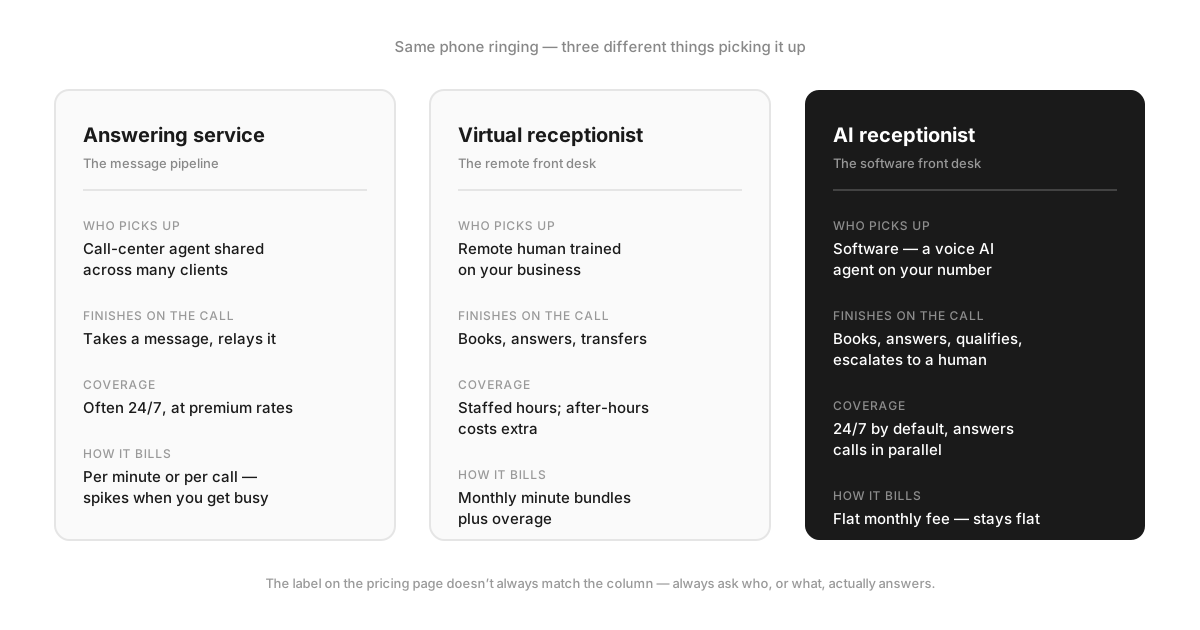
- Answering service:a call center answers in your business name, follows a short script, takes a message, and relays it to you. Humans on the line, but shallow ones: they usually can't book your calendar or answer real questions about your business. You pay per minute or per call.
- Virtual receptionist: a remote human (or small team) trained on your business who acts like your front desk: books appointments, answers FAQs, screens and transfers calls, takes payments at some services. The deepest human option short of hiring, and priced accordingly, per minute in bundles.
- AI receptionist:software that picks up your phone, talks to callers in a natural voice, books appointments directly on your calendar, answers your specific FAQs, takes structured messages, and escalates to a human when it's out of its depth. Answers 24/7, in parallel, for a flat monthly fee.
Why the terms are so confusing
The confusion isn't your fault; it's partly strategy. For decades, "answering service" meant the humble message-taking call center, and "virtual receptionist" was the premium rebrand: same industry, more training, higher price. Then AI voice agents arrived and did the reverse move, borrowing the established human labels because "virtual receptionist" converts better than "phone bot." Today you'll find human services and AI products selling under identical names, sometimes at a 10x price difference for the same label.
The result: comparing "virtual receptionist plans" across vendors can mean comparing a trained human in Arizona to a language model, without either pricing page saying so plainly. Neither is wrong to buy. They're just different products, and the label has stopped telling you which one you're getting. So ignore the label and classify by two facts: who answers (person or software) and what they can complete(relay a message vs. finish the job on the call). And for completeness: none of these three is an IVR, the "press 1 for sales" phone tree, which only routes calls and handles nothing - we've untangled AI receptionist vs. IVR separately.
What each one actually does
Answering service: the message pipeline
The classic answering service is a shared call center. Agents answer for dozens of businesses at once, greet callers with your business name, and work from a brief script: who's calling, what's it about, best callback number. The message reaches you by text, email, or portal. Better services add basic dispatch ("if it's a burst pipe, call the on-call tech"), and 24/7 coverage is common at a premium.
The honest limits: agents know your script, not your business. Ask anything past the second follow-up question and you'll hear "I'll pass that along." Most can't see your calendar, so nothing gets booked; every call becomes homework for you tomorrow morning. And because agents juggle many accounts, quality varies call to call. It's a fine product for one narrow job: making sure a human voice picks up and a message doesn't get lost. Just price that job honestly, because per-minute billing on message-taking adds up fast.
Virtual receptionist: the remote front desk

A virtual receptionist service assigns you a human (usually a small dedicated team) who actually learns your business. They book appointments on your real calendar, answer questions about your services and pricing, screen sales calls from real leads, do warm transfers, and at some services handle intake forms or payments. Done well, callers can't tell they're not sitting in your office.
This is the strongest human option short of hiring, and it's the right pick when the calls themselves are the hard part: emotional, high-stakes, or complex enough that empathy and judgment close the deal. The trade-offs are structural, not quality problems. Humans cost human money, so plans are sold as minute bundles that get expensive exactly when your phone gets busy. Coverage windows are real: nights and weekends cost extra or aren't offered. And one receptionist answers one call at a time, so your Monday-morning rush still stacks up in a queue.
AI receptionist: the software front desk
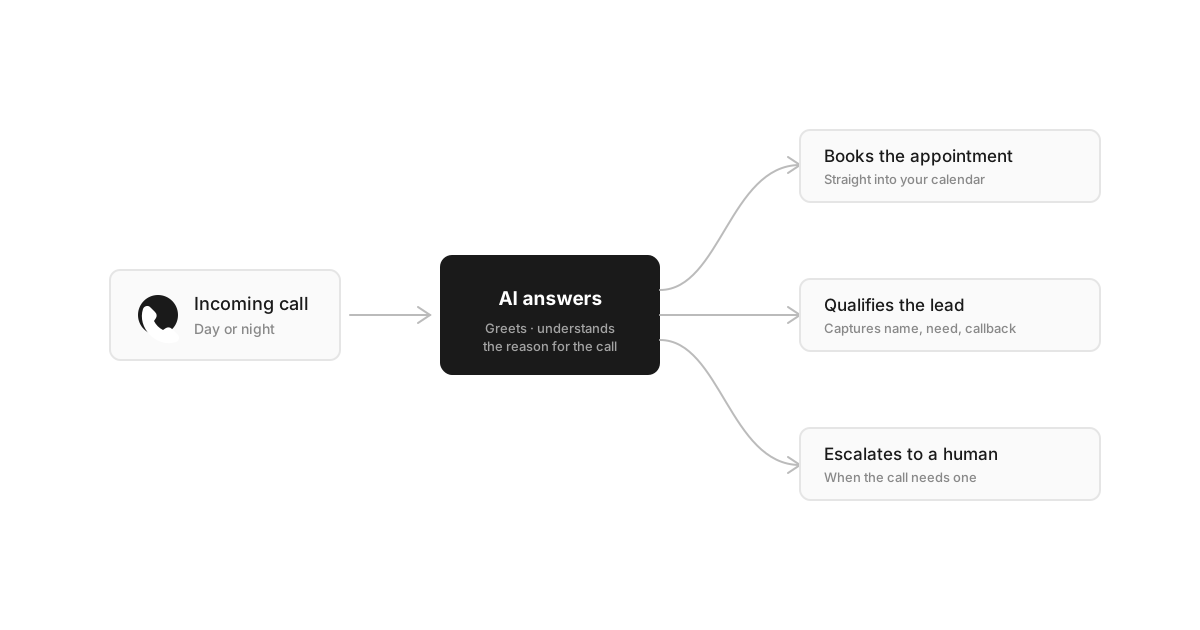
An AI receptionist is a voice agent on your phone number. It answers instantly, in a natural voice (how natural is a fair question; we've written an honest breakdown of that), understands why the caller rang, and then completes the routine jobs end to end: books the appointment on your calendar, answers your FAQs from instructions you control, qualifies the lead, takes a structured message, texts you a summary. It answers at 2 a.m. and during the rush, handles multiple calls in parallel, and costs a flat monthly fee that doesn't move when volume does.
The honest limits, stated as plainly as we stated the others': it is not a person. On an emotional call, a genuinely weird request, or a caller who just hates talking to machines, it should recognize the situation and hand off to a human, and a well-configured one does exactly that. If your instinct is "but could it replace my actual receptionist?", that's a different question than this article's, and we answered it honestly here: it replaces missed calls, not people.
Side by side
The same three services, one table. Read the rows that match your actual pain, not all of them.
Answering service vs. virtual receptionist vs. AI receptionist
| Answering service | Virtual receptionist | AI receptionist | |
|---|---|---|---|
| Who picks up | Call-center agent shared across many clients | Remote human trained on your business | Software (a voice AI agent) |
| Core job | Take a message, relay it | Book, answer, screen, transfer | Book, answer, qualify, message, escalate |
| Books your calendar | Rarely | Yes | Yes (direct integration) |
| Knows your business | A thin script | Deeply, after onboarding | As deeply as its instructions & integrations |
| 24/7 coverage | Often, at premium rates | Limited; after-hours costs extra | By default, same flat rate |
| Three calls at once | Yes (large shared staff) | Queues during your rush | Yes (answers in parallel) |
| Empathy on a hard call | Fair, script-bound | Excellent | Weak; should hand off to a human |
| Pricing model | Per minute / per call | Monthly minute bundles + overage | Flat monthly fee |
| Bill when volume spikes | Spikes with it | Spikes with it | Stays flat |
What each one costs
Ranges below are typical US small-business pricing in 2026; any given vendor can sit outside them. The structure of the bill matters more than the headline number.
How the costs of virtual receptionist services compare (2026)
| Service | Typical monthly cost | Billing model | After-hours & holidays |
|---|---|---|---|
| Answering service | $150 - $1,000+ | Per minute ($1-$2) or per call | Often billed at premium rates |
| Virtual receptionist | $200 - $1,500+ | Minute bundles + overage | Costs extra or not offered |
| AI receptionist | $30 - $300, flat | Monthly subscription | Included at the same rate |
| In-house hire (context) | ~$3,000+ fully loaded | Salary + benefits | Overtime, if staffed at all |
- Answering service: roughly $150 to $1,000+ a month, built from per-minute rates around $1 to $2 (or per-call pricing near $1.50 to $2.50). Cheap-looking base plans with 100 minutes are gone in a week at real call volume, and after-hours minutes often bill higher.
- Virtual receptionist: roughly $200 to $1,500+ a month. Entry plans commonly start around $200 to $300 for a small bundle of minutes or calls, and a genuinely busy phone line can push past what a part-time hire would cost. For context, a full-time in-house receptionist runs about $37,000 a year before benefits, per the Bureau of Labor Statistics, which is the ceiling this whole market prices under.
- AI receptionist: roughly $30 to $300 a month, flat. Volume moves you between tiers, not into per-minute panic. The traps live elsewhere (setup fees, per-integration charges, overage rates), and we've broken those down in our AI receptionist pricing guide.
One cost that never shows up on any pricing page: the calls nothing answers. Research on lead response, including HBR's classic study, shows the odds of qualifying a lead collapse within minutes of first contact. A caller who hits voicemail usually just dials your competitor. Whichever of the three options you pick, the expensive choice is the status quo where the phone sometimes rings out.
Which one should you pick?
Skip the feature checklists. Find the sentence that sounds like your business:
- "Most of my calls are bookings, hours, and the same ten questions." AI receptionist. Paying a human per minute to repeat your opening hours is the worst deal in this article, and routine volume is exactly what AI finishes end to end.
- "I lose calls after hours and during the rush, in bursts." AI receptionist. Parallel pickup and flat-rate 24/7 coverage is the one combination no human service can structurally offer.
- "My calls are rare, but each one is high-stakes and emotional." Virtual receptionist. A grieving family calling a funeral home or a panicked client calling a defense attorney deserves a human, and at low volume the per-minute economics stop hurting. This is the case where we'd honestly point you away from our own product as the first line.
- "I just need messages to stop dying in voicemail overnight." Either an answering service or an AI receptionist does this; the AI does it cheaper and books the appointment instead of writing it down. The classic answering service wins mainly when a policy or a franchise contract requires a live human on the line.
- "Some calls are routine volume, some genuinely need a person." Both, layered. AI answers everything first and finishes the routine majority; the hard minority gets warm-transferred to you or a live service. You pay human rates only for calls that earn them. This hybrid is what most growing businesses should actually run, and no vendor's category label will tell you that.
If the arrows point you at AI, the next question is which one, and that market has its own traps: our buyer's guide to choosing an AI receptionist is the checklist we'd want used against us. And if you'd rather judge by ear than by article, you can talk to our AI receptionist right now and check the flat-rate pricingyourself. Worst case, you'll know exactly which of the three boxes you're shopping in.
Frequently asked questions
What is the difference between an answering service and a virtual receptionist?
An answering service takes messages. A shared pool of call-center agents picks up in your business name, follows a thin script, writes down who called and why, and relays it to you. A virtual receptionist is a remote human who acts like your actual front desk: they learn your business, book appointments on your calendar, answer common questions, and transfer calls. The receptionist does more per call and costs more per minute; the answering service is cheaper but essentially a message pipeline.
Is an AI receptionist the same as a virtual receptionist?
No, though vendors increasingly use the terms interchangeably. 'Virtual receptionist' traditionally means a remote human answering your calls. An AI receptionist is software: a voice agent that answers, books, and takes messages with no human on the line. Some AI products now market themselves as virtual receptionists, so the question to ask any vendor is simple: when my phone rings, is a person or a program answering it?
Which is cheapest: an AI receptionist, a virtual receptionist, or an answering service?
At almost any real call volume, the AI receptionist, because you're not paying for human minutes. Typical small-business AI plans run about $30 to $300 a month flat. Live answering services bill roughly $1 to $2 per minute and land at a few hundred dollars a month; virtual receptionist plans with small minute bundles commonly start around $200 to $300 and climb fast. Human options are only price-competitive if your call volume is very low.
How do the costs of different virtual receptionist services compare?
Compare the billing model before the headline price. Answering services bill per minute (about $1-$2) or per call and typically land at $150-$1,000+ a month; virtual receptionist plans sell minute bundles that start around $200-$300 and climb past $1,500 at busy volumes; AI receptionists charge a flat subscription of roughly $30-$300 regardless of when calls arrive. The structural difference: human services cost more exactly when you're busiest - rushes, nights, holidays - while a flat AI fee doesn't move. At very low call volume the gap narrows and human options become price-competitive.
Can I combine an AI receptionist with human answering?
Yes, and for many businesses it's the best configuration. A common setup: the AI answers everything first, handles the routine 70 to 80% of calls (booking, FAQs, messages), and warm-transfers or escalates the rest to you or a live service. Another is time-based: humans during business hours, AI for nights, weekends, and overflow. You pay human rates only for calls that genuinely need a human.
Do answering services and virtual receptionists work after hours?
Many offer 24/7 coverage, but it's where per-minute pricing hurts most: nights, weekends, and holidays often bill at premium rates, and busy after-hours months produce surprise invoices. An AI receptionist covers 2 a.m. exactly like 2 p.m. at the same flat rate, which is why after-hours coverage is usually the first job businesses hand to AI even when they keep humans on daytime calls.