
Let's get the bias out of the way first: we build AI receptionists, so we have every reason to tell you they're magic. They're not. They're very good at a specific, valuable slice of the job and genuinely bad at the rest. The businesses that get the most out of them are the ones who know exactly where that line sits. Here's the honest version.
Our articles are still written by humans!
Get human written articles in your Google feed.
The honest answer
"Can AI replace a human receptionist?" is the wrong question, and asking it usually leads to a disappointing answer in both directions. Pose it as a straight swap and an AI looks either miraculous or useless depending on which call you imagine. The useful question is narrower: which parts of the receptionist's job can an AI do well today, and what do you do with the rest?
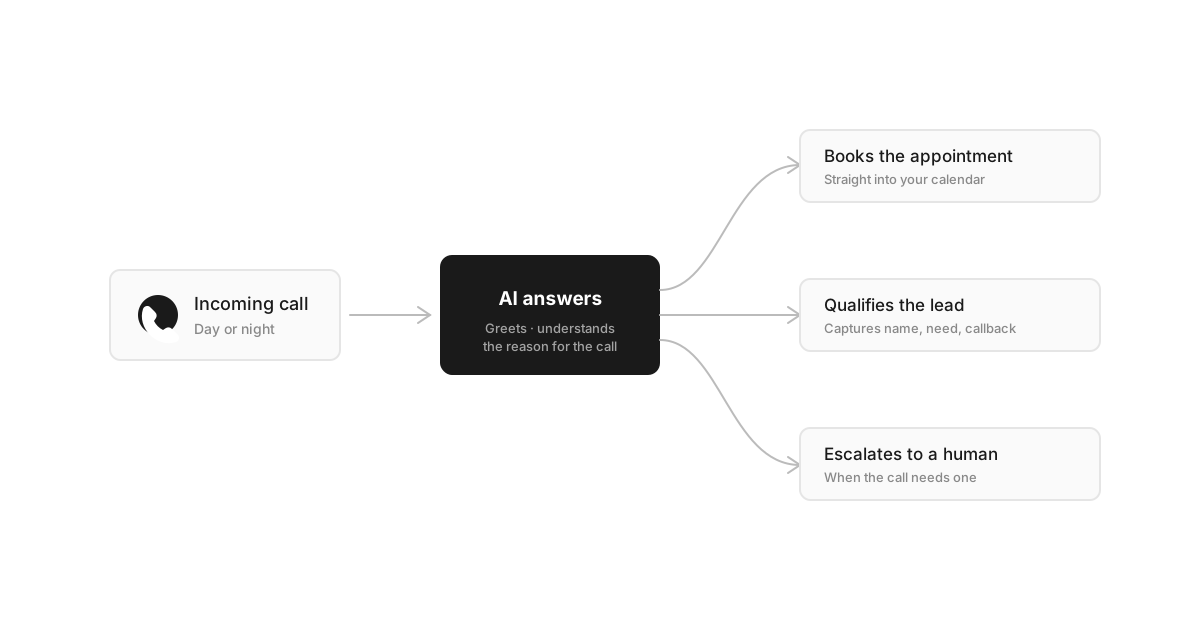
For the typical small business (a dental office, a plumbing company, a salon, a law firm) the job breaks down into a large, repetitive core and a small, hard tail. The core is answering, booking, confirming, taking messages, and answering the same ten questions about hours, location and pricing. The tail is the angry caller, the unusual request, the conversation that needs a person who can read the room. AI eats the core. It chokes on the tail. Everything below is just detail on that.
And if you've already made the call and what you actually need is the mechanics - which tasks move first, how to switch without dropping callers - we've written the practical companion to this article: how to replace a front desk receptionist with AI, step by step. This piece is the should you; that one is the how.
Where AI genuinely wins
These aren't marketing claims. They're the places where the economics and the technology line up so clearly that a human front desk simply can't compete.
- It never misses a call.A human receptionist is on one line at a time, takes lunch, goes home at five, and can't answer three phones at once. An AI answers every call on the first ring, at 2 a.m., during the rush, in parallel. For most small businesses the honest baseline isn't a perfectly staffed desk. It's a chunk of calls going to voicemail and never calling back.
- It responds instantly, which is where money is won. Decades of sales research, including HBR's classic study on lead response time, show that the odds of qualifying a lead collapse within minutes of first contact. An AI that picks up on ring one and books the job on the spot beats a callback an hour later, every time.
- It's consistent. It never has a bad day, never forgets to ask for the callback number, never gives a different answer than the one before. Routine quality is exactly the kind of thing software is good at and tired humans are not.
- It's cheap and flat-rate.No salary, no benefits, no overtime for nights and weekends, no per-minute answering-service bill that spikes in your busy season. For coverage you were never going to staff anyway, the cost comparison isn't close. (If you're weighing the outsourced options against each other, see our AI vs. virtual receptionist vs. answering service comparison.)

Where AI still loses
If we stopped at the section above, we'd be doing the thing we said we wouldn't. Here is the other half, plainly.

- Empathy in real situations.A frightened patient, a customer whose order went wrong, someone calling about a sensitive matter: these people want to feel heard by a human. An AI can be polite and even warm, but it doesn't actually care, and on calls where that matters, people can tell.
- Genuine edge cases and judgment.The request that doesn't fit any script, the exception only the owner can approve, the "it's complicated" situation: these need someone who can improvise and take responsibility. An AI should recognize it's out of its depth and hand off, not bluff.
- Hard audio and messy speech. A bad connection, heavy background noise, strong accents, people talking over each other, callers who ramble: all of it degrades accuracy. Humans fill these gaps with context. AI is improving fast but still mishears more than a person in the same room would.
- Trust, for some callers.A share of people simply don't want to talk to a machine and will be annoyed to discover they did, especially if it wasn't disclosed. That reaction is real and worth respecting, not engineering around.
None of this is a reason to avoid the technology. It's a reason to deploy it with a clear-eyed view of its job description, and an escape hatch for the calls it shouldn't be handling.
Side by side
The same comparison, condensed. "It depends" is doing real work in a couple of these rows, and that's the point.
AI receptionist vs. human front desk, by job
| Task | AI receptionist | Human receptionist |
|---|---|---|
| Answer every call, 24/7 | Excellent | Limited by hours & headcount |
| Instant pickup during a rush | Excellent (answers in parallel) | Poor (one line at a time) |
| Routine booking & confirmations | Excellent | Good |
| Answering repeat FAQs | Excellent | Good, but tedious |
| Cost for nights & weekends | Flat fee | Overtime / extra staff |
| Empathy on a hard call | Weak | Excellent |
| Unusual requests & judgment | Weak (should escalate) | Excellent |
| Noisy line / strong accent | Fair, improving | Good |
| Upselling & reading the room | Limited | Strong with a good hire |
How to deploy it honestly
The businesses that are happiest with an AI receptionist treat it as a layer over their phone line, not a replacement for their team. A practical setup:
- Start with overflow and after-hours. Point missed calls, busy signals and nights or weekends at the AI first. This is pure upside, because those calls were going to voicemail anyway, and it lets you judge quality on real calls before trusting it with more.
- Give it a clean escalation path.Decide what it does when it's out of its depth: warm-transfer to whoever's on, or take a detailed message and text you a summary immediately. An AI that knows when to step back beats a more capable one that doesn't.
- Disclose that it's an AI.A short, natural line up front isn't just decent. Depending on where you operate and how you record calls, clear disclosure can also be a legal expectation. See the FTC's guidance on clear and conspicuous disclosure for the spirit of it, and check your local rules.
- Read the transcripts for the first few weeks.Every call should leave a summary. Skim them, find the spots where it stumbled, and tighten the script. The product gets better the more you treat it like a new hire in training, not a set-and-forget box. If you're writing that script yourself, our AI receptionist prompt templates are free to copy.
That's the philosophy; the full week-by-week rollout - audit, parallel run, promotion, and the mistakes that sink it - is laid out in our step-by-step transition plan.
When you should not use one
Against our own commercial interest: an AI receptionist is the wrong tool if your call volume is tiny and you genuinely answer every call yourself, because the problem you'd be solving doesn't exist yet. It's also a poor fit if nearly every call is high-stakes, emotional or deeply non-standard, where the value isthe human on the line. And if you can't commit to a working escalation path, don't deploy one at all. An AI that traps callers with no way to reach a person does more brand damage than a missed call ever would.
For everyone in the wide middle (businesses drowning in routine calls, bleeding leads after hours, paying people to answer the same questions all day) the math is straightforward. You're not replacing your receptionist. You're giving them back the calls that actually need a human, and handing the rest to something that never sleeps. If that's you, see what our AI receptionist can do, how the setup and pricing work, and judge it on your own calls.
Frequently asked questions
Can an AI receptionist fully replace a human receptionist?
For most small businesses, no, and you probably shouldn't want it to. It can replace the part of the job that is missed calls, after-hours coverage, repetitive booking and basic FAQs, which is often 70 to 80% of call volume. The remaining calls (judgment, empathy, messy edge cases, upset customers) are still better handled by a person. The realistic win is a hybrid: AI takes everything it can, a human takes what's left.
Will callers know they're talking to an AI?
Often not on a routine booking call, because modern voices are natural and the conversation is short. But some callers will notice, especially on complex or emotional calls, and a few simply dislike talking to a machine. The honest move is not to deceive: a brief, natural disclosure early in the call costs you almost nothing and protects trust.
What happens on a call the AI can't handle?
A well-configured AI receptionist should recognize its limits and escalate, either transferring to a human if someone is available, or taking a detailed message and texting you a summary so you can call back fast. The failure mode to avoid is an AI that loops, stalls, or pretends to help when it can't. Escalation paths matter more than raw capability.
Will AI replace receptionists as a job?
Partially, and unevenly. The phone-heavy version of the role - answering, booking, message-taking - is already being automated, and businesses that would have hired for the phones increasingly buy software instead. But the receptionist job was never only the phone: greeting walk-ins, paperwork, payments, and reading the person at the counter don't automate with a voice agent. What we actually see is the role shifting toward the in-person half while AI absorbs the call volume - fewer pure phone-answering jobs, not the disappearance of front desks.
Is an AI receptionist cheaper than hiring someone?
Almost always, on raw cost. A full-time receptionist is a salary plus benefits, an answering service bills per minute or per call, and an AI receptionist is a flat monthly fee that covers nights, weekends and overflow without overtime. The fair comparison, though, isn't 'AI vs. a great receptionist.' It's 'AI vs. the calls you're currently missing entirely,' which for many small businesses is the real status quo.