

Every answering service in the United States says it is bilingual. Put the pages side by side and the word turns out to describe four different things: a Spanish speaker who picks up, an English speaker who transfers you, a three-way call with an interpreter, or software. They do not cost the same, they are not open the same hours, and only some of them survive a caller who switches language halfway through a sentence. We sell the software kind, so read this with that in mind - we have linked every vendor claim to the vendor's own page so you can check us.
Our articles are still written by humans!
Get human written articles in your Google feed.
The short answer
A bilingual answering servicetakes your calls in English and at least one other language, which in the US nearly always means Spanish. The need is not marginal. The Census Bureau's most recent language report counted 41.8 million people aged five and over who spoke Spanish at home in 2019, of whom 61.4% reported speaking English "very well" - which leaves roughly four in ten who did not. The 2024 American Community Survey (table C16001) puts the figure at 44.9 million Spanish speakers, 18.4 million of whom speak English less than "very well".
If you only remember one thing from this guide: the price difference between vendors is smaller than the difference in what happens to a Spanish-speaking caller at 9 p.m. on a Saturday. Some services answer in Spanish. Some play a Spanish voicemail greeting. You find out which by reading the hours on the vendor's own bilingual page, and then by calling.
Four things "bilingual" can mean
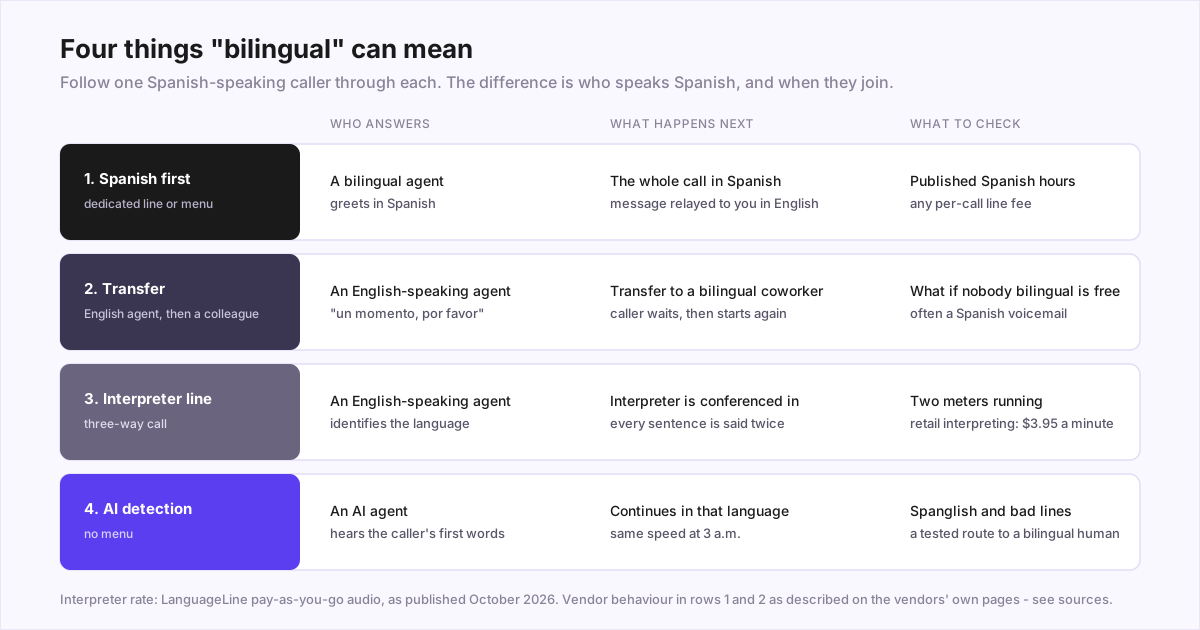
The four delivery models behind the word “bilingual”
| Model | What the caller experiences | Where it breaks |
|---|---|---|
| 1. Spanish-speaking agent answers first | A menu (“para español, oprima 2”) or a separate number routes the call to a bilingual agent, who greets in Spanish | Only as good as the staffing rota - check the published Spanish hours. A dedicated line can carry a per-call fee |
| 2. English agent, then a transfer | An English-speaking agent answers, hears Spanish, says “un momento, por favor” and transfers to a bilingual colleague | The caller's first experience is not being understood. If no bilingual agent is free, the fallback is often voicemail |
| 3. Third-party interpreter line | The agent identifies the language, dials an interpreting service and runs a three-way call; every sentence is spoken twice | Slow and metered twice - the answering service's minutes plus the interpreter's. Realistic for rare languages, expensive for Spanish volume |
| 4. AI language detection | The agent greets, hears the caller's first words and continues in that language without a menu | Code-switching, strong regional accents, bad lines. Needs a tested route to a bilingual human |
None of these is dishonest. The problem is that a landing page rarely says which one you are buying, and the two cheapest-looking options - model 2 with thin staffing, and model 3 for a language your callers use every day - are the ones that feel worst to the caller.
Ruby is unusually direct about running model 2. Its bilingual page states that "not all Ruby receptionists are bilingual", and that a receptionist who only speaks English will say "un momento, por favor" and transfer the call to a bilingual coworker. That is a clear description of what you get, and more than most vendors offer.
What vendors actually publish
We read the bilingual, pricing and help pages of the services below on October 1, 2026 and recorded only what each company states about itself. Where a company publishes nothing on a point, the table says so rather than guessing. Vendors change these pages; follow the link before you rely on a row.
Spanish coverage as published by each vendor (checked October 1, 2026)
| Service | Spanish hours | Extra cost for Spanish | How the caller reaches Spanish |
|---|---|---|---|
| Ruby | Bilingual page says 24/7 for incoming calls; its FAQ elsewhere gives weekday hours for bilingual service - ask which applies to your plan | Included in all plans at no additional cost | English-speaking receptionist transfers to a bilingual coworker |
| Smith.ai | Spanish-speaking agents online 24/7; if none is available the call goes to a voicemail with a Spanish greeting | Transfer to a Spanish-speaking agent at no extra cost; dedicated Spanish line is an add-on at $1.00 per call | Transfer by default; dedicated line works best behind a press-1/press-2 menu you set up yourself |
| PATLive | English 24/7; Spanish 8 a.m. to 10 p.m. Eastern | No extra charge | Auto attendant: press 1 for English, 2 for Spanish (help page). Messages are written in English |
| Posh | Monday to Friday, 8 a.m. to 6 p.m. Eastern; otherwise a Spanish voicemail greeting or an English-speaking receptionist | Included in all plans | Not published |
| Abby Connect | Day and night, weekends and holidays; overnight calls can go to its AI receptionist, human receptionists, or both | Included on every plan at no additional charge | Not published |
| AnswerConnect | Bilingual receptionists “around the clock” | Add-on with “a small additional charge per month”; amount not published | Two tiers: transfer from an English-speaking associate, or direct routing to a bilingual receptionist when one is available |
| AnswerForce | 24/7 in English and Spanish | Part of the monthly plan | Not published |
| ReceptionHQ | English around the clock; Spanish during core business hours | After-hours surcharges apply to bilingual answering on weekends and federal holidays | Not published |
| AnsweringService.com | English 24 hours; Spanish 5 a.m. to 8 p.m. Mountain time | Not published | Not published |
Three patterns are worth pulling out of that table.
- "Included at no extra cost" is now the norm. Five of the nine say so in writing. If a salesperson quotes you a Spanish surcharge, you have alternatives.
- Hours are the real variable.Four of the nine publish Spanish coverage that is narrower than their English coverage. A plumber whose emergency calls arrive at night is buying something quite different from PATLive than from a service staffed in Spanish around the clock - and both pages say "bilingual" at the top.
- The message comes back in English.PATLive states that all messages are written in English even when the call was in Spanish, and Ruby says it relays the message back in English. That is usually what an English-speaking owner wants, but it means the quality of the translation in the message is the agent's, and you will not see the original words.

Interpreter lines: the real numbers
For languages other than Spanish, most services either do not offer anything or bring in a telephone interpreter. Anserve says so plainly: live Spanish-speaking agents, plus "access to over 200 additional languages through professional interpretation services". It is a legitimate model, and it is worth knowing what it costs when you buy it directly.
Published telephone interpreting rates (checked October 1, 2026)
| Provider | Published rate | Notes |
|---|---|---|
| LanguageLine, pay-as-you-go | $3.95 per minute, audio | No contract, setup fee or monthly minimum. Retail rate for occasional users |
| LanguageLine, Minnesota state contract | $1.05 per minute, phone | Shows how far a volume contract sits below retail. Not available to you; useful as a benchmark |
| Propio Pass | $1,000 for 1,000 minutes | Prepaid; unused minutes expire after 12 months. Interpreters for popular languages “typically found in 30 seconds or less” |
| Certified Languages International | Not published | Per-minute price depends on estimated monthly volume and language mix |
Two mechanical points matter more than the rate. First, an interpreted call is consecutive: the caller speaks, the interpreter repeats it, the agent answers, the interpreter repeats that. Every sentence is said twice, so the call is longer, and if your answering service bills by the minute you are paying its meter and the interpreter's at the same time. We have not found a credible published figure for how much longer, so we are not going to give you one.
Second, the traditional workflow puts the delay at the worst moment. LanguageLine's own description of it is that "staff often answer the call first, identify the caller's language, and then connect an interpreter, creating delays and added complexity" . For a Vietnamese-speaking caller once a month that is an acceptable trade. For Spanish in Houston it is not.
AI: where it is good, and where it is not
This is the model we build, so here is the evidence in both directions.
The case for it
On clean, single-language speech, recognition accuracy in Spanish is not the weak link. The paper that introduced OpenAI's Whisper model reports word error rates for its large-v2 model of 4.2% in English and 3.0% in Spanish on the FLEURS benchmark, and 9.4% against 5.6% on Common Voice. Spanish is among the best-served languages in every major speech stack. Add the two structural advantages of software - the Spanish "shift" never ends, and the tenth simultaneous caller gets the same answer speed as the first - and you have a real answer to the coverage-hours problem in the table above.
The case against it
Real callers do not speak benchmark Spanish. In a 2023 Pew Research Center survey, 63% of US Latinos said they use Spanglish at least sometimes, and 40% said they do so often. That is exactly the condition speech recognition handles worst. A 2025 study of code-switching measured Whisper large-v3 at a 4.9% word error rate on monolingual Spanish and 29.4% on a Spanish-English code-switched telephone corpus. Part of that gap is the telephone audio rather than the switching, as the comparison is between read speech and conversational calls - but a phone line is where an answering service lives, so the combined number is the relevant one.
Automatic language detection has its own failure mode. The platform our own agents run on documents that its language-detection tool "is not enabled automatically" and warns that "background speech or an unusual accent can occasionally trigger a switch the caller did not intend". A television in Spanish behind an English-speaking caller is a realistic way to produce that. It is fixable in configuration, and it is a thing to test rather than assume.
How detection and voice work in practice, and how to configure the hand-off, is covered in our bilingual AI receptionist guide; the list of supported languages is in what languages an AI receptionist can speak.
What happens to Spanish callers today
There is surprisingly little published research on what English-only phone lines cost ordinary businesses, and we are not going to quote a vendor statistic to fill the gap. The best evidence comes from healthcare, where researchers have run the experiment properly.
In a cross-sectional audit study published in JAMA Network Open in 2024, trained callers posing as new patients rang 479 clinic numbers 985 times in English, Spanish and Mandarin, asking for a cancer care appointment. English-speaking callers got an appointment date or scheduling information on 61.4% of calls. Spanish-speaking callers did on 36.4%. Mandarin-speaking callers did on 19.0%. Nearly half of the Spanish and Mandarin calls - 291 of 586 - ended because of a language barrier, and the authors broke that down:
- 151 calls: the caller was told no, or was hung up on.
- 110 calls: the caller was disconnected because an automated message needed input and gave no instructions in their language.
- 30 calls: the caller reached interpreter services and still could not get further help.
These were hospital-affiliated clinics with language-access obligations and budgets, not small businesses. Read the three bullets as a list of what to test for: a person who cannot cope, a menu that only speaks English, and an interpreter hand-off that technically happens and practically fails. All three exist in answering services too.
When language is a legal question
Most private businesses have no general federal obligation to answer the phone in Spanish, and a lot of marketing copy in this space overstates the law. The landscape also changed in 2025, so older articles are unreliable. Executive Order 14224 revoked Executive Order 13166, the 2000 order behind most federal limited-English-proficiency guidance, and the Department of Justice has since rescinded its guidance under it. The points below are the narrower rules that still apply on their own terms. This is general information, not legal advice.
- Healthcare that receives federal funds. Under 45 CFR 92.201, a covered entity "must take reasonable steps to provide meaningful access to each individual with limited English proficiency", and where interpreting is the reasonable step it "must offer a qualified interpreter". The same section says that when machine translation is used for text that is critical to a person's rights, benefits or meaningful access, "the translation must be reviewed by a qualified human translator". That sentence is written about translated text; the rule does not address AI voice agents directly, and whether an AI phone agent satisfies the interpreter requirement is a question for your compliance counsel, not for a vendor.
- California contracts. Civil Code section 1632 applies to a business that "negotiates primarily in Spanish, Chinese, Tagalog, Vietnamese, or Korean" when entering certain agreements - among them auto and retail instalment contracts, consumer loans, residential leases longer than a month and legal services fee agreements. The business must hand over a translation of the contract before it is signed. If your answering service negotiates terms in Spanish on your behalf, that can be what triggers the duty.
- Door-to-door and similar sales.The FTC's Cooling-Off Rule, 16 CFR 429.1, makes it an unfair practice to fail to give the buyer a contract "in the same language, e.g., Spanish, as that principally used in the oral sales presentation".
The practical rule that falls out of all three: a script in any language should take the message, book the visit and answer factual questions. It should not quote binding terms in a language your paperwork does not exist in.
The five-call test
Demos are run in English by a salesperson at 2 p.m. on a Tuesday. Run these five calls yourself, or have a Spanish-speaking employee or friend run them, on a trial account before you commit. Each one targets a failure from the sections above.
- Saturday, 9 p.m., Spanish only. Say nothing in English. Time how long it takes until someone - or something - answers you in Spanish. A Spanish voicemail greeting is a fail for an emergency trade.
- The Spanglish call."Hola, necesito un appointment para el lunes, pero no sé si mi insurance lo cubre." Check whether the request and the day survive into the message you receive.
- Names and numbers. Give a two-surname name, a street name with an ñ or an accent, and a phone number read the Spanish way, in pairs. This is where bookings quietly go wrong: the call sounds fine and the callback number is off by a digit.
- Read the message. Compare what you said with what arrived in English. You are testing the translation in the summary, which is the only part of the call you will ever see.
- Ask for a person."¿Puedo hablar con una persona?" Whatever answered, find out what happens next and how long it takes. With an AI agent this is the most important of the five (how transfers to a human work).
Five calls take under an hour and tell you more than any comparison table, including the one in this article.
Which model fits which business
Matching the delivery model to your call pattern
| Your situation | What tends to fit | Why |
|---|---|---|
| A steady share of Spanish calls, mostly in business hours | A live service that includes Spanish at no extra cost and routes directly to a bilingual agent | Human nuance where it helps most; limited Spanish hours do not hurt you |
| Spanish calls at night and weekends - emergency trades, towing, property management | A service that publishes 24/7 Spanish staffing, or an AI agent with a bilingual human escalation | Coverage hours are the constraint, and several live services stop staffing Spanish in the evening |
| Occasional calls in many languages | Any solid English and Spanish service, plus an interpreter line used on demand | At a few calls a month, $3.95 a minute is cheaper than a specialist plan |
| Healthcare, legal, or anything where the words carry liability | Qualified bilingual staff or a qualified interpreter for the substantive conversation; scripts and AI for scheduling and intake only | The legal standards above are about accuracy and qualification, not availability |
| Callers who mix English and Spanish freely | A bilingual human first, or an AI agent you have personally tested with code-switched calls | This is the measured weak point of speech recognition |
For the money side, per-minute and per-call billing are explained in our answering service cost guide, and our own flat monthly plans, which include Spanish and the other supported languages without a surcharge, are on the pricing page. If nights and weekends are the gap, the after-hours answering guide covers how to split coverage between a daytime team and an overnight service.
Frequently asked questions
What is a bilingual answering service?
It is an answering service that can handle a caller in more than one language - in the US that almost always means English and Spanish. The phrase hides four different delivery models: a Spanish-speaking agent answers first, an English-speaking agent answers and transfers to a bilingual colleague, an agent conferences in a third-party telephone interpreter, or an AI agent detects the language and replies in it. They differ in wait time, hours of coverage and cost, so ask a vendor which one you are buying before you compare prices.
Does a bilingual answering service cost extra?
It depends on the vendor, and the published answers vary. As of October 2026 Ruby, Abby Connect, PATLive, Posh and AnswerForce state that English and Spanish answering is included in their plans at no extra charge. Smith.ai transfers Spanish callers to a Spanish-speaking agent at no extra cost but charges $1.00 per call for a dedicated Spanish line. AnswerConnect describes bilingual routing as an add-on with a small additional monthly charge and does not publish the amount. The larger cost difference is usually hours, not surcharge: several services staff Spanish only during the business day.
Are Spanish-speaking agents available 24/7?
Not everywhere. PATLive publishes English coverage 24/7 and Spanish from 8 a.m. to 10 p.m. Eastern. Posh publishes bilingual receptionists Monday to Friday, 8 a.m. to 6 p.m. Eastern, with a Spanish voicemail greeting or an English-speaking receptionist outside those hours. AnsweringService.com publishes Spanish from 5 a.m. to 8 p.m. Mountain time, and ReceptionHQ publishes Spanish during core business hours. Others, including Abby Connect, AnswerForce and Smith.ai, state round-the-clock Spanish. Check the vendor's own page, then test it with a real call on a Saturday night.
How much does a telephone interpreter cost per minute?
Published retail rates are a few dollars a minute. LanguageLine's pay-as-you-go service lists $3.95 per minute for audio interpreting with no contract or monthly minimum, and Propio sells a prepaid block of 1,000 minutes for $1,000. Volume contracts are far cheaper - a Minnesota Department of Commerce contract sheet lists LanguageLine phone interpretation at $1.05 per minute. Interpreted calls are conducted consecutively, with each side waiting for the interpreter, so they also run longer than a same-language call.
Can an AI answering service handle Spanish?
For clean, single-language Spanish, yes - current speech recognition is roughly as accurate in Spanish as in English on standard benchmarks. The weak spot is code-switching. In a Pew Research Center survey 63% of US Latinos said they use Spanglish at least sometimes, and published research puts speech recognition error rates on Spanish-English code-switched telephone speech several times higher than on monolingual Spanish. A good setup lets a caller reach a bilingual human whenever the AI is struggling, and you should test it with the way your customers actually talk.
Is an interpreter or an AI enough to meet legal language requirements?
For most private businesses there is no general federal duty to answer the phone in Spanish. There are specific rules that do bite: health programs that receive federal funds must take reasonable steps to provide meaningful access under 45 CFR 92.201, including a qualified interpreter, and California Civil Code 1632 requires a translated contract when certain consumer agreements are negotiated primarily in Spanish, Chinese, Tagalog, Vietnamese or Korean. An answering service does not discharge either duty by itself. This is general information, not legal advice.
What about languages other than Spanish?
Most US answering services staff English and Spanish only. A few publish an interpreter layer for everything else: Anserve states it provides live Spanish-speaking agents plus access to over 200 additional languages through professional interpretation services, and AnswerNet states it employs native speakers of English, French and Spanish and uses a translation service for other languages. AI agents cover more languages out of the box - the platform we build on documents 31 - but accuracy varies by language, so the same advice applies: test the language your callers speak.
Sources
- U.S. Census Bureau: Language Use in the United States: 2019 (ACS-50, Dietrich and Hernandez, August 2022)
- U.S. Census Bureau: American Community Survey 2024 1-year estimates, table C16001, Language Spoken at Home for the Population 5 Years and Over
- Chen et al., Access to Cancer Care for Simulated English-, Spanish- and Mandarin-Speaking Patient Callers, JAMA Network Open 2024;7(6):e2415587
- Pew Research Center: Latinos' Views of and Experiences With the Spanish Language (September 20, 2023)
- Radford et al., Robust Speech Recognition via Large-Scale Weak Supervision (the Whisper paper), arXiv:2212.04356
- Ugan et al., PIER: A Novel Metric for Evaluating What Matters in Code-Switching, arXiv:2501.09512
- 45 CFR 92.201 - Meaningful access for individuals with limited English proficiency (eCFR)
- California Civil Code section 1632 - translation of contracts negotiated in Spanish, Chinese, Tagalog, Vietnamese or Korean
- 16 CFR 429.1 - FTC Cooling-Off Rule: contract in the language of the oral sales presentation (eCFR)
- Executive Order 14224, Designating English as the Official Language of the United States (Federal Register, March 6, 2025)
- LanguageLine Solutions: pay-as-you-go interpreting services (published per-minute rate)
- Minnesota Department of Commerce: LanguageLine contract information sheet (state contract per-minute rate)
- Propio Pass: prepaid interpreting minutes
- Smith.ai help center: Have all your calls answered by Spanish-speaking bilingual receptionists
- Ruby: bilingual answering service
- PATLive: bilingual receptionists
- Posh: bilingual answering service
- Abby Connect: bilingual answering
- AnswerConnect: bilingual answering service
- ElevenLabs Agents documentation: language detection system tool