

In a lot of American neighbourhoods, the call you're missing isn't after hours - it's in Spanish. A caller who reaches a line that can't serve them in their first language does the same thing anyone does: hangs up and dials someone who can. We build AI phone agents, so weigh this accordingly - but the underlying gap is large, measurable, and stubbornly under-served, which is exactly why it's worth writing about honestly.
The short answer
A bilingual AI receptionist answers your phone in more than one language - most commonly English and Spanish - understanding the caller, answering their questions, and booking their appointment in whichever language they speak. The best implementations don't make the caller choose from a menu; they open with a brief bilingual greeting, hear which language the caller uses, and mirror it for the rest of the conversation. And when the call is over, you get the booking and the notes in your language, so you serve a Spanish-speaking caller without having to speak Spanish yourself.
Why bilingual answering is a real gap
This isn't a rounding error in the market. According to the U.S. Census Bureau's language-use data, roughly 42 million people speak Spanish at home, and millions of them report speaking English less than "very well." For a business in Texas, California, Florida, or dozens of other markets, that isn't a niche - it's a large slice of the people dialling your number.
The behaviour of a caller who can't be served in their language is the same as any other missed call: they leave. Except this one is more predictable, because there's a clear reason and a clear alternative - the competitor down the road whose receptionist speaks Spanish. The cost of that is the same one we break down in our cost of a missed call guide, just with an extra filter on top: you're not only missing calls, you're systematically missing them from one community.
How a bilingual voice agent works
The experience that actually feels good to a caller isn't a phone tree. It's detection: the agent figures out the language from natural speech and adapts, the way a bilingual person would.
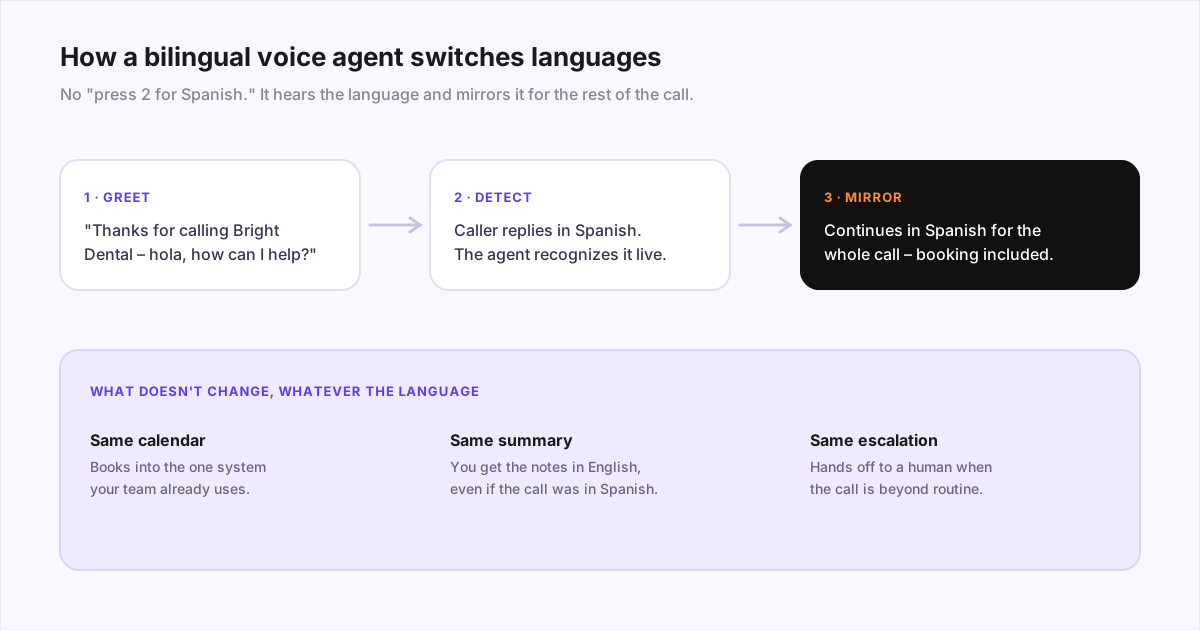
Under the hood, three things have to work in whichever language the caller chooses: it has to hear them accurately (speech-to-text that handles the language and accent), think in context (understand the request and your business rules), and speak back in a natural voice. The quality bar for the voice itself is the same one we set out in do AI voices sound human on the phone - and it applies per language: a voice that sounds natural in English but stilted in Spanish isn't bilingual, it's monolingual with a translation bolted on. Test both.
Bilingual AI vs. a bilingual human
The fair comparison isn't AI against a perfect fluent human who works every hour - it's AI against what you can actually staff. Seen that way, the trade-offs are clear:
Bilingual AI receptionist vs. a bilingual human receptionist
| Bilingual AI | Bilingual human | |
|---|---|---|
| Availability | Every hour, every language, in parallel | Their shift only; one call at a time |
| Hiring difficulty | None - it's built in | High - fluent bilingual staff are scarce and in demand |
| Routine calls (book, hours, FAQs) | Strong and consistent in both languages | Strong |
| Dialect & regional nuance | Good, improving; can miss heavy regional slang | Excellent - a native speaker just gets it |
| Emotional / sensitive calls | Should hand off to a person | Excellent - empathy and cultural context |
| Notes back to your team | Summary in your language automatically | Depends on the person taking notes |
| Cost | Flat monthly fee, no language premium | A salary, and often a premium for fluency |
The pattern is the one that runs through all of these comparisons: software wins on coverage, consistency, and cost for the routine majority; the human wins on the calls where empathy and cultural nuance close the deal. The strongest setup uses both - which we argue more fully in can an AI receptionist replace a human.
Beyond Spanish, and beyond a menu
Spanish is the headline case in the US, but the same capability extends further. A capable voice agent can handle a range of languages, which matters for markets with large Vietnamese, Mandarin, Tagalog, Portuguese, or Haitian Creole populations. The list of what's supported and how well is worth checking per vendor and per language - we keep a plain answer to what languages an AI receptionist can speak for exactly that reason.
The design principle that matters most: avoid the menu. "Press 1 for English, 2 for Spanish" is the old IVR pattern, and it's a small friction that quietly signals a second-class experience. Live language detection - the agent simply hears you and responds in kind - is the difference between a caller feeling served and a caller feeling processed. If you're weighing this against a traditional phone tree, we've untangled AI receptionist vs. IVR separately.
Where it still needs a human
Against our own interest, here's where bilingual AI is still catchable, and where pretending otherwise would be a disservice:
- Heavy regional dialect and slang. Spanish varies enormously - Mexican, Caribbean, Central American, Castilian. A good agent handles standard speech well, but thick regional idiom can trip it in a way a native speaker from that region never would.
- Emotional and sensitive calls. A frightened, grieving, or angry caller wants to feel met by a person who shares their language andtheir context. That's a handoff, not a script.
- Code-switching mid-sentence.Bilingual callers often blend languages fluidly within a single sentence. The better agents cope; it's still one of the harder edges to get perfectly smooth.
- Cultural nuance beyond the words. Tone, formality, and the unspoken expectations of a community are things a thoughtful human carries and a language model only approximates.
How to set it up well
- Lead with a bilingual greeting. A short opener that signals both languages lets the caller relax and reply in theirs - detection does the rest.
- Test each language like a real caller.Don't trust a demo. Call in Spanish, mumble a date, change your mind, and judge whether the voice and comprehension hold up - not just whether it technically responds.
- Set a bilingual escalation path.Decide which calls go to a person, and make sure that person can serve the caller's language too. A handoff to someone who can't help is worse than no handoff.
- Get your summaries in your language.Confirm the notes and bookings come back to your team in the language they work in, so a Spanish call doesn't become an English-speaking owner's guessing game.
The bottom line
In a large and growing share of American markets, "answer the phone" quietly means "answer it in more than one language," and the businesses that don't are handing a whole community to whoever does. A bilingual AI receptionist closes that gap for the routine calls that make up most of the day - fast, consistent, available every hour, and without the hiring struggle that kept bilingual reception out of reach. It won't replace a fluent human on the sensitive calls, and it shouldn't try. But it makes sure no caller hangs up simply because the line didn't speak their language.
If a real part of your community calls in Spanish, the cheapest experiment is to hear it for yourself. You can talk to our AI receptionist, try it in more than one language, and check the flat monthly pricing - the same whether the call comes in English or Spanish. Trust your own ears, in both.
Frequently asked questions
Can an AI receptionist answer calls in Spanish?
Yes. A modern AI voice agent can greet callers, understand them, answer questions, and book appointments in Spanish - and in many other languages - with a natural voice. The better systems detect the caller's language from their first words and continue the whole call in it, with no 'press 2 for Spanish' menu. For a business serving a bilingual community, that means a Spanish-speaking caller gets the same fast, complete service as an English-speaking one, on the same phone line.
Is a bilingual AI receptionist as good as a bilingual human?
For routine calls - bookings, hours, common questions, taking a message - a good bilingual AI is genuinely comparable, and it's available 24/7 without the hiring difficulty of finding fluent bilingual staff. Where a human still wins is nuance: heavy regional dialects, emotional or sensitive conversations, and cultural context that goes beyond the words. The honest setup is AI for the routine multilingual volume, with a clean handoff to a bilingual human when the call needs one.
How does the AI know which language to speak?
Two ways, often combined. It can open with a short bilingual greeting and then detect the language the caller responds in, switching automatically for the rest of the call - the smoothest experience. Or it can offer an explicit choice up front. The key is that detection happens live from natural speech, so most callers never have to navigate a menu; they just talk, and the agent mirrors their language.
Why does answering in Spanish matter for my business?
Roughly 42 million people in the US speak Spanish at home, per the Census Bureau, and a large share of business calls come from people who are far more comfortable - and more likely to book - in their first language. If a caller reaches a line that only handles English, many will simply hang up and call a competitor who speaks their language. Bilingual answering isn't a nicety in those markets; it's the difference between capturing the call and losing it.
Does the AI translate the call for me afterward?
Yes - this is one of the quiet advantages. Even when a call happens entirely in Spanish, a good AI receptionist can deliver you the summary, the booking, and the caller's details in English (or whichever language your team works in). So you serve a caller in their language without needing to speak it yourself, and you still get notes you can act on.