
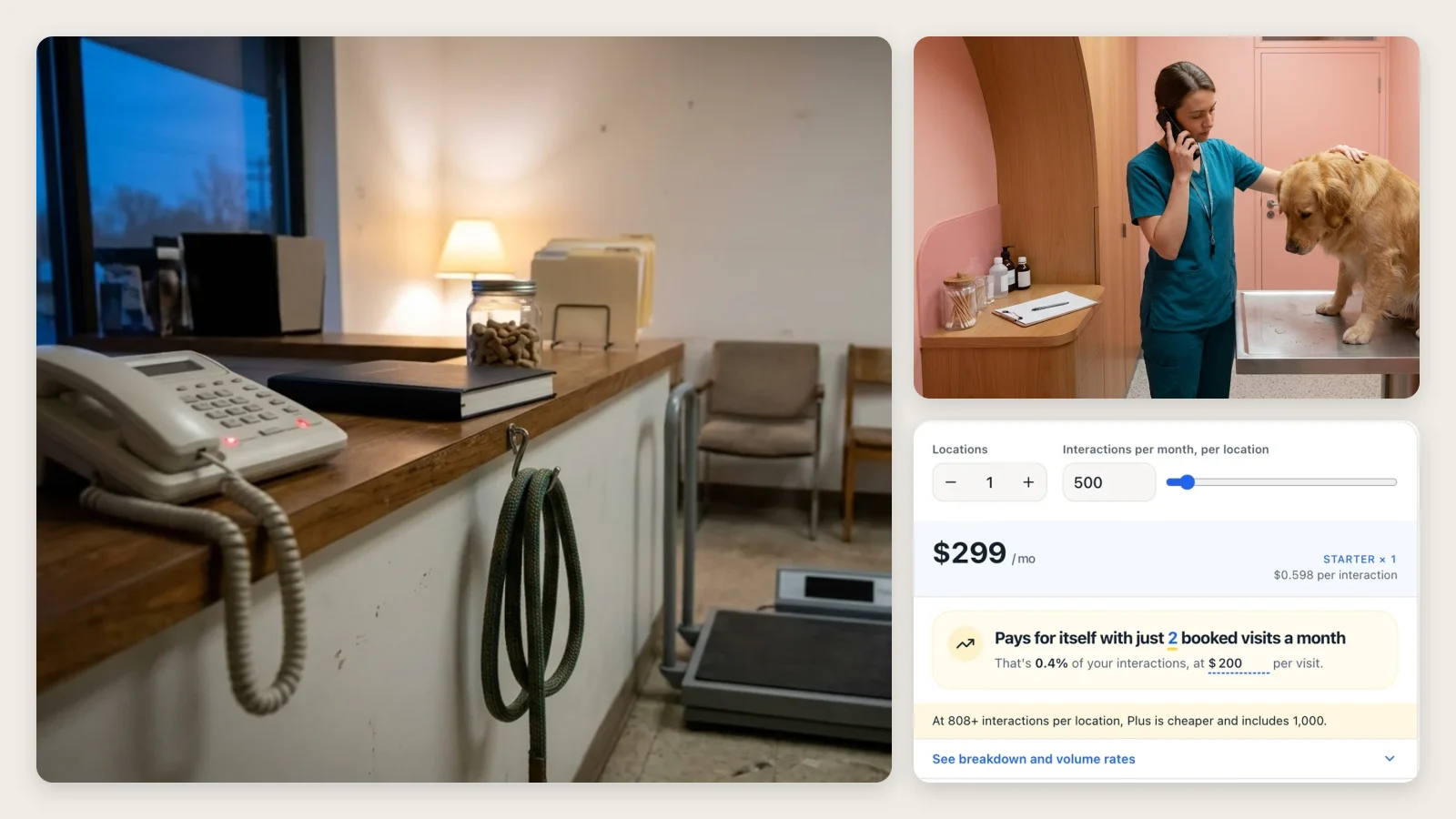
Search for the best AI answering service for veterinary clinics and the results are almost all vendor pages, plus a couple of ranked lists written by companies selling one. This is another ranked list from a company that sells one, so read it with that in mind. We make a general AI receptionist, and it comes last in this ranking. It does not write into ezyVet, Cornerstone or AVImark, and in this category that is the thing that matters. Every price and claim below was read on the vendor's own page on November 3, 2026. Where a vendor does not publish something, we say so rather than guess.
Our articles are still written by humans!
Get human written articles in your Google feed.
The short answer
For a one-to-three location small-animal practice that loses calls at lunch, after hours and during the 9 a.m. rush, the shortlist is:
- VetRec if you want to know the price before the demo. It has published plans, ten named PIMS and write-back.
- PupPilot if your PIMS is not one of the common ones, or if you want to try it for a week without signing anything.
- VetPawer AVA if you are a group and want a vendor that says it already runs in close to a thousand hospitals.
- Dodo if you run an emergency or specialty hospital.
- GuardianVets if the after-hours calls you lose are clinical questions. It is credentialed technicians, not AI.
- A general AI receptionist if you only need the phone answered after close and you are happy for the morning team to confirm bookings.
The ranking, in one table
Ordered for the clinic most likely to be reading this: a general small-animal practice with one to three locations. If your clinic is different, the order changes, which is what the "best when" column is for.
Six veterinary phone options, ranked for a small general practice (checked November 3, 2026)
| # | Product | Best when | Books into the PIMS? | Published price? |
|---|---|---|---|---|
| 1 | VetRec AI Receptionist | You want a price and a named PIMS list before the demo | Yes, 10 named | Yes, $299 or $499/mo per location |
| 2 | PupPilot | Your PIMS is less common, or you want a no-signature trial | Yes, 14 named, 130+ claimed | No |
| 3 | VetPawer AVA | You are a group and want a vendor with scale | Yes, 10 named | No |
| 4 | Dodo | You run an emergency or specialty hospital | Yes, reads and writes | No |
| 5 | GuardianVets (human) | Your after-hours calls are clinical questions | Says it integrates, none named | No |
| 6 | A general AI receptionist | You only need after-hours coverage and the PIMS is not the point | No, calendar only | Yes, typically $99 to €299/mo |
How we ranked these, and who we are
Most rankings for this query give no method, so here is ours.
- Only first-party claims count. Every figure comes from the vendor's own product or pricing page, read on November 3, 2026, and is linked at the bottom. We did not copy numbers from other lists. Several of them repeat integration claims that the vendors themselves do not make.
- Write access to the PIMS outranks everything else. An AI that books into your schedule removes work. One that emails a summary gives the front desk a to-do list. Both are marketed with the same headline.
- A published price is itself a signal. Cheap is not better. But a price page tells you which kind of clinic the vendor is built for. Demo-only pricing usually means quotes per location and an annual agreement.
- We disclose our own position. We sell a general AI receptionist. It books into Google Calendar, Outlook or Cal.com, not into a PIMS. That is why it is sixth. If you need PIMS write-back, the four AI products above ours are better choices.
What we did not do: score voice quality in a bake-off. It would be stale within a quarter, and voice is not what decides this purchase. The general case for evaluating any AI receptionist is in how to choose an AI receptionist.
The four rungs of booking a call
"Rosie is due for her vaccines, anything after five this week?" is the most common call a clinic gets. There are four different things an AI can do with it, and vendors describe all four with the word "integrates".
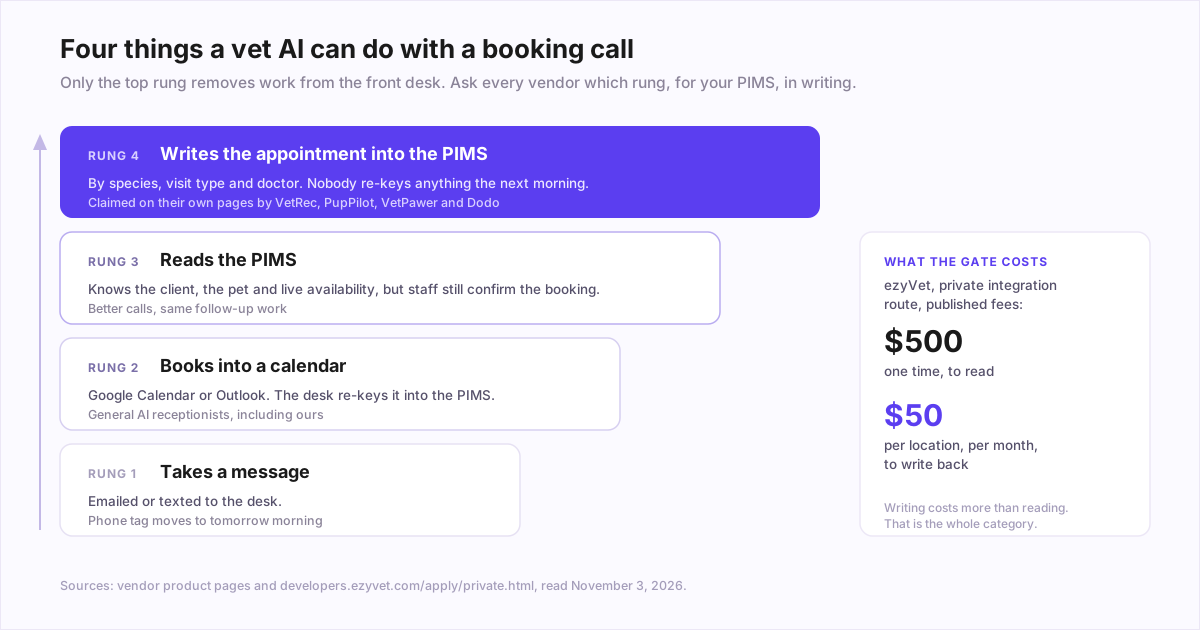
What goes wrong below rung 4 never shows up in the call recording. A dental cleaning booked as a 15-minute slot, a cat booked with the doctor who only sees large animals on Tuesdays, two new puppies in one exam room. You find these at 7:45 the next morning, when the day is already full. A product on rung 4 avoids them because the PIMS already knows the visit length, the provider and the room. A product on rung 2 cannot know them.
Rung 3 deserves a note. Recognising the caller and the pet ("Hi Marcus, is this about Rosie?") makes a good demo. But if staff still have to confirm and enter the booking, the front desk does the same work as before, just with better notes.
What the PIMS vendors charge to write
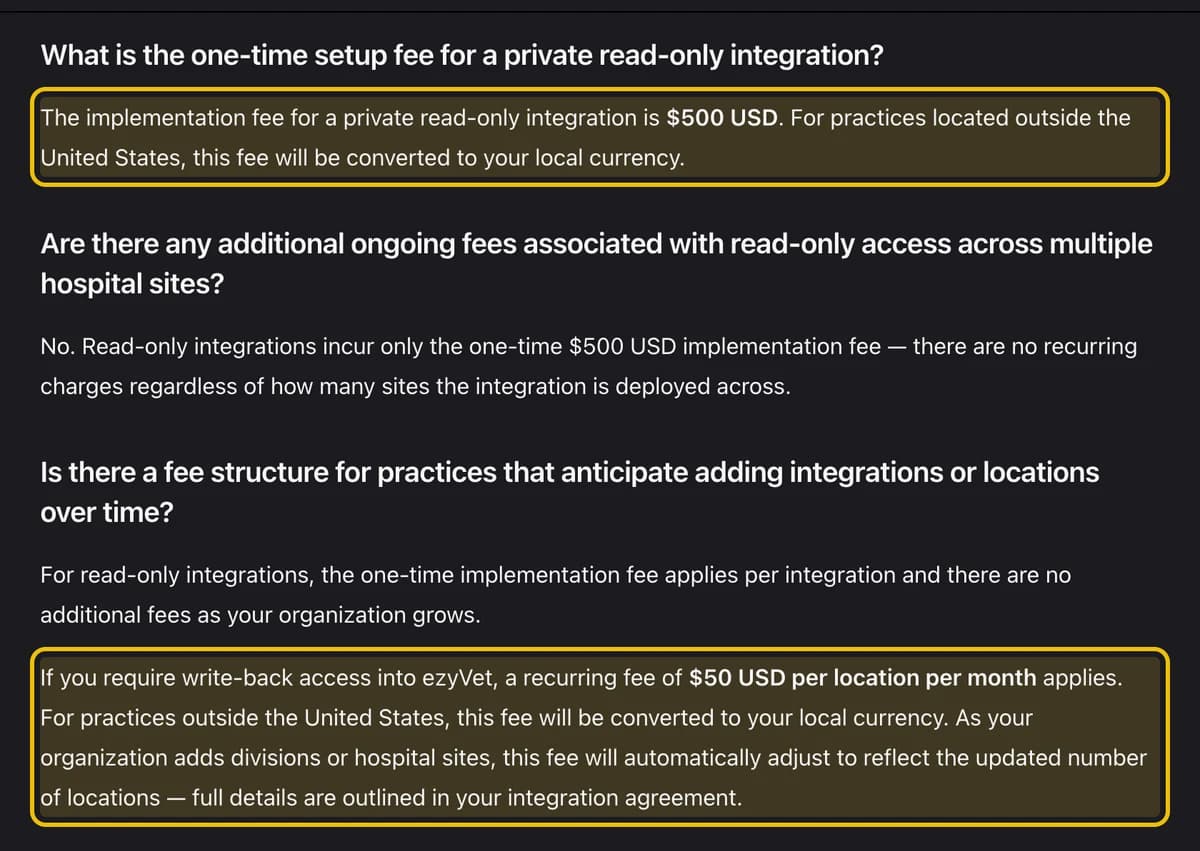
The reason so few products can honestly claim rung 4 is that the PIMS vendors control it, and they do not give it away. ezyVet, owned by IDEXX, is the clearest example because it publishes its terms.
On its private-integration route, meant for a practice or group building something for its own use, the implementation fee for a read-only integration is $500 and there are no further charges for reading. Writing is different: a "recurring fee of $50 USD per location per month applies" for write-back access, and each separate use case, such as reporting or booking, needs its own agreement and setup fee.
The commercial route, for vendors selling to many clinics, is a process rather than a price list. The partner must complete development, documentation and certification in the 6 months after signing, pass a 60-minute certification session, then find five clinics to pilot the integration for six weeks. Consultation fees are "stated in the partner agreement", which is not public.
The other systems are less open:
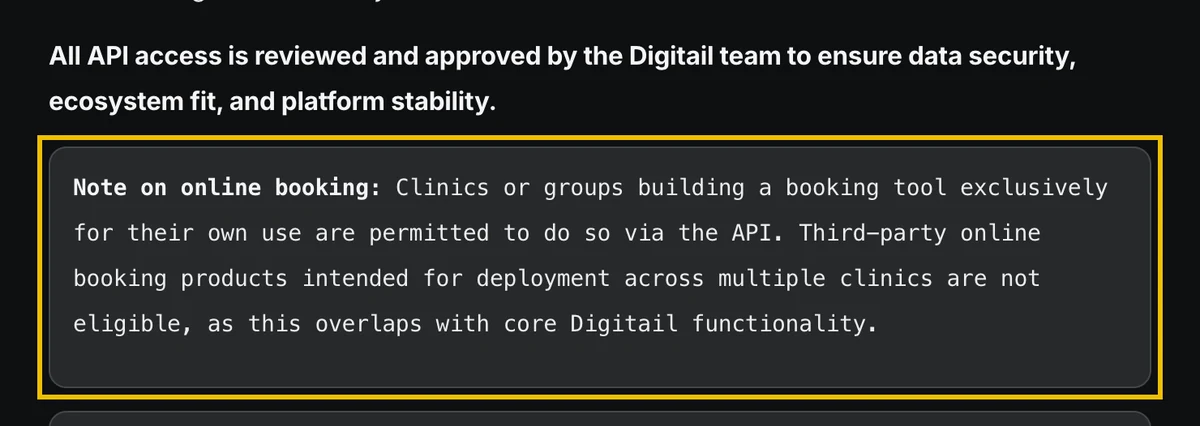
- Digitail publishes an API but excludes third-party online booking products deployed across multiple clinics, "as this overlaps with core Digitail functionality". VetRec and PupPilot both list Digitail anyway. Ask them on what terms.
- Covetrus (AVImark, Pulse, Impromed) describes its Connect API as a permissions-based integration platform, with no public fees or terms.
- Provet Cloud has public REST documentation, including a how-to for creating appointments, with access granted through a request form.
- IDEXX Cornerstone lists integration partners but publishes no API terms we could find.
The six, one at a time
1. VetRec AI Receptionist: the one with a price
VetRec also sells an AI scribe for veterinary records, and the receptionist sits alongside it. It is the only veterinary-specific vendor on our list that publishes full pricing.
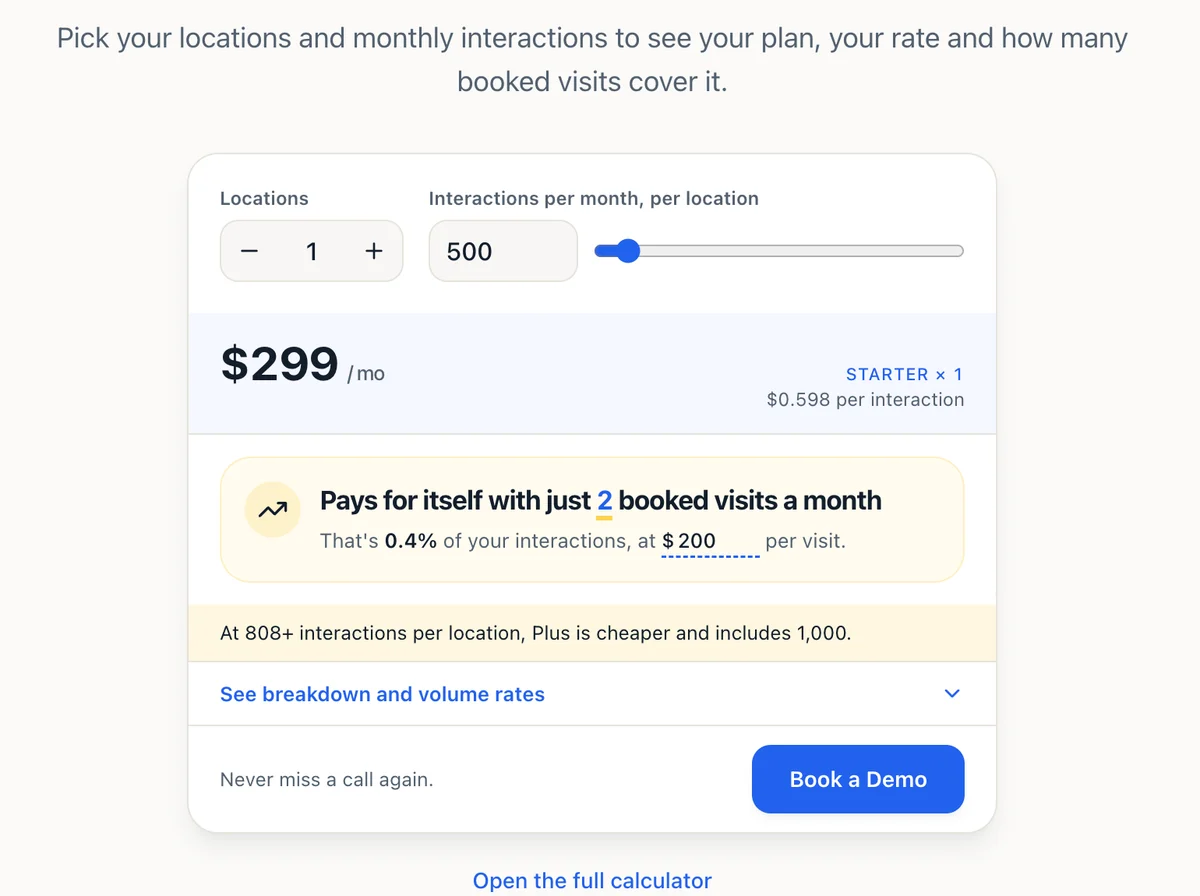
- Price: Starter $299 a month for up to 500 interactions, Plus $499 for up to 1,000, and "additional calls are $0.65 each" beyond the allowance. An online-booking-only plan is $99. The calculator prices interactions per month, per location, so a three-location group pays three times.
- PIMS: names Vetspire, ezyVet, Cornerstone, Instinct, AVImark, Impromed, Shepherd, Pulse, Provet and Digitail, and says it "writes everything back into your PIMS".
- Emergencies: urgent or sensitive calls "go to your team with the context attached".
- Watch: an interaction includes texts and web chat, not just calls, so a busy text line uses up your allowance. VetRec's own break-even note says Plus becomes cheaper at 808 interactions per location.
2. PupPilot: the widest PIMS list
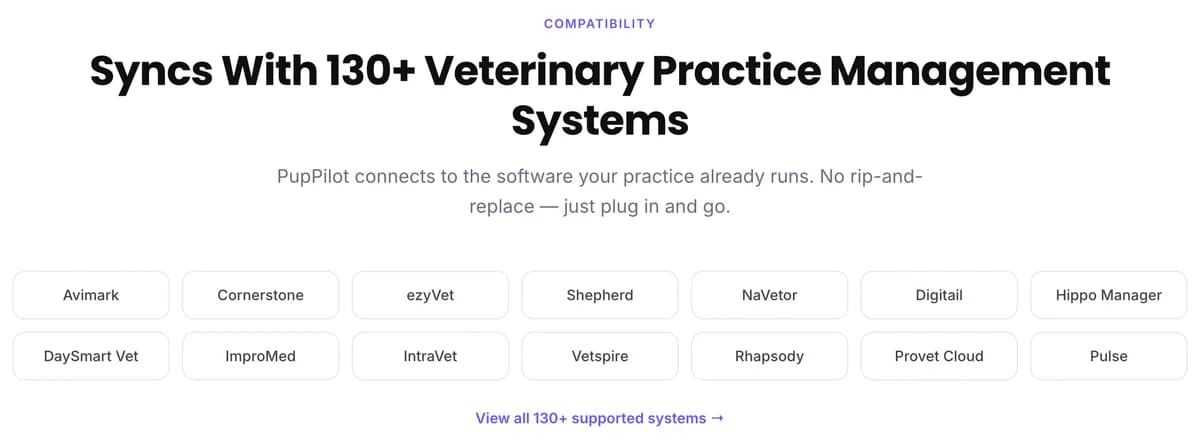
- PIMS: "PupPilot books appointments directly in your practice management software." It names AVImark, Cornerstone, ezyVet, Shepherd, NaVetor, Digitail, Hippo Manager, DaySmart Vet, ImproMed, IntraVet, Vetspire, Rhapsody, Provet Cloud and Pulse, and claims 130+ in total.
- Handoff: live transfer to your team with the caller's name, the patient and the reason on screen. A caller who asks for a person, or sounds frustrated, is moved to one immediately and added to an opt-out list for future calls. That is a detail other vendors leave out.
- Emergencies: routed "to your on-call vet according to your protocols". Non-urgent after-hours calls are booked for the next business day.
- Price: not published. Every clinic starts with a free one-week trial with nothing to sign, which is the lowest-risk start on this list.
3. VetPawer AVA: the one with scale
- Scale: claims 985+ veterinary hospitals and 300K+ appointments monthly. That is the largest deployment claim from any AI vendor here.
- PIMS: books "directly into your PIMS" and recognises the caller and their pets. It also sells outbound calling to lapsed clients.
- Terms: "No upfront costs or long-term contracts". VetPawer is the only vet-specific vendor here that puts contract terms on its homepage.
- Price and emergency handling: neither is described on the page. Ask how a red-flag call is routed before you sign.
4. Dodo: built for emergency hospitals
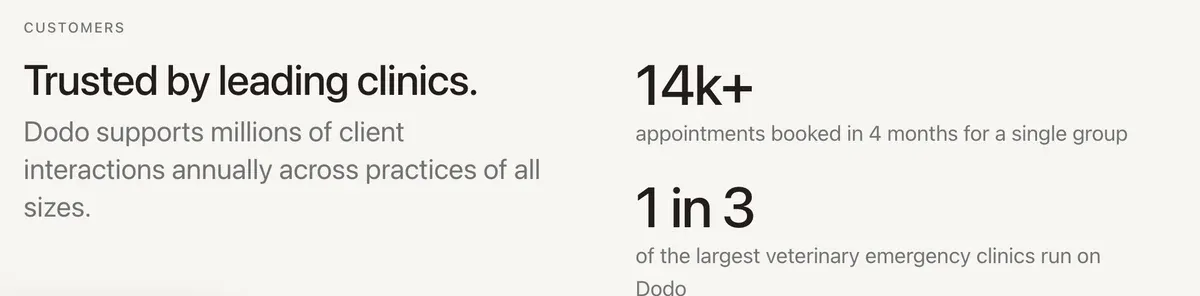
- Segment: claims 1 in 3 of the largest veterinary emergency clinics run on Dodo, and 14k+ appointments booked in four months for a single group.
- PIMS: "Reads and writes directly to your practice management system. Schedules, records, medications, notes." Books by species, visit type and provider availability.
- Emergencies: "Detects emergencies, provides ER info, and alerts your on-call team." It is the only one of the vet-specific vendors that says outright it gives the caller the ER details.
- Price: not published.
5. GuardianVets: people, not AI
GuardianVets is here because it solves a problem that no AI product should try to solve: a pet owner at 11 p.m. asking whether this can wait until morning.
- Who answers: "a real, U.S.-based Credentialed Veterinary Technician". The page gives a minimum of three to five years of clinical experience in one place and five in another. Clinical operations are led by a named chief medical officer, Dr. Lori Teller.
- Scale: claims 2.5 million after-hours cases triaged, nights and weekends.
- PIMS: says it connects "directly to your PIMS" so triage notes and appointments sync, but names no system on the homepage.
- Price: not published. You are paying for a credentialed person's time on every call, so expect more than any AI plan.
6. A general AI receptionist, including ours
This is the category we sell in. My AI Front Desk is $99 a month for 200 voice minutes, then about $0.25 a minute. Ours is €99 for 1,000 minutes on one line, or €299 for 3,000 minutes with three concurrent calls, and €0.09 a minute after that (pricing). Both book into a calendar, not a PIMS.
What you get is the phone answered after close and at lunch, the clinic's hours, directions and policies answered correctly, bookings and refill requests captured with species and reason, and an SMS summary of every call. Emergencies get the ER details your vets set, plus an urgent text to the on-call phone. What you do not get is a live transfer of the caller to the ER, or an appointment in ezyVet. Someone at the desk confirms it in the morning.
That is a real limitation, and for a clinic doing 80 calls a day it is the wrong product. For a two-doctor clinic whose real problem is the voicemail box after 6 p.m., it costs a fraction of everything above it.
Checked and not ranked
- Weave. A popular vet phone system. On its veterinary page the AI receptionist is still "Join the waitlist", while the site banner offers early access. Worth revisiting once it ships for vets.
- AgentZap. A general AI receptionist from $109 a month that says it books appointments directly into Covetrus Pulse through the API. Not veterinary-specific, and its page says it "triages emergencies", which is wording to test hard on a demo call. Worth a look if you run Pulse and want a published price.
- CallJess. Often listed for vets. Its site did not load for us on the day we checked, so we have nothing first-party to report.
What it costs, worked through
Take one clinic with 600 phone, text and chat interactions a month, averaging two and a half minutes each, and price it only where the published numbers allow it.
One location, 600 interactions a month (prices published November 3, 2026)
| Option | How it bills | Monthly cost | Books into |
|---|---|---|---|
| VetRec Starter | $299 for 500, then $0.65 each | $364 | Your PIMS |
| VetRec Plus | $499 for 1,000 | $499 (cheaper only above 808) | Your PIMS |
| My AI Front Desk | $99 for 200 minutes, then ~$0.25/min | ~$424 for 1,500 minutes | A calendar |
| AI Receptionist Now Team | €299 for 3,000 minutes | €299 | A calendar |
| PupPilot, VetPawer, Dodo, GuardianVets | Not published | Ask for a quote at your volume | Your PIMS (GuardianVets: not named) |
The interesting line is the first one. With PIMS write-back, VetRec costs less than the minute-based calendar product at this volume. Minute-based pricing gets expensive when clinic calls run long, and they do. For scale, the BLS puts the median wage of a veterinary assistant at $38,150 a year (May 2025), about $3,179 a month before benefits, and a credentialed technician at $47,380. Every hour a technician spends on hold-and-schedule calls is clinical time you are paying for and not getting.
When you ask the four demo-only vendors for a quote, ask three things: is it per location, what counts as an interaction or a minute, and is there a term or setup fee. Wider market rates for live and AI answering are in what an answering service costs.
Emergencies: what the AI may and may not say
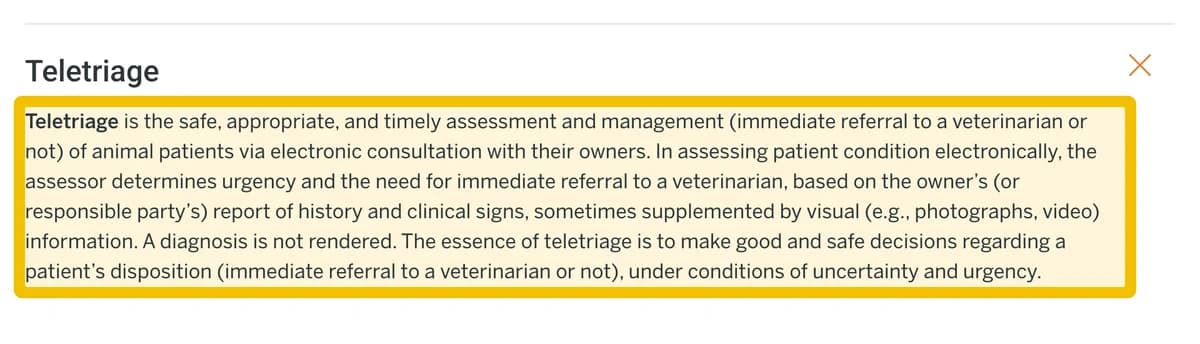
The AVMA defines teletriage as the assessment and management of animal patients by phone or video, deciding urgency and whether the animal needs a veterinarian now. It adds that "a diagnosis is not rendered". It is still a clinical judgement. That is what GuardianVets' technicians do, and it is what an AI must not do. None of the AI vendors we checked claims to. They all describe routing.
Routing still needs a list. Ask your veterinarians to write one. A good starting point is what veterinary teaching hospitals tell owners counts as an emergency. The UW-Madison School of Veterinary Medicine and the University of Missouri Veterinary Health Center both list signs like these:
Red flags that should send a caller to the ER immediately (from two veterinary teaching hospitals' owner guidance)
| Caller says | What the AI does |
|---|---|
| Trouble breathing, seizures | ER name, address and number in the first sentence; texts them; alerts the on-call phone |
| Retching but nothing comes up, belly suddenly large and tight | Same. In a medium or large dog this is the call every clinic fears most |
| Male cat straining in the litter box, or can't pass urine | Same. The caller often thinks it is constipation |
| Ate something toxic, or might have | ER plus a poison line: ASPCA (888) 426-4435 or Pet Poison Helpline (855) 764-7661 |
| Hit by a car, bleeding that won't stop, eye injury, difficult labour | ER details; capture the pet and callback number; alert the team |
| "Not eating since yesterday", limping, "just seems off" | Not a red flag on its own. First same-day slot, or a staff callback, as your vets decide |
| Euthanasia, end-of-life questions, grief | A person, immediately. No script past the handoff |
The poison lines are worth getting right in the script, because owners ask what they cost. The ASPCA Animal Poison Control Center says only that "a consultation fee may apply". Pet Poison Helpline states a $99 per-incident fee, with follow-up consultations included. Do not let the AI quote a number for the ASPCA line. It is not published.

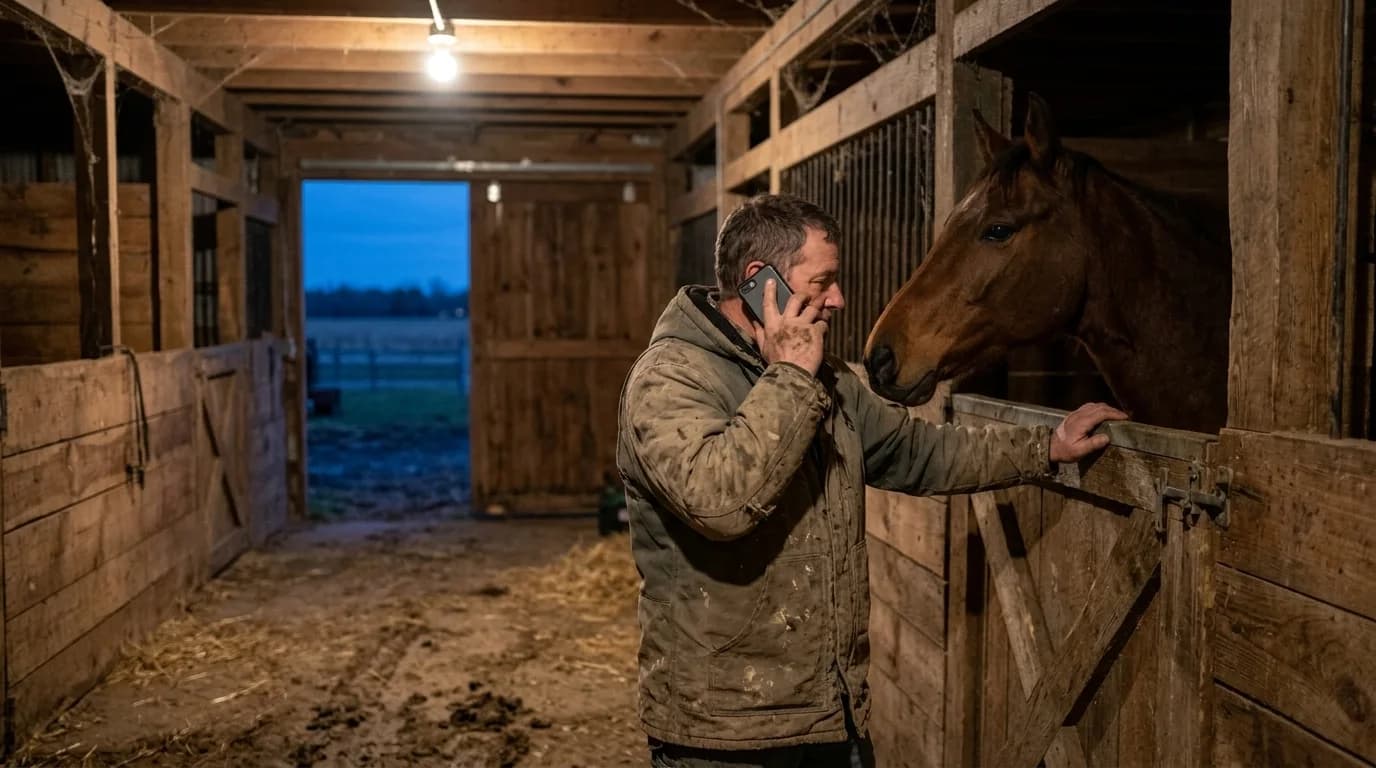
Mixed and large-animal practices are a different case. There is often no ER to send the caller to, so the AI's job becomes dispatching the on-call vet: where the animal is, which gate or barn, what the caller sees, and a callback number that has signal there.
We cover that, and the overflow setup, in our veterinary answering service guide.
The HIPAA badge on a vet product
VetRec's footer shows a HIPAA badge, and other vet vendors use the same language. That is fine, but it does not mean what clinics often assume. HIPAA protects health information about individuals, and the rule defines an individual as the person who is the subject of protected health information. A dog is not. Veterinary records are protected by state practice acts instead. Texas, for example, says a veterinarian may not violate the confidential relationship with a client.
So treat the badge as a statement about security, and read the contract for three things: how long call recordings are kept, whether they are used to train models, and whether you get them when you leave. A SOC 2 Type II report, which VetRec also displays, tells you more about security than a HIPAA logo does.
A fifteen-minute test call
VetRec publishes a live demo number and PupPilot lets you talk to its AI in the browser. Use them, or ask any vendor for a test line configured with your clinic's hours, and make five calls:
- The vaccine booking. "Rosie needs her boosters, anything after five on Thursday?" Then check the sandbox schedule. Did an appointment appear, with the right length, for the right doctor?
- The new client with two pets. A dog and a cat in one call. Does it book two patients or one?
- The gum call from the box above. Time how long before you hear an ER address.
- The question it cannot know. "Do you see rabbits?" A good agent says it will check and takes a number. A bad one makes something up, and it will make up prices too.
- "Can I talk to someone?" Say it once, politely. Where does the call go after hours, and what happens if nobody answers?
The more general version of this test, with the reasoning behind each step, is in AI voice agent vs chatbot vs IVR. We run the same kind of ranking for dental practices, where the PIMS gate works the same way and costs more.
When none of these is the answer
- Your problem is daytime capacity. If two people cannot keep up with 90 calls a day at the desk, an AI handling the overflow helps, but you are short a person. Hire, then automate the edges.
- Your clinical calls are the problem. If most after-hours calls are owners worried about symptoms, a technician-staffed line does the job and an AI does not.
- You are changing PIMS this year. Adding a voice agent in the same quarter means you will not know which change broke the schedule. Do the migration first.
- Nobody owns the knowledge base. Fees change, doctors' days change, the ER you refer to changes its hours. Someone has to update the AI every month, or it will answer with old information.
- A text-back would do. An automatic text to every missed call recovers a lot of bookings for very little. Here is how that works.
If the honest answer is that you just need the phone answered after 6 p.m. and at lunch, and the morning team can confirm bookings, that is the problem we built for. Forward only those hours, using conditional call forwarding, load your vets' red-flag list, and read two weeks of call summaries before you give it more.
Frequently asked questions
What is the best AI answering service for a veterinary clinic?
It depends on which job you need done, because these products differ far more in what they can write into your practice management system (PIMS) than in how they sound. For a one-to-three location general practice that wants a published price, VetRec is the most transparent: $299 a month for up to 500 interactions, per location, with write-back into ten named PIMS. If your PIMS is less common, PupPilot names the widest list. For larger groups, VetPawer claims 985+ hospitals. For emergency hospitals, Dodo targets that segment directly. If the after-hours problem is clinical questions rather than bookings, a credentialed-technician line such as GuardianVets is doing a different and legitimate job. Checked November 3, 2026.
Can an AI receptionist book directly into ezyVet, Cornerstone or AVImark?
Some say they can, and the important question is whether it reads or writes. VetRec, PupPilot, VetPawer and Dodo all say on their own pages that they book into the PIMS, and each names ezyVet, Cornerstone and AVImark among the systems. The PIMS vendors gate that access. ezyVet's published private-integration terms charge a one-time $500 for read-only access and a recurring $50 per location per month for write-back, and its commercial partner route requires development and certification within six months plus a six-week pilot at five sites. Ask any vendor in writing which of your systems it supports and whether it writes the appointment or only reads availability.
How much does an AI answering service for vets cost?
Only one veterinary-specific vendor in our shortlist publishes full pricing. VetRec charges $299 a month for up to 500 interactions or $499 for up to 1,000, with additional interactions at $0.65 each, priced per location. An interaction can be a call, a text or a web chat. PupPilot, VetPawer, Dodo and GuardianVets do not publish prices. General AI receptionists that book into a calendar rather than the PIMS start around $99 a month: My AI Front Desk is $99 for 200 voice minutes, and ours is €99 for 1,000 minutes. Prices checked November 3, 2026.
Can an AI answering service give triage advice to pet owners?
No, and you should reject any product that tries. The AVMA defines teletriage as assessing urgency and the need for immediate referral to a veterinarian, and notes that a diagnosis is not rendered. That assessment belongs to a trained person working from protocols, such as a credentialed veterinary technician. An AI receptionist should recognise red flags your veterinarians listed, such as trouble breathing, unproductive retching, a male cat straining to urinate, seizures, trauma or toxin ingestion, and immediately give the emergency hospital's details and alert the on-call team. None of the AI vendors we checked claims to give clinical advice. They all describe routing.
Does HIPAA apply to veterinary clinics?
Generally no. HIPAA protects health information about individuals, and the rule defines an individual as the person who is the subject of protected health information. A pet is not. Client records are still protected, by state veterinary practice acts rather than HIPAA. Texas, for example, says a veterinarian may not violate the confidential relationship with a client (Occupations Code §801.353). So a 'HIPAA compliant' badge on a veterinary AI product is a statement about the vendor's security posture, not a legal requirement for your clinic. What you should read instead is the contract: how long call recordings are kept, whether they train models, and what happens to them when you leave.
What should an AI do with a 2 a.m. poisoning call?
Give the caller two numbers in the first seconds and assess nothing. One is your designated emergency hospital. The other is a poison line: the ASPCA Animal Poison Control Center at (888) 426-4435, where a consultation fee may apply, or Pet Poison Helpline at (855) 764-7661, which charges $99 per incident. Then it takes the pet's name, the substance and the time, texts both numbers to the caller, and alerts your team so the morning shift knows. Whether the exposure is dangerous is a clinical question, so the AI should not offer an opinion on it.
Is an AI answering service cheaper than hiring another receptionist?
For phone coverage alone, yes, by a wide margin. The BLS put the median annual wage for veterinary assistants at $38,150 in May 2025, about $3,179 a month before benefits. At 600 interactions a month, VetRec's published pricing comes to $364. But a person at the desk also checks patients in, takes payments and calms a frightened owner, and no phone product does any of that. Most clinics are not short of daytime hands. They lose the lunch, after-hours and 9 a.m. overflow calls, and that narrower problem is the one these products solve.
Sources
- VetRec: AI Receptionist for veterinary clinics (plans, per-location calculator, named PIMS)
- PupPilot: veterinary answering service (PIMS list, trial, emergency routing)
- VetPawer: AVA AI receptionist for veterinary practices
- Dodo: AI receptionist for veterinary clinics
- GuardianVets: after-hours answering by credentialed veterinary technicians
- ezyVet developers: private integration fees ($500 read-only, $50 per location per month for write-back)
- ezyVet developers: commercial partner process (six-month certification window, five-site pilot)
- Digitail API documentation: eligibility rules for third-party booking products
- Provet Cloud REST API: access request and appointment how-to
- Covetrus: technology integration hub (Covetrus Connect API)
- Weave: veterinary phone system (AI Receptionist waitlist)
- AVMA: Veterinary telehealth, the basics (definition of teletriage)
- UW-Madison School of Veterinary Medicine: when to seek emergency care
- University of Missouri Veterinary Health Center: recognizing a medical emergency
- ASPCA Animal Poison Control Center
- Pet Poison Helpline ($99 per incident fee)
- 45 CFR 160.103: HIPAA definitions, including 'individual'
- Texas Occupations Code §801.353: veterinarian-client confidentiality
- BLS Occupational Outlook Handbook: veterinary assistants and laboratory animal caretakers (median pay, May 2025)
- BLS Occupational Outlook Handbook: veterinary technologists and technicians (median pay, May 2025)
- AgentZap: Covetrus Pulse integration page
- My AI Front Desk: pricing