
Search "dental AI receptionist" and you get a page of ranked lists written by companies selling one. This is another of those, and you should read it with that in mind: we make a general AI receptionist, which places us fifth in our own ranking and outside the top four on the criterion that actually matters here. What follows is the ranking we would give a dentist who called and asked, with every published number sourced and every unpublished one named as unpublished - because the thing that separates these products is not how they sound. It is what they are allowed to write into Dentrix, Eaglesoft or Open Dental, and almost nobody in the search results will tell you that straight.
Our articles are still written by humans!
Get human written articles in your Google feed.
The ranking, in one table
Ordered by how well each one serves the practice most likely to be reading this: a one-to-three location general practice that is losing calls after hours and at lunch. Change that starting assumption and the order changes with it, which is exactly why the third column exists.
Five dental phone products, ranked for a small general practice (August 2026)
| # | Product | Best when | Published price? |
|---|---|---|---|
| 1 | Dentina | You want a price and a named PMS list before you spend an hour on a demo | Yes - from $299/mo |
| 2 | Weave AI Receptionist | Weave is already your phone system and patient messaging | No |
| 3 | Arini | You are a DSO or a group with a real procurement process | No |
| 4 | Peerlogic | Your front desk answers the phone and still loses the patient | No |
| 5 | A general packaged AI receptionist | You need the phone answered after hours and the PMS is not the point | Yes - typically €99-€299/mo |
How we ranked these - and who we are
Most rankings in this SERP are unfalsifiable, so here is the method, stated plainly enough that you can disagree with it.
- Only first-party claims count.Every figure below comes from the vendor's own pricing page, product page or press release, read in August 2026. Where a vendor does not publish something, we say so rather than repeating a number from another listicle. Several of the top-ranking pages for this query assert PMS integrations that the vendors themselves do not name anywhere.
- Write access to the practice management system outranks everything. A voice agent that books into your schedule removes work. One that emails a summary creates a to-do list. Both are sold with the same headline.
- Published pricing is itself a ranking signal. Not because cheap is good, but because a price page tells you the shape of the customer the vendor is built for. Demo-only pricing is an accurate signal about deal size, not evasiveness.
- We disclose our own position. We sell a general packaged AI receptionist. It does not write into Dentrix or Open Dental. That is why it is fifth here and not first, and if the PMS write-back is what you need, four other products on this page beat ours.
What we have not done: run a scored bake-off of voice quality. We could not do it honestly at the scale required, the results would be stale in a quarter, and it is not the axis that decides these purchases anyway. The general question of how to evaluate any of them is covered in how to choose an AI receptionist.
Why voice quality is the wrong test
Ask a dental AI to book a cleaning and it will sound superb doing it. That tells you almost nothing, because the hard part of a dental booking is not the conversation. It is that "book me an appointment" expands into five separate lookups, and a general-purpose voice agent has access to none of them.
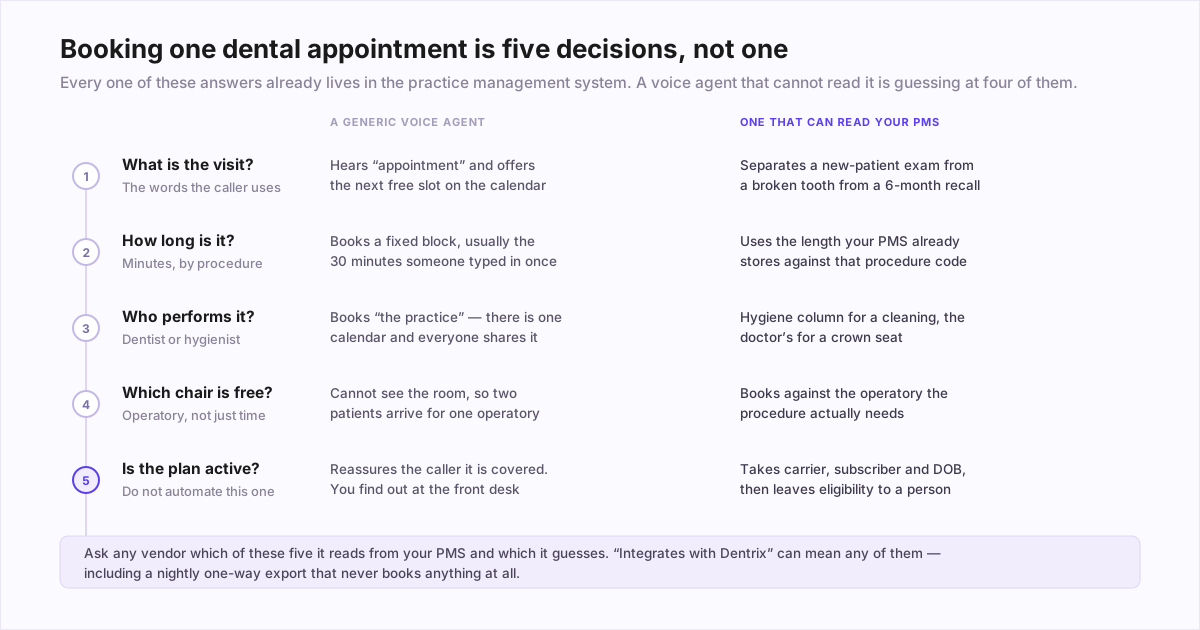
The failure modes are specific and they are all operational rather than conversational. A crown seat booked into a thirty-minute hygiene slot costs you the afternoon. Two patients booked into one operatory costs you a review. A recall booked with the doctor rather than the hygienist costs you a chair-hour you cannot get back. None of these sound wrong on the recording. They surface at 7:40 the next morning, when the schedule is already printed.
And the fifth decision is the one worth being conservative about. Eligibility changes without warning, and a voice agent that reassures a caller their plan covers the visit has committed your practice to a conversation at the front desk that you did not agree to. The correct behaviour is to take the carrier, the subscriber and the date of birth, and hand it to a person. Ask every vendor what their agent says when a caller asks "is this covered?" The good ones have a rehearsed answer.
The gate nobody in the SERP mentions
Here is why so few products in this category can honestly claim write access: the practice management vendors control it, and the process is neither instant nor free.
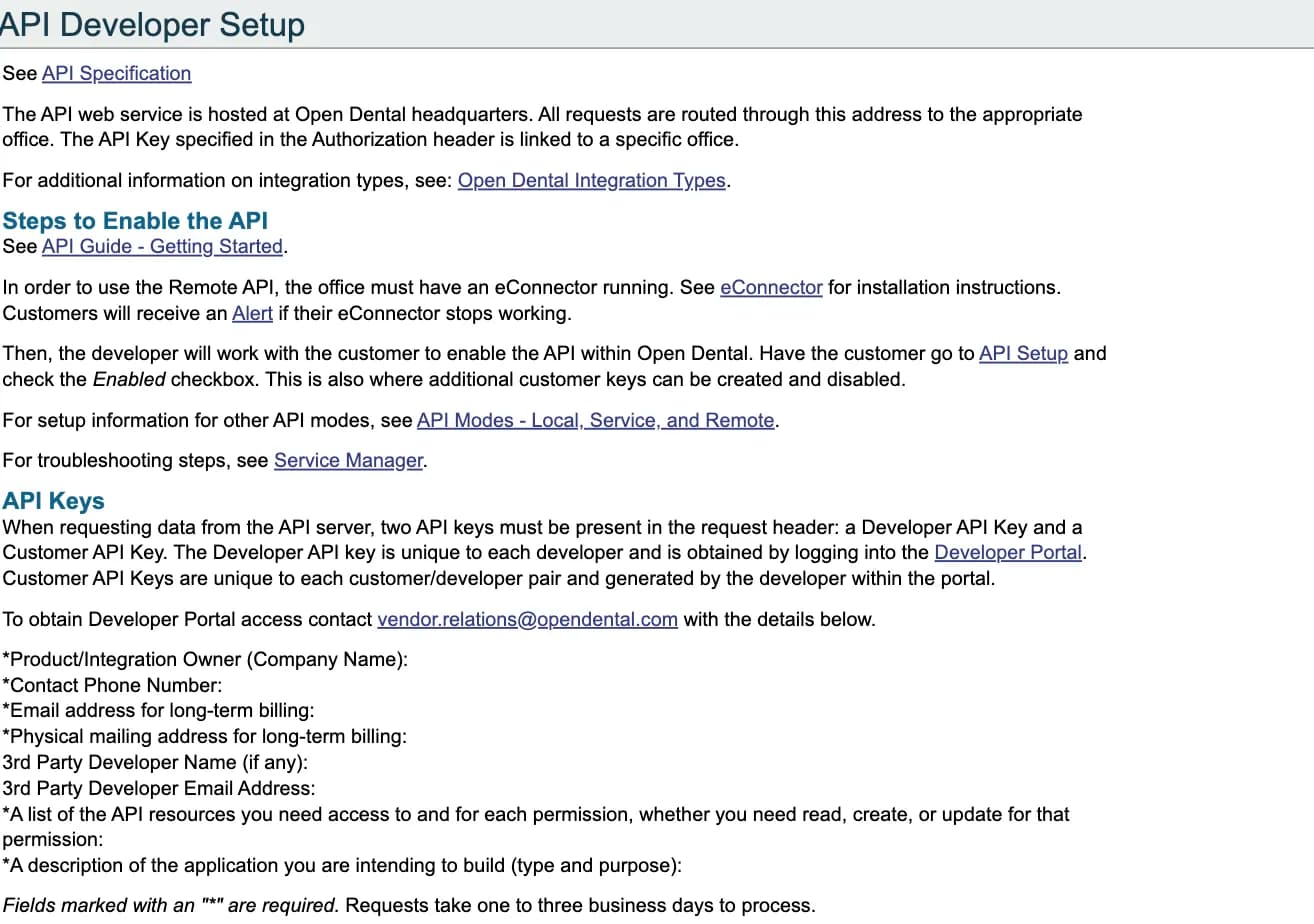
Open Dental publishes the whole thing. To get Developer Portal access, a vendor emails vendor relations and supplies its company name, a phone number, a billing email, a physical mailing address, and a list of the API resources they need access to and for each permission, whether you need read, create, or update. Requests take one to three business days. Every request thereafter carries two keys - a Developer API Key belonging to the vendor and a Customer API Key unique to your practice - and your office has to run the eConnector service and tick Enabled in API Setup before any of it works.
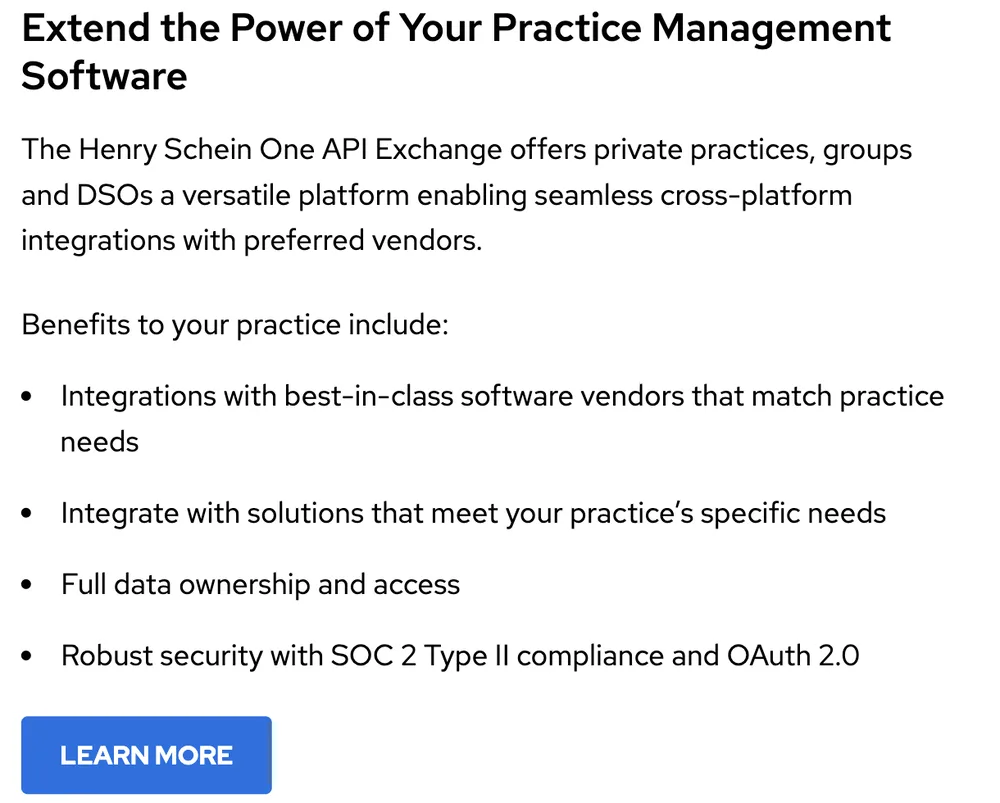
Dentrix routes third parties through Henry Schein One's API Exchange, which sets a security floor rather than a paperwork one: the programme states that all integrated software vendors are SOC2 Type II and OAuth2.0 certified. For a small vendor, a SOC 2 Type II report is a genuine, months-long, five-figure undertaking. That is the moat, and it is why the field of products that can really write into dental software is narrow.
The Dentrix Developer Program publishes the rest of it, and the numbers are the clearest explanation of this whole category. For the on-premise Dentrix API there is a one-time registration fee of $5,000 for read access and a further $5,000 for write access, plus a monthly royalty by API category. For Dentrix Ascend it is a $5,000 registration fee and $47 per Ascend location per month, including 30,000 calls and 3GB of data, with overage at $0.0018 per call and $1.00 per GB.
For multi-location groups the $47 line compounds: a fifteen-practice group is paying fifteen times over for the privilege of letting software talk to its own data. Nobody raises this in a demo, because it is usually absorbed into the vendor's per-location price. Ask anyway - it tells you whether the person selling to you understands their own cost base.
The five, one at a time
1. Dentina - the only one that answers the question in public
Dentina earns the top slot on legibility more than on any feature. It is the one product in this category whose own site tells you the price before you talk to anybody - Standard Inbound starting at $299 per month and Premium Inbound at $399 per month, billed annually per location, with a 30-day free trial and cancel anytime. It also names the systems it works with rather than gesturing at them: Dentrix, Dentrix Ascend, Open Dental, Eaglesoft, Curve, Denticon, Cloud9, Dentrix Enterprise, Dolphin, OrthoTrac and PracticeWorks.
The product covers voice, SMS reply to missed calls, and web chat on the inbound side, plus outbound recalls pulled from the PMS, family-aware confirmations, and reactivation of patients lapsed eighteen months or more. Treatment follow-up is marked on its own site as a Q2 2026 item, which is a level of roadmap honesty this category does not usually volunteer.
The critical read: a published price is not proof of anything except a published price. Naming eleven systems tells you which systems, not the permission level in each. Take the trial, and spend it checking whether an appointment it books arrives in the right column with the right length - not whether it sounds pleasant.
2. Weave AI Receptionist - the smallest decision, if you are already there
Weave is a healthcare communications platform - phones, texting, payments, reviews, recall - and its AI Receptionist is a layer on top of all of it. On its product page Weave describes it as an always-on agentic AI Receptionist that books appointments, answers FAQs, takes payments and hands off to staff. It did not build this from nothing: in May 2025 Weave announced it would acquire TrueLark, an AI front-desk platform with real DSO deployments, for $35 million - $25 million in cash and $10 million in equity.
That acquisition is the strongest single argument for Weave and the clearest signal about where this category is going. Platforms that already hold your patient communications are not waiting to be disintermediated by a phone startup; they are buying one. If Weave is already your phone system, adding its receptionist is a change of configuration rather than a change of vendor - no porting, no second integration, one bill, one support number.
The critical read: the AI product page does not name a single practice management system, describing them only as leading practice management systems. Weave has a large integration estate elsewhere on its site, so this is a documentation gap rather than a capability claim - but it is your job to close it. Ask, in writing, which of your systems and whether the agent creates appointments or only reads availability. And be honest with yourself about the counterfactual: if you are not on Weave, adopting Weave to get its receptionist is a platform migration standing in for a phone problem.
3. Arini - built for the buyer with a procurement process
Arini positions itself as the leading AI receptionist for dentists, with the pitch aimed squarely at revenue recovery: answer every call, reactivate every patient, and stop opportunities for care slipping. Its stated scope goes well past answering - reactivation campaigns, online scheduling, confirmations, recall management, with insurance verification described as roadmap. There is an enterprise partner motion and an analytics product alongside the core.
For a DSO, that shape is right. Multi-location dentistry has genuinely different requirements - routing between locations, per-provider rules, consolidated reporting - and a vendor that sells by demo and quotes by portfolio is built for that conversation.
The critical read, and it matters: most of the ranked lists above this one on the results page state that Arini has native Dentrix, Eaglesoft and Open Dental integration. On the Arini page we read in August 2026, no practice management system is named at all. It may well have all three; that is not the point. The point is that a claim repeated by six listicles and made by none of them checkable is exactly the kind of thing you should not carry into a purchase. Ask Arini directly, name your system, and ask for read or write in the same sentence.
4. Peerlogic - the one solving a different problem, well
Peerlogic sits slightly outside this comparison and belongs in it anyway, because a real share of practices searching for an AI receptionist do not have a coverage problem. They have a conversion problem. The phone gets answered; the caller still does not book. Peerlogic's centre of gravity is conversational intelligence over your existing calls - what was said, what was missed, which team member converts - with an AI assistant that also texts missed calls, answers questions and books.
If your front desk answers ninety per cent of calls and books forty per cent of them, a voice agent that answers the other ten per cent is rounding error. Fixing the forty is the whole business.
The critical read: like Weave and Arini, no PMS is named on the page and no price is published. And be clear about what you are buying - analytics products create work before they save it. Somebody has to listen to the coaching, run the huddle and change the script. If nobody in your practice owns that, the dashboard becomes a subscription to a graph.
5. A general packaged AI receptionist - including ours
The last category is the one we are in, and it is fifth here for an honest reason: it does not touch your practice management system. A general AI receptionist answers with your greeting, knows your hours, services and location, screens and routes, books onto a mainstream calendar, escalates a genuine emergency to a real phone, and drops a transcript in your inbox. It goes live the same day, costs a flat monthly fee, and cancels month to month - ours is €99 or €299 a month depending on volume.
For an after-hours and lunchtime overflow line, that is frequently the correctly sized purchase, and the arithmetic is not close: a dental vendor at $299 per location per month solving a problem you have for two hours a day is a different trade from a general product at a third of the price solving exactly those two hours. The general product also handles the calls that are not bookings at all - the sales calls, the wrong numbers, the patient asking whether you are open on Saturday - which is most of the volume.
The critical read, on ourselves: if what you need is an appointment to land in the hygiene column with the right length against the right operatory, we cannot do that, and neither can any other general product regardless of what its home page implies. Buy one of the four above. We are also not the right answer for a practice that needs outbound recall campaigns driven from the PMS, or insurance workflows of any kind.
What each one actually costs
Two of these five publish numbers. Rather than fill the gaps with guesses, here is exactly what each vendor states, and what the silence usually means.
Published pricing as of August 2026 - confirm before buying
| Product | What the vendor publishes | What to expect |
|---|---|---|
| Dentina | Standard Inbound from $299/mo, Premium Inbound from $399/mo, billed annually per location. 30-day free trial. | Annual commitment, priced per location. Outbound campaigns quoted separately. |
| Weave AI Receptionist | Nothing. Pricing page exists; the AI product page carries no figure. | Bundled into a platform subscription - so the real question is the total Weave bill, not the AI line. |
| Arini | Nothing. Book a demo. | Per-location quote, annual term, enterprise motion. Expect a procurement cycle. |
| Peerlogic | Nothing on the product page. | Quoted. Analytics products often price per location or per seat. |
| General packaged AI receptionist | Flat monthly, publicly listed. Ours is €99 (1,000 min) or €299 (3,000 min), €0.09 per extra minute. | Month to month, live same day, no PMS write-back. |
One structural point worth more than any of these numbers: per-location pricing and per-location API fees compound in the same direction. A three-location group evaluating a $299 product is looking at roughly $10,800 a year before the Dentrix Ascend API line, not $3,588. Run your own arithmetic on locations, not on the headline.
If you are comparing against a live dental answering service
Many practices searching for a dental answering service are really choosing between three shapes, not five products. Be honest about how many calls you miss in a normal week before picking one.
Answering models for a dental practice
| Model | Best fit | Watch out for |
|---|---|---|
| Live human operators | Practices that want a person on every call and have steady, predictable volume | Usually billed per minute or per call; hold times when several calls hit at once; operators who do not know dental triage or your software |
| AI receptionist | Heavy lunch, after-hours and overflow volume; routine booking, recall and reactivation; small front desks | Must be configured for emergency triage, insurance honesty and HIPAA; needs a clean handoff for anything clinical or sensitive |
| Hybrid (AI first, human backup) | Most growing practices: the AI catches every call, a person takes the ones that need one | You must define exactly what triggers a handoff and where it goes |
The meter matters as much as the rate. A per-minute live service bills hardest in exactly the weeks you bought it for, while the AI products above are flat or per location. The base-plus-per-minute structure of live services, and what real monthly bills look like, is broken down in virtual receptionist pricing. Whichever you compare, weigh it against what you are losing: a new patient is not one cleaning but years of exams, hygiene and restorative work, plus the family they refer.
After hours and emergencies: what the AI should do
Yes, an AI receptionist answers dental calls after hours - that is the most common reason practices buy one. Lunch, the first hour of the morning, evenings and weekends are when patients are free to call and your office often is not, and during the day the front desk is checking patients in and walking them back while the phone rings through. On those calls the agent should do four things: answer instantly; capture the patient cleanly (name, callback number, new or existing, reason for the visit, the insurance they want on file); sort urgency by your rules; and either book the visit or, if it cannot write into your PMS, leave a request the front desk can act on in the morning.
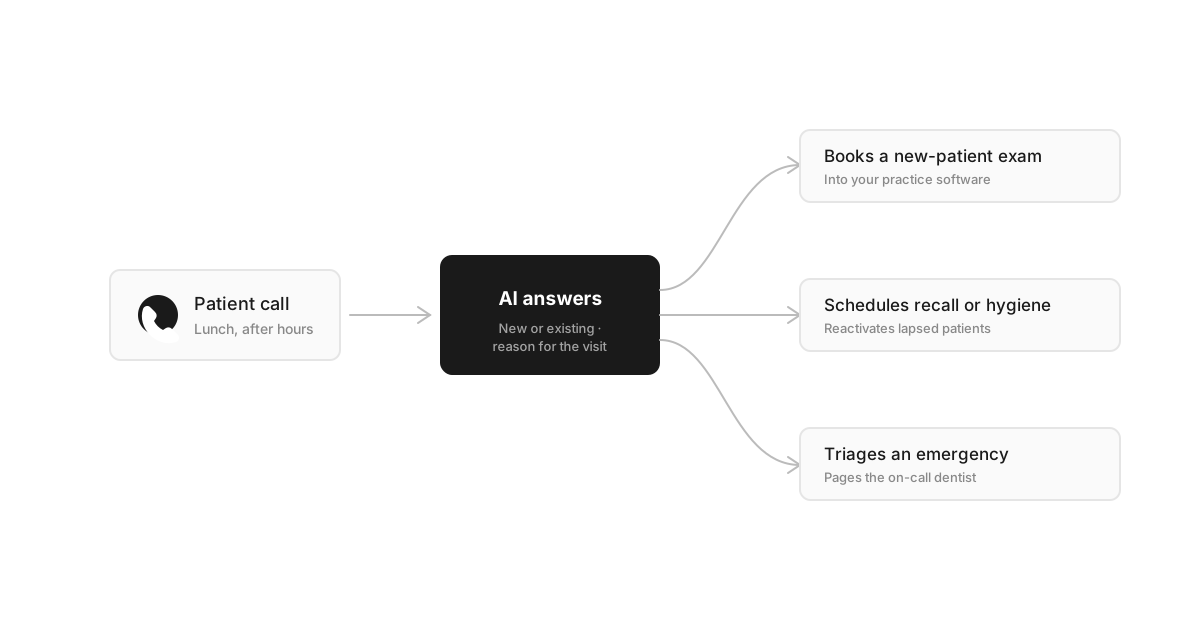
The emergency rules are the highest-stakes configuration in the whole setup, and they belong in writing before the first forwarded call:
- Hard stop to 911 or the ER. Facial swelling that affects breathing or swallowing, bleeding that will not stop, or trauma. The agent tells the caller to call 911 or go to the ER now, then escalates to a person. It never schedules this for tomorrow.
- Page the on-call dentist. Time-critical dental emergencies such as a knocked-out tooth get flagged urgent and paged with the callback number, rather than left in a queue until morning.
- Book or route by your definitions."My crown fell off" and "I'd like a cleaning" are different calls from "my tooth was knocked out an hour ago," and each goes where you decided in advance.
- Never diagnose. An AI must not decide whether pain is serious, recommend treatment or advise on medication. Its only job on a symptom call is triage and escalation.
- Anxious callers go to a person early. Dental anxiety is real, and a frightened patient often wants a human voice. A polite AI is not the same thing, and they can tell.
If the agent cannot reach anyone, it must say so and tell the caller what to do next. Wiring the escalation chain so someone actually wakes up is covered in our 24-hour answering service guide, and the wider healthcare version of these triage rules is in the medical answering service guide.
What good calls sound like
The quality of any answering setup lives in the script, and the short ones work best - long scripts are where AI and tired humans both go wrong. Three calls worth modelling, whichever product you buy:
New-patient booking
Note the longer new-patient slot rather than a squeezed-in checkup, and the forms going out before the visit so the patient arrives ready.
The emergency call - triage and escalate, never diagnose
Any first-aid line in a script like this should be wording your dentist has signed off, said the same way every time.
The insurance question - capture, don't promise
The moment a call ends, the front desk should get a one-line summary it can act on: "New patient, cracked molar, Delta Dental, booked Thu 2pm, forms sent" or "Recall, existing patient, hygiene, booked next Tue 9am." That summary is the actual product. Templates for these modules are in our AI receptionist prompts.
The BAA conversation, before the demo
A vendor that answers your phone receives patient names, phone numbers, the reason for the visit and, usually, a recording of the whole exchange. That makes it a business associate creating, receiving, maintaining or transmitting protected health information on your behalf, under 45 CFR 160.103. You need a signed business associate agreement in place before the first live call, not after the pilot goes well - HHS guidance on business associates sets out what that agreement must cover, and the ADA's own FAQ makes the same point for practices. Compliance is yours as the covered entity; a vendor's marketing cannot grant it to you.
Ask for the document itself and read four clauses: how long call recordings and transcripts are retained; whether your call content is used to train or improve models; which subprocessors touch the audio - the speech and language vendors underneath almost every product in this category; and what happens to your data when you cancel. A vendor with this in order will send you a PDF the same day. One that answers "we are fully HIPAA compliant" and changes the subject has told you something.
A fifteen-minute test that settles it
Every vendor here will give you a demo number. Do not let them drive. Call it yourself, from a mobile, with a colleague listening, and run these seven. It sorts the field faster than any comparison table, including ours.
- "I chipped a tooth, it's bleeding."Does it triage and escalate, or offer you Thursday at 3? Emergency handling is the single most revealing turn in dentistry.
- "I need a cleaning." Then ask which provider it just booked you with. If it cannot answer, it is not reading your columns.
- "Is that covered by my insurance?" The right answer is a careful one that collects details and defers. Any confident yes is a liability.
- Interrupt it mid-sentence. Talk over the greeting. Real callers do this constantly and it is where weaker products fall apart.
- Ask something not in the knowledge base."Do you do Invisalign on Saturdays?" A good agent says it will check and takes a number. A bad one invents an answer, and it will invent prices too.
- Ask for a human. Time it. Where does it go after hours, and what happens if nobody picks up?
- Then go and look at the schedule. This is the whole test. Did an appointment appear, in the right column, with the right length, against the right operatory? Everything before this is theatre.
The same protocol, in more general form and with the reasoning behind each step, is in AI voice agent vs chatbot vs IVR. We run the same ranking for two other trades whose systems of record work completely differently - restaurants, where the write-back is a POS, and home services, where the platform vendors now ship their own agent.
When none of these is the answer
- Your problem is daytime capacity, not coverage. If the phone rings ninety times a day and two people cannot keep up, an AI answering the overflow will book badly at volume. Hire, then automate the after-hours edge.
- Your patient base will not take it. A practice built on twenty years of the same voice at the front desk can lose more in goodwill than it recovers in captured calls. Run it after hours only for a quarter and read the reviews.
- You are mid-migration. Changing practice management systems and introducing a voice agent in the same quarter guarantees you will not know which one broke the schedule.
- Nobody owns the knowledge base. Every product here is exactly as accurate as what you loaded into it. Fees change, hygienists leave, hours move. Half an hour a month, permanently, or it degrades into a confident liar.
- What you actually wanted was missed-call text-back. For a meaningful number of practices, an automatic text to every missed call recovers most of the loss for a fraction of the cost - the case for it is here.
If after all that the honest answer is that you just need the phone answered after six and at lunch, that is the narrow problem we built for. Start with the after-hours rules and the scripts above, forward only the lunch, evening and overflow calls you are already missing, and read the first two weeks of transcripts before you hand it the main line.
Frequently asked questions
What is the best AI receptionist for a dental practice?
There is no single best one, because the products differ far more in what they can write into your practice management system than in how they sound. If you want a published price and a named PMS list before you take a demo, Dentina is the most legible option on the market. If Weave is already your phone system, the Weave AI Receptionist is the smallest decision you can make. If you run a DSO with a procurement process, Arini is built for that shape of buyer. If your front desk answers the phone but converts badly, Peerlogic is solving a different problem and solving it better. And if you only need the phone answered after hours, a general packaged AI receptionist costs a fraction of all of them.
Does a dental AI receptionist integrate with Dentrix or Open Dental?
Some do, and the word 'integrate' is doing an enormous amount of work in that sentence. Both systems gate third-party access behind a real programme. Open Dental requires the developer to request a Developer API Key from vendor relations, supplying a billing address and a list of the exact permissions they need, then generate a per-office Customer API Key - and the practice must run the eConnector and tick Enabled in API Setup. Dentrix goes further: the Dentrix Developer Program charges a one-time $5,000 registration fee for read access and a further $5,000 for write, and Henry Schein One's API Exchange states that all integrated software vendors are SOC 2 Type II and OAuth 2.0 certified. So ask any vendor two questions in writing: which of my systems, and read or write? A nightly one-way export is an integration too, and it will never book anything.
How much does a dental answering service cost?
It depends on which kind. Among dental AI products, Dentina publishes the clearest numbers: Standard Inbound starting at $299 per month and Premium Inbound starting at $399 per month, billed annually per location, with a 30-day free trial. Arini, Weave and Peerlogic all sell through a demo request rather than a price page, which usually signals per-location quotes and an annual contract. A general packaged AI receptionist that does not touch your PMS runs roughly €99-€299 per month. Live human answering services usually bill per minute or per call on top of a base plan, so the bill rises with exactly the busy weeks you bought it for. The gap between the AI numbers is not margin - it is the cost of writing into dental software.
Can an AI receptionist book a dental appointment correctly?
Booking a dental appointment is five decisions, not one: what the visit is, how long that procedure takes, whether it belongs in the hygiene column or the doctor's, which operatory is free at that time, and whether the plan is active. A voice agent that cannot read your practice management system is guessing at four of them, and the failure mode is not a rude call - it is two patients arriving for one chair, or a crown seat booked into a 30-minute hygiene slot. Ask a vendor which of the five it reads and which it assumes.
Does an AI answer dental calls after hours?
Yes - after hours and lunch are where an AI receptionist earns its keep, because those are the windows patients are free to call and nobody is at the desk. After hours it should capture the patient (new or existing, reason for the visit, insurance carrier, callback number), book or request the visit depending on whether it can write into your practice management system, and send a summary for the morning huddle. For emergencies it should triage by rules you set, never diagnose: a knocked-out tooth pages the on-call dentist straight away, and facial swelling that affects breathing or swallowing, uncontrolled bleeding or trauma gets a hard stop - call 911 or go to the ER now - followed by an escalation to a person.
Is a dental AI receptionist HIPAA compliant?
The product is not the unit of compliance - the arrangement is. A vendor that receives patient names, phone numbers, appointment reasons or call recordings on your behalf is a business associate under 45 CFR 160.103, and you need a signed business associate agreement before it takes a single live call. Ask for the BAA as a document, not a reassurance, and read what it says about call recordings: how long they are retained, whether they are used to train models, and what happens to them when you leave. A vendor that cannot produce a BAA on request is not ready to answer a dental phone.
Should I use an AI receptionist or hire a second front desk person?
They fail in opposite directions, so the question is which failure you can live with. A person handles the distressed patient, the insurance argument and the walk-in standing at the counter far better than any model, and costs the same whether the phone rings or not. An AI answers at 9 p.m., at lunch and when three lines ring at once, never gets pulled away by a patient at the desk, and is useless at judgement. Most practices we speak to are not short of daytime capacity - they are losing the after-hours and lunchtime calls entirely, which is the narrow problem this software actually solves.
What about DSOs and multi-location groups?
Multi-location changes the maths in three ways. Per-location pricing turns a $299 decision into a five-figure annual line. API fees are per location too - the Dentrix Ascend API is $47 per location per month on top of a $5,000 one-time registration fee, so a fifteen-practice group is paying fifteen times. And the interesting requirement stops being 'answer the phone' and becomes routing: which location, which provider, which of your two hygiene schedules. That is genuinely enterprise software, and it is where a vertical vendor with a real DSO deployment history earns the premium a single practice should refuse to pay.
Sources
- Open Dental: API Developer Setup (developer key, customer key, eConnector)
- Henry Schein One: API Exchange for practices (SOC 2 Type II, OAuth 2.0)
- Dentrix Developer Program: FAQ (registration fees for read and write, Ascend per-location fee)
- Dentina: pricing and named practice management systems
- Weave: AI Receptionist product page
- Businesswire: Weave Communications to acquire TrueLark for $35 million (5 May 2025)
- Arini: product site
- Peerlogic: product site
- 45 CFR 160.103 - definition of business associate (HIPAA administrative requirements)
- HHS: Business Associates under HIPAA (business associate agreement requirements, 45 CFR 164.504(e))
- American Dental Association: FAQ on HIPAA Business Associates
- FTC .com Disclosures: how to make effective disclosures in digital advertising