

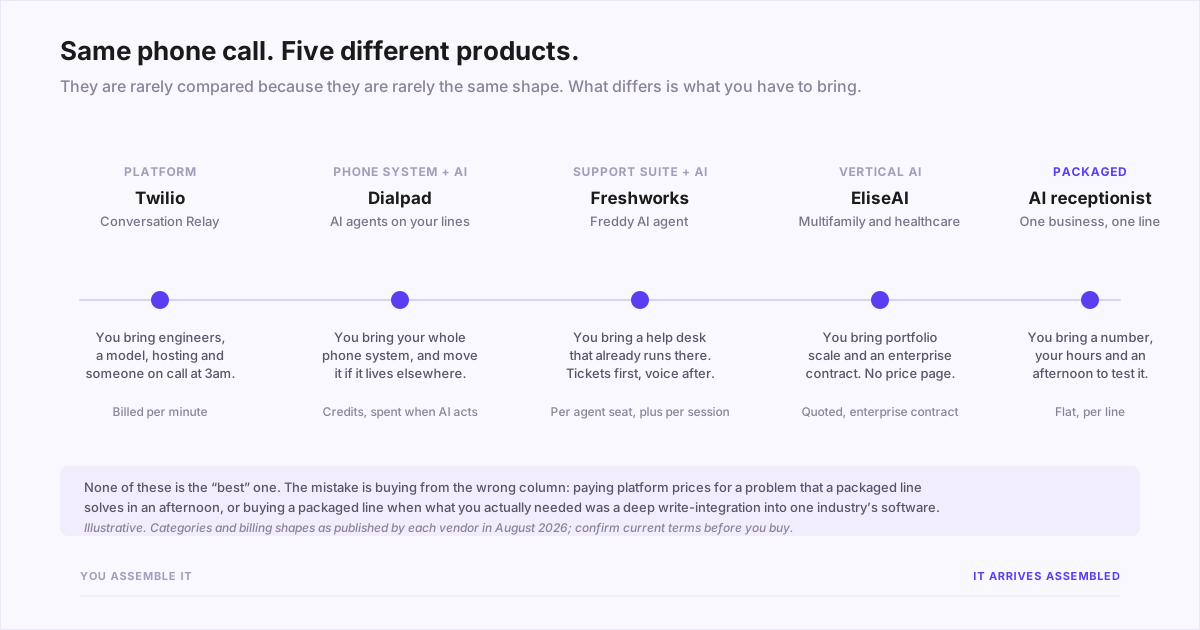
Search for something that answers your business phone with AI and these four names keep surfacing together, which is odd, because they are not competitors in any normal sense. One is a developer platform, one is a phone system, one is a support desk, and one is an enterprise product for a single industry. They land on the same shortlist because they all credibly answer "can AI handle our calls?" with yes - and then answer "what do I have to do first?" with wildly different numbers. We make the fifth kind, the packaged sort, so weigh this accordingly. It is still worth knowing which shape each one is before you book four demos.
Our articles are still written by humans!
Get human written articles in your Google feed.
The short answer
Four products, one sentence each
| Product | What it really is | Best when |
|---|---|---|
| Twilio | The telephony and speech plumbing, streamed to software you write | You have engineers and want to own the behaviour completely |
| Dialpad | A business phone system with autonomous AI agents inside it | You are replacing your phone system anyway |
| Freshworks | A support desk whose AI agent also reaches the voice channel | Your callers are existing customers who already have tickets |
| EliseAI | Enterprise AI built into one industry's systems, voice included | You run a large multifamily portfolio or a healthcare network |
| A packaged AI receptionist | One business, one line, configured and live the same day | You want the phone answered and nothing else to change |
Why these four end up on one shortlist
Because the question people type is about an outcome - the phone gets answered properly - and every layer of the stack now markets against that outcome. The infrastructure company says you can build it. The phone company says it is already in the phone. The support company says it is already in the help desk. The vertical company says only theirs understands your industry. All four are telling the truth about their own product and none of them is answering the question you asked, which is which of these is the smallest thing that solves my problem.
Twilio: the parts, not the product
Twilio is where a large share of this industry's phone calls physically arrive, including many belonging to vendors that never mention it. Its Conversation Relay product exists precisely to make voice AI buildable: the docs describe it as letting Twilio handle the heavy lifting of speech recognition and text-to-speech so you can focus on building your application. Audio streams to a WebSocket server you run; your code decides what to say and what to do.
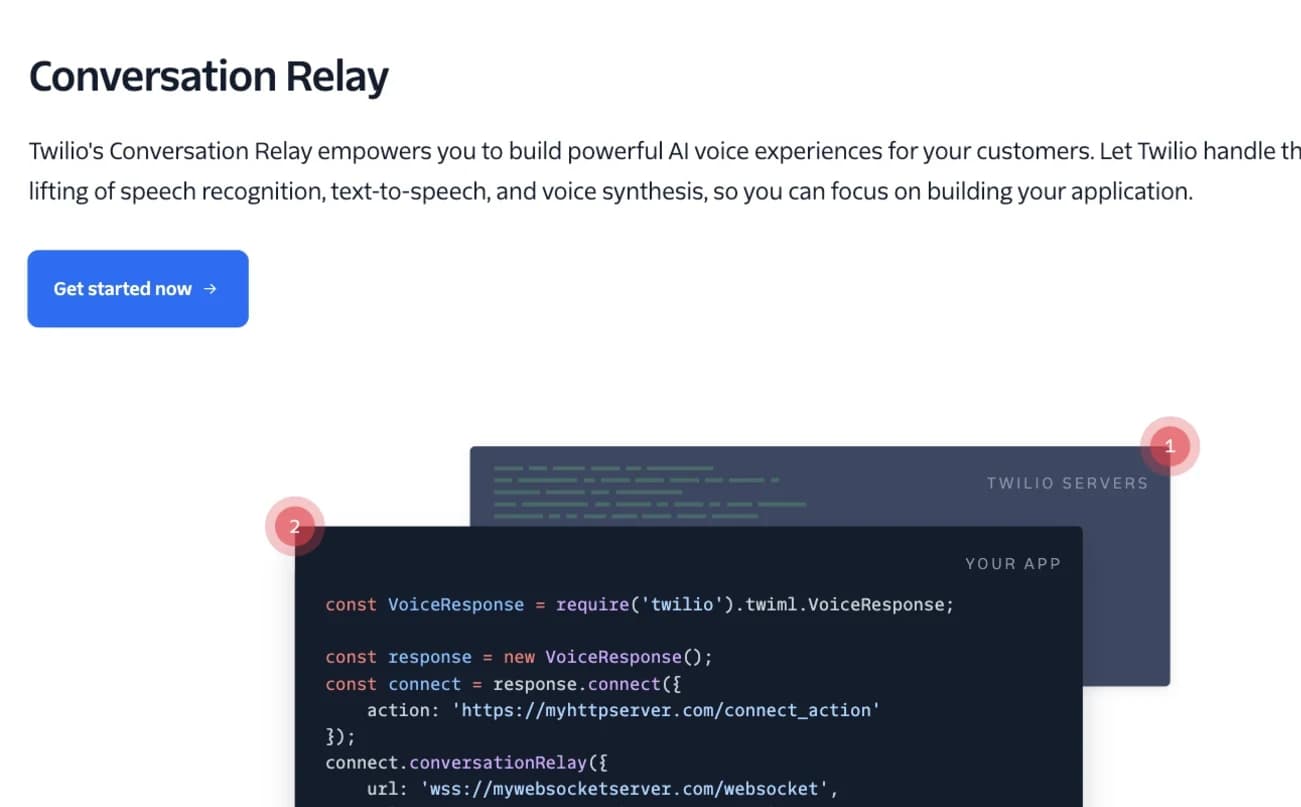
That is an excellent deal for a team with engineering capacity. You get exact control over turn-taking, over what the agent may and may not say, over which systems it writes to, and over your own data. Usage is billed by the minute, so the marginal cost of a call is small and legible.
The honest cost is not the platform bill. It is that a phone line is a production system with a 3 a.m. shift. Someone has to own the moment the model starts hallucinating prices, the week the speech provider gets slower, the caller whose transfer failed silently, and the retention policy for recordings. Teams who want that ownership build better products than they can buy. Teams who bought a platform hoping to avoid a project have, in fact, started one.
Dialpad: AI on a phone system you move to
Dialpad is a business communications platform - calls, messaging, meetings, contact centre - that has spent the last few years pushing hard into agentic AI, with autonomous agents that answer calls, resolve routine requests, route by intent, and hand off to a human with the context already gathered. As an AI phone experience it is genuinely capable and it sits where calls already live, which is the correct architectural instinct.
The scope is the thing to be clear-eyed about. Adopting Dialpad for the AI means adopting Dialpad, which is a phone system migration: numbers, users, licences, training, and whatever your existing contract says. If that migration was already on the roadmap, the AI is close to free upside and you should take it seriously. If it was not, you are running a company-wide telecoms project to stop missing calls after six.
Pricing has moved with the product. Its pricing page now describes AI agents on a credit pool rather than a per-seat line, with credits used only when AI delivers value - a conversation counted as billable when the AI retrieves information or executes a real action such as scheduling, routing or an order lookup. That is a defensible way to charge, and it is worth reading twice: it also means your bill scales with exactly the calls you most want handled, and forecasting it requires knowing your own call mix better than most businesses do.
Freshworks: AI on a support desk
Freshworks sells customer-service and IT-service software - Freshdesk, Freshservice - with Freddy as the AI layer across it. Its published Freshdesk pricing runs from $19 per agent per month on Growth to $89 on Enterprise, billed annually, with the Freddy AI agent metered separately: the first 500 sessions included, then $49 per 100 sessions. Voice lives in the omnichannel and contact-centre products rather than the base help desk, so a phone-first deployment is not the default path through this product.
The shape here is a ticket system that also answers calls. That is exactly right for a business whose callers are existing customers with account histories, order numbers and open tickets - the AI can see the record and continue the story. It is a poor fit when your callers are strangers: a plumbing company's 7 p.m. caller has no ticket, no account and no history, just a leak and four other numbers to try.
The decisive question is not about features. It is whether you already run your support in Freshworks. If yes, adding Freddy is a small, low-risk decision made inside a tool your team knows. If no, you are implementing a help desk in order to answer a telephone.
EliseAI: one industry, all the way down
EliseAI is the clearest example in this list of a different strategy altogether: rather than being horizontal and shallow, be vertical and deep. It targets multifamily property management and healthcare, automating leasing and resident or patient communication across voice, text, email and chat, and integrating into the systems those industries actually run on.
Depth of this kind is expensive to build and genuinely hard to copy, because it is not a model problem. Writing a leasing enquiry or a work order into the software a large operator runs means clearing that vendor's partner programme, its data agreements and its interface fees - a subject worth its own article, which we gave it in AI receptionists for property management. When that work is done, an AI that files the ticket correctly is worth far more than one that emails you a summary.
And it prices like it. Enterprise, quoted, contract-scale, sold by demo request. For an operator with thousands of doors, per-door economics make that straightforward arithmetic. For a manager with two hundred, the same product is a procurement cycle in exchange for capability you have no way to consume.
The fifth option nobody puts on the list
Between "write it yourself" and "sign an enterprise contract" sits the category most businesses reading a comparison like this actually need: a voice agent packaged for one business's phone line. A number, a greeting, your hours and services, booking rules, an escalation path, transcripts in an inbox. Configured in an afternoon, flat monthly price, cancellable.
It is missing from most comparisons for a boring reason: the products in it are small, so they do not appear on analyst grids next to Twilio and Freshworks. That absence is not a quality signal in either direction. We are in this category, and its real limitations are worth stating plainly: the integrations go about as deep as mainstream calendars and CRMs, not into industry systems with partner programmes; there is no roadmap influence at enterprise scale; and if you need the phone experience to be strategically differentiated rather than simply competent, you will eventually want to build. What you get in exchange is that it is working this week.
Five products, five different meters
This is where comparison shopping goes wrong, so it is worth putting side by side. None of these charge for the same thing, which means the cheapest headline number is meaningless until you convert everything to your own annual total.
What each one counts (as published in August 2026 - confirm before buying)
| Product | The meter | What makes the bill move |
|---|---|---|
| Twilio | Usage, by the minute, plus your own model and hosting spend | Call volume and call length - plus engineering time, which is not on the invoice |
| Dialpad | Seats for the phone system, credits for AI | Credits are consumed when the AI retrieves information or takes an action |
| Freshworks | Per agent per month, plus AI agent sessions | Headcount on the desk, and AI sessions past the 500 included |
| EliseAI | A quoted enterprise contract | Portfolio size, and the scope of what is automated |
| Packaged AI receptionist | A flat monthly fee per line | Usually included minutes, then overage - so an unusual month is visible |
One consequence deserves saying out loud: usage meters and outcome meters punish success. A month where the AI handles more calls is a month where it costs more, which is correct in principle and unpleasant when it lands in a quarter you had already budgeted. Flat pricing has the opposite failure - you pay for a quiet month. Neither is a trick; pick the one that matches how much variance your finance conversation can absorb. Our own take on the general shape of these bills is in AI receptionist pricing.
Which column are you actually in?
- Do you have engineers who want to own a phone line? Not "could" - want, with an on-call rota. If yes, build on a platform and stop reading comparisons.
- Were you already replacing your phone system this year? If yes, evaluate the AI inside the phone systems you were shortlisting anyway. If no, do not start a telecoms migration to fix an answering problem.
- Do your callers already exist in a help desk? If your calls are follow-ups on tickets, the AI belongs next to the tickets. If your calls are strangers with a problem and a shortlist of competitors, it belongs next to the phone.
- Does your industry have a system of record with a partner programme? If your value depends on writing into Yardi, AppFolio, Epic or their equivalents, vertical software has done work you cannot shortcut. Ask any generalist vendor, in writing, what they can actually write into it.
- Is the honest answer "I just want the phone answered"? Then the packaged option is not a compromise, it is the correctly sized purchase - and the checklist for choosing one is a shorter document than any of the above.
The costs that arrive later
- Number porting and the fortnight around it. Moving a main business number is the riskiest hour in any of these projects. Forwarding to a new number avoids it entirely, and takes about five minutes.
- The knowledge base nobody owns.Every one of these products is only as accurate as what you loaded. Prices change, staff leave, the service area expands. Budget someone's half hour a month, permanently.
- Integration work priced as "available". "Integrates with your CRM" can mean a two-way sync or a webhook that emails a summary. The gap between those is your team's time.
- Seats you did not think you were buying. Platform products bill people, not phone lines. A five-person business adding three seats to get one AI feature has changed the maths substantially.
- The exit. Ask what happens to your transcripts, recordings and call history when you leave, and whether the number comes with you. Ask before you sign, when the answer is still cheap.
If you want to price the smallest version of this against whatever enterprise quote you are holding, our plans are month-to-month, and the seven-question demo call works just as well on the other four.
Frequently asked questions
Is Twilio an AI receptionist?
No - Twilio sells the parts you would build one from. Its Conversation Relay product streams a live call to software you write over a WebSocket and handles speech recognition, speech synthesis and interruption handling, while you supply the model, the business logic, the integrations and the hosting. That is a great deal if you have engineers and want total control. It is not something you switch on for a business with one phone line.
Can Dialpad answer calls without a human?
Yes. Dialpad markets autonomous AI agents that answer calls, resolve routine requests, route by intent and hand off to a person with context. The catch is not capability, it is scope: Dialpad is a business communications platform, so you are adopting a phone system, not adding a receptionist to the one you have. If you were replacing your phone system anyway, that is a feature rather than a cost.
Does Freshworks Freddy handle phone calls?
Freshworks positions Freddy as an AI agent across its support products, and voice sits inside its contact-centre and omnichannel offerings rather than in the base help-desk plan. Its published Freshdesk pricing is per agent per month, with AI agent usage billed separately by session - 500 sessions included, then charged per hundred. The mental model is a support desk that also takes calls, not a phone line that also files tickets. Which one you need depends on whether your callers are existing customers with tickets or strangers with questions.
What is EliseAI and who is it for?
EliseAI is a vertical AI platform aimed at multifamily property management and healthcare, automating leasing and resident communication across voice, text, email and chat with deep integration into the software those industries actually run on. Its own site sells via demo request rather than a public price page, which is the usual signal for enterprise, quoted, contract-scale software. For a large portfolio that is exactly right. For a twelve-property manager it is a category error.
Which is cheapest?
The question does not survive contact with the billing models, because none of the four charges for the same unit. Twilio bills usage by the minute, Dialpad bills AI through a credit pool consumed when the AI actually does something, Freshworks bills per agent seat plus per AI session, and EliseAI quotes a contract. A packaged AI receptionist bills a flat monthly fee per line. The only comparison that means anything is the total for your own call volume over a year, with setup effort priced in.
Can I just build my own on Twilio and skip the vendors?
You can, and for some teams it is the right answer. Budget honestly: telephony, speech, a model and hosting are the easy part. The work is turn-taking that survives real callers, a knowledge base that stays current, write access to your calendar or CRM with sane failure handling, escalation that wakes a real person, transcripts and recordings retained lawfully, and someone who owns it at 3 a.m. Teams that enjoy that work end up with something better than they can buy. Teams that do not end up maintaining a phone system by accident.
What if I already use one of these for something else?
That is the strongest argument any of them has. If your support desk is already Freshworks, adding Freddy is a smaller decision than introducing a new vendor. If you were migrating to Dialpad anyway, its AI agents come along for the ride. The mistake is the reverse: adopting an entire platform because you wanted the phone answered, which is a large project standing in for a small one.