

Every ranked list of AI receptionists for contractors has the same problem: it was written by someone selling one, and it quietly skips the product most likely to be the right answer. Between August 2025 and April 2026, Jobber, Housecall Pro and ServiceTitan all shipped their own AI that answers the phone. If you pay one of them already, that is where your evaluation starts - and it is why the top of this ranking is not a vendor at all. We sell a general AI receptionist, which puts us fifth on our own list. Everything below is sourced to the vendors' own pages, with the numbers they publish and an explicit note wherever they publish nothing.
Our articles are still written by humans!
Get human written articles in your Google feed.
The ranking, in one table
Ordered for the shop most likely to be reading this: one to twenty trucks, running an FSM, losing calls after hours and during the summer peak. A one-van operation should read from row four down.
Five options for a home services contractor, ranked (August 2026)
| # | Option | Best when | Published price? |
|---|---|---|---|
| 1 | The AI inside your FSM | You already pay for ServiceTitan, Jobber or Housecall Pro | Partly - Jobber bundles it; ServiceTitan bills per call |
| 2 | Avoca | Established shop, wants booking, win-back and CSR coaching in one | No |
| 3 | Sameday AI | You want a number on a page and native FSM scheduling | Yes - from $449/mo |
| 4 | Rosie or Goodcall | One to five trucks, calendar-level booking is enough | Yes - from $49 and $79/mo |
| 5 | A general packaged AI receptionist | After-hours cover, jobs still booked by a human in the morning | Yes - typically €99-€299/mo |
Do you need one at all?
Before ranking anything, the prior question - because for some shops the honest answer is no. Your best jobs call while your hands are inside a wall. The homeowner with a burst pipe or a dead panel does not leave a voicemail; she hangs up and dials the next company in the results. The classic Harvard Business Review research on lead response found the odds of a meaningful contact collapse within the first hour. For someone standing in a flooding kitchen, the window is the four rings before your greeting starts.
What it should actually produce is narrower than the marketing suggests: a booked job with a full address, a callback number, what is broken and since when, and the access notes a dispatcher would ask for - gate code, lockbox, dog in the yard, tenant or owner - screened against the ZIP codes and towns you cover before a slot is offered. Every out-of-area booking it prevents is a drive you did not waste. Quote requests that are not bookable yet should arrive with scope and timeline so you call back with context. What it should not do is diagnose the furnace, quote a repipe sight unseen, or negotiate. The wrench stays yours.
- You probably need one if calls ring out while the crew is on jobs, everything after six goes to voicemail, or you are a solo operator - you physically cannot answer while you work, and every missed call is your own job lost.
- You probably do not if you get a handful of calls a week from repeat customers who will happily text you, or if most of your phone traffic is high-touch commercial work - a caller negotiating a large contract or a property manager with a portfolio problem deserves a person from the first ring.
If you are in the first group, the rest of this page is about which one - and that question changed sharply in the last eight months.
What changed in the last eight months
This category was reasonably simple until recently. Contractors bought an FSM for scheduling and dispatch, and bought answering separately, from a human service or an AI vendor. That separation is closing, quickly.
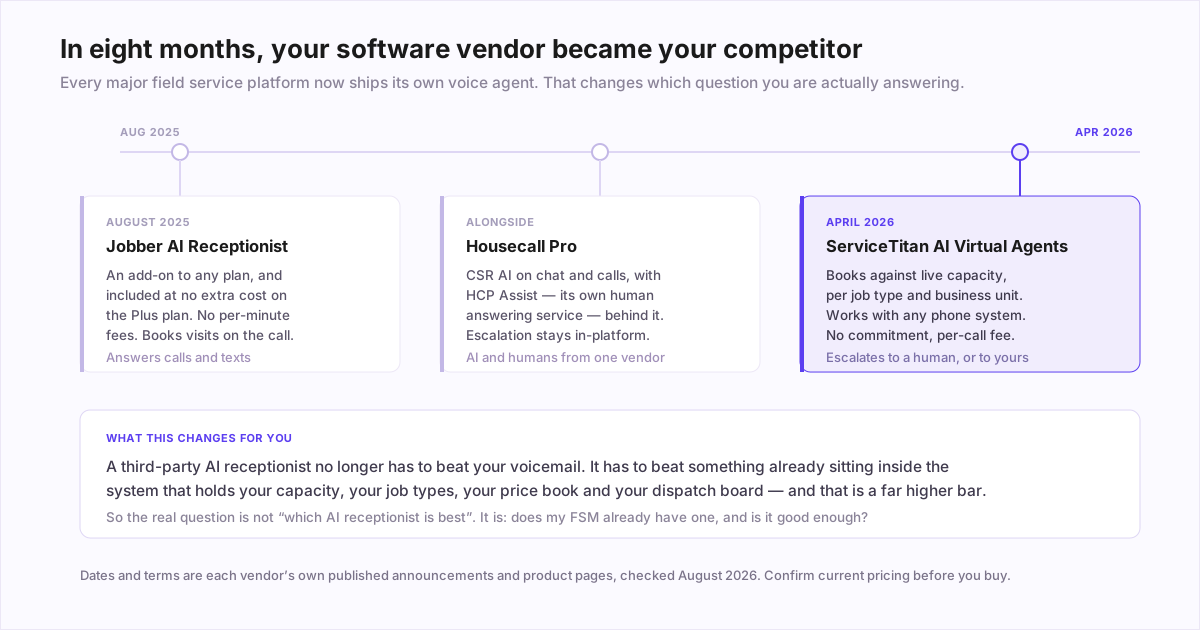
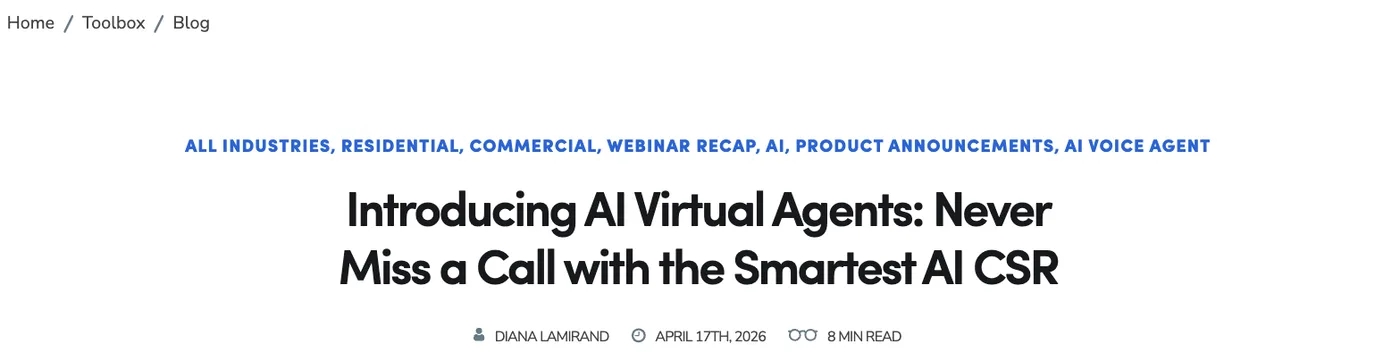
ServiceTitan announced its version in April 2026 and did not hedge about who it was aimed at. Its own launch write-up lists, among the reasons contractors need this, that third-party answering services just don't cut it for the trades. When the platform your dispatch runs on says that in public, the question for every third-party vendor - including us - stops being "are we good" and becomes "are we better than the thing already inside the software you pay for".
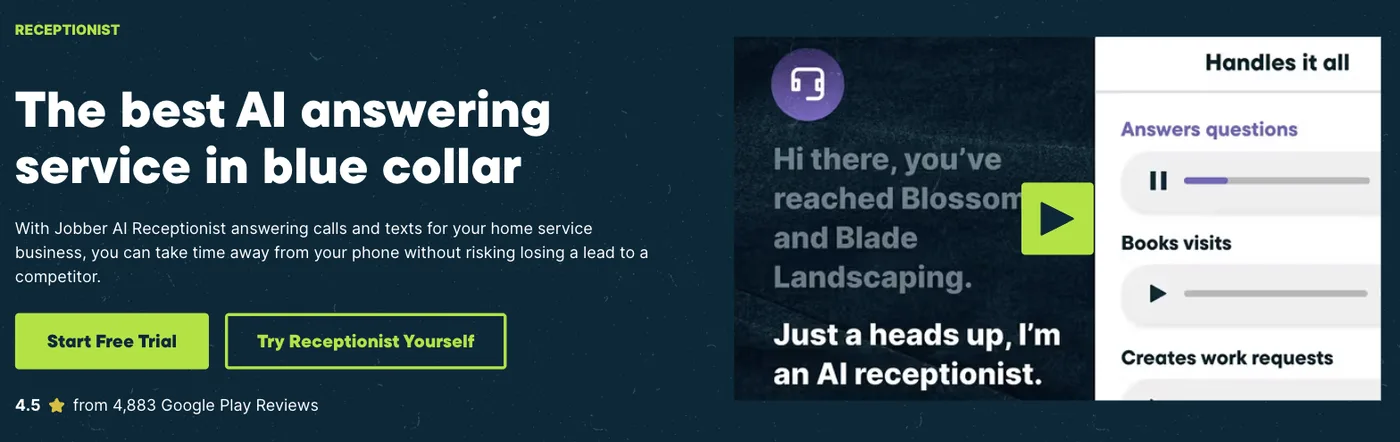
Jobber got there earlier and aimed lower down the market. It launched its AI Receptionist on 18 August 2025, and its own announcement states that Receptionist has handled more than 200,000 conversations on behalf of participating businesses before the product went generally available. Its positioning is not subtle either.
How we ranked these - and who we are
- First-party sources only. Every number below comes from a vendor pricing page, product page or announcement read in August 2026. Where a vendor publishes nothing, we say so rather than repeating a figure from another blog. Several widely-cited prices for this category do not appear on any vendor site we could find.
- Depth of field-service write-back is the main axis. An agent that books a job against real capacity removes work. One that emails a lead creates a to-do list for a dispatcher. Both are sold with the same headline about never missing a call.
- The incumbent gets the top slot on merit. Not loyalty - arithmetic. Zero integration risk, live capacity, your job types, one bill, one support number. A third party has to be meaningfully better to justify existing alongside that.
- We disclose our own position. We sell a general packaged AI receptionist. It does not write into ServiceTitan or Housecall Pro. That is why it is fifth, and if the FSM write-back is the point, four other options here beat ours.
Booking a job you cannot staff
The demo everyone runs is the wrong one. You call, you say the AC is out, the agent is polite, it books you Thursday, everyone nods. Now ask what happens on the third day of a heatwave when Thursday has been full since Monday.
There are three possible answers and only one of them is good. It books anyway, and a dispatcher spends the morning ringing customers to cancel - which converts a missed call into a broken promise, the more expensive of the two. It refuses to book and takes a message, which is honest and wastes the capture. Or it sees the board, offers what genuinely exists, and escalates the ones that cannot wait.
This is the specific thing the native products are built to do. ServiceTitan describes its agents as the only virtual agents that integrate with adaptive capacity directly inside of ServiceTitan, and lets you restrict which job types the agent may book down to the business unit, with a custom dispatch fee and its wording set per job type. Whether or not you buy theirs, that list is the specification to hold every other vendor against.
The five, one at a time
1. The AI already inside your field service software
ServiceTitan AI Virtual Agents. Announced April 2026. Books and reschedules against live capacity, recognises members, states your dispatch fee, classifies its own calls so booked ones tie back to jobs, and escalates to a human team member, a cellphone, or a third-party answering service. It works regardless of your phone system - Contact Center Pro, Phones Pro or a third party. On commercials, ServiceTitan states businesses do not need a commitment to start and pay a per-call usage fee, which is unusually buyer-friendly for a platform feature.
Jobber AI Receptionist. Launched 18 August 2025. Answers calls and texts, captures job requests and books visits during the call, and feeds leads into your existing workflow. Commercially it is the friendliest arrangement on this page: an add-on to any plan, included at no additional cost on the Plus plan, with no per-minute fees. For a small shop already on Jobber Plus, the correct next step is to switch it on this week and shortlist nothing.
Housecall Pro. Pairs CSR AI across chat and calls with HCP Assist, its own human answering service, so the escalation path stays inside one vendor. That hybrid is a genuinely good shape for the trades, where the calls an AI should not take are the ones that matter most.
The critical read: native is not automatically better, and version one of anything is version one. Test it against the same seven calls below before you conclude it is enough. The specific things to check are the ones a platform tends to ship late - how fast it escalates, whether it handles two simultaneous calls, what it does with a caller who will not speak to a machine, and how the transcript reaches whoever needs it at 6 a.m. Also read the meter: a per-call fee is excellent at a hundred calls a month and worth modelling at a thousand.
2. Avoca - the deepest third party, if you are big enough
Avoca describes itself as the AI Front Office for Service Businesses, and the scope is genuinely wider than answering. Three modules: Book (an AI CSR for 24/7 job booking, a self-service scheduler, web chat), Win Back (speed-to-lead, outbound campaigns, Google LSA), and Coach (real-time scoring and analytics for your human CSRs). It is listed as a ServiceTitan Certified App with deep CRM integration, and its footer carries Housecall Pro and FieldRoutes badges.
The Coach module is the part most worth attention and the part nobody shortlists for. Plenty of contractors do not have an answering problem - they have a booking-rate problem on calls their own CSRs already take. Buying a product that scores those calls and coaches on them is a different, often larger, lever than answering the overflow.
The critical read: no published price, a demo-led motion, and a product surface aimed at shops with a real CSR team to coach. A two-truck operation buying Avoca is buying three modules to use one. And now that ServiceTitan ships its own agent, ask Avoca directly what its booking does that the native one does not - it is a fair question and they will have a real answer.
3. Sameday AI - the one that publishes a number
Sameday is an AI phone agent aimed squarely at converting inbound calls into booked jobs for contractors, and it is the only dedicated home-services vendor here that will tell you the price without a meeting: Launch starting at $449 per month with 500 minutes, three locations and unlimited users; Scale at $789 with 1,000 minutes, unlimited locations and voice cloning; Enterprise quoted, adding multilingual voices, advanced analytics and API access. Pro scheduling with ServiceTitan is listed on both paid tiers, and the page promises zero surprise fees.
The critical read: price the minutes, not the plan. 500 minutes is roughly 165 three-minute calls a month - fine for after-hours cover at a small shop, thin as a primary line for anyone busy. Work out your real monthly call minutes first, then look at which tier that lands in, because the jump from $449 to $789 arrives sooner than most people expect. And as with Avoca, the ServiceTitan question is now fair game: what does this do that the native agent does not?
4. Rosie or Goodcall - for one to five trucks
Below the field-service tier sits a set of general small-business AI receptionists that trades buy constantly, and two of them are worth naming because they publish clear, honest pricing.
Rosie runs $49 a month for 250 minutes, $149 for 1,000 with direct calendar booking, warm and live transfers, and $299 for 2,000 with unlimited message scenarios and custom agent training. A website texting add-on is $50 a month for 25 conversations and $1 each after. Integrations are Zapier-led rather than native.
Goodcall takes an unusual and rather clever meter: $79, $129 or $249 per agent per month (roughly 15% less annually) with unlimited minutes and tokens, billed instead on unique customers - 100, 250 or 500 a month, then $0.50 per additional caller. For a trade whose callers rarely ring twice, that is worth modelling; for one with a repeat maintenance base, it is a genuinely cheap meter.
The critical read: neither writes into a field service platform. They book onto a calendar and hand you a lead, which for a one-to-five-truck shop where the owner is also the dispatcher is often exactly right - the job was going to be scheduled by a person regardless. Above about five trucks, the missing FSM write-back starts costing a dispatcher real hours.
5. A general packaged AI receptionist - including ours
Last, honestly. A general AI receptionist answers with your greeting, knows your trades, service area, hours and call-out fee, triages emergencies against rules you write, escalates a genuine one to a real phone until somebody picks up, books onto a mainstream calendar and drops a transcript in your inbox. Flat monthly - ours is €99 or €299 a month - live the same day, month to month.
Where this wins is the shape of problem most small contractors actually have: the phone is fine from eight to five because someone is in the office, and everything from six in the evening to seven the next morning goes to voicemail, which is where a meaningful share of the year's emergency work is decided. Buying a $449 field-service product to cover thirteen hours a day is a different trade from buying a €99 one.
The critical read, on ourselves: if you need a job to appear on the dispatch board against real capacity, we cannot do that, and no general product can regardless of what its home page says about HVAC. Buy the native one or Avoca. We are also the wrong answer if your volume needs more than three simultaneous calls, or if you want CSR coaching, outbound win-back campaigns, or speed-to-lead on Angi and Thumbtack.
What each one actually costs
Published pricing as of August 2026 - confirm before buying
| Option | What the vendor publishes | The meter |
|---|---|---|
| ServiceTitan AI Virtual Agents | No rate card; states no commitment required and a per-call usage fee | Per call - scales with exactly the volume you want handled |
| Jobber AI Receptionist | Add-on to any plan; included at no additional cost on Plus; no per-minute fees | Bundled into the plan |
| Avoca | Nothing. Book a demo. | Quoted - expect an annual term aimed at established shops |
| Sameday AI | Launch from $449/mo (500 min, 3 locations); Scale from $789/mo (1,000 min, unlimited locations) | Monthly, banded by minutes |
| Rosie | $49 / $149 / $299 per month for 250 / 1,000 / 2,000 minutes; texting add-on $50 | Monthly, banded by minutes |
| Goodcall | $79 / $129 / $249 per agent per month, ~15% off annually; unlimited minutes | Unique callers - 100 / 250 / 500, then $0.50 each |
| General packaged AI receptionist | Ours is €99 (1,000 min) or €299 (3,000 min), €0.09 per extra minute | Flat monthly with included minutes |
Four different meters on one page - per call, bundled, per minute, per unique caller - which means the cheapest headline tells you nothing until you convert everything to your own annual total. Pull last month's call log, count the calls and the minutes, and price all four. Then compare that number to what the missed ones cost you, which for trades with an average job value in the hundreds is usually the shorter calculation - the method is here.
The calls an AI must hand over immediately
Trades carry a category of call that no voice agent should ever attempt to handle, and the rule needs writing down before you configure anything, not after an incident.
- A smell of gas. The agent does not troubleshoot, does not book, does not ask diagnostic questions. It tells the caller to leave the property and call the gas emergency line or 911 from outside, then escalates to a human. There is no version of this that is a booking.
- A carbon monoxide alarm. Same handling. Out of the building first, emergency services, then you.
- Smoke, burning smell, or anything electrical arcing. Same again.
- Water actively flooding. Shut-off guidance is reasonable and useful; a Thursday appointment is not.
- A vulnerable person with no heat or no cooling. Not an emergency service call, but not a routine booking either. Elderly, an infant, a medical dependency - these should route to a human who can make a judgement about tonight.
Below that line sits a second kind of emergency that is a booking, just not a Thursday booking: a burst pipe, sewage coming up a drain, no heat with a toddler in the house in January. The agent flags it urgent, pages the on-call tech with the address and a one-line summary, and tells the caller exactly what happens next - "a tech will call you back within the hour" beats "someone will get back to you" every time. Then the third lane: the dripping faucet, the fence quote, the fall gutter clean go straight onto the calendar with a text confirmation. The skill is keeping three lanes separate at 2 a.m. with a stressed caller talking over the greeting, which is why you write the definitions down instead of hoping.
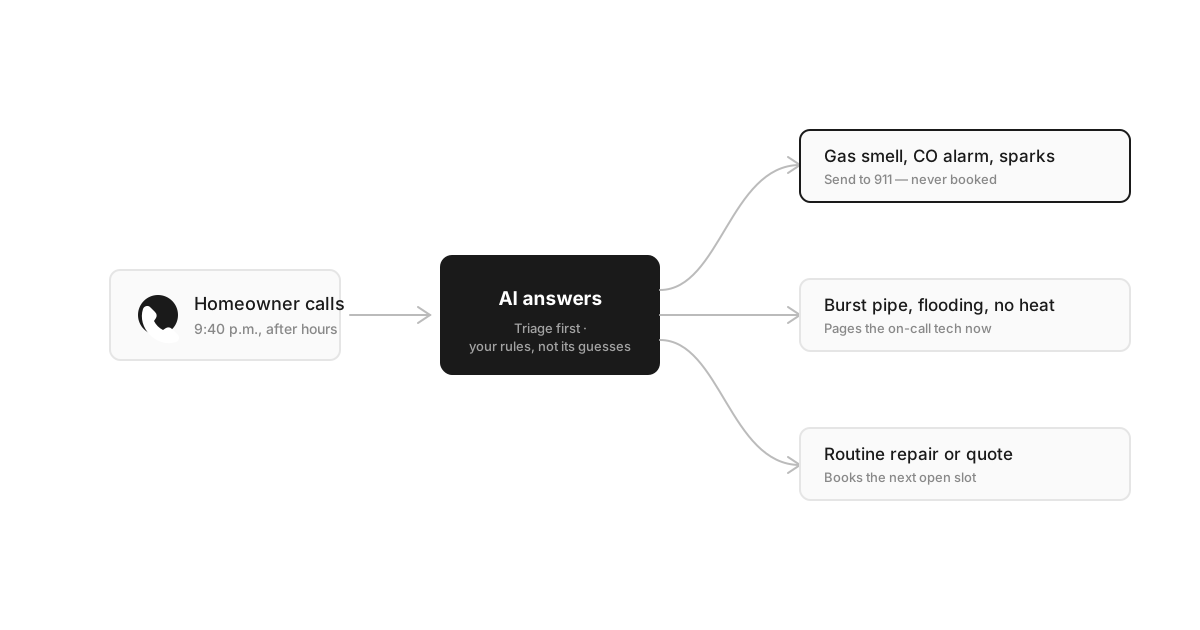
Within the lower two lanes, triage is where a well-configured agent genuinely outperforms voicemail: severity, whether the system is fully down or intermittent, whether anyone is home, whether it is under warranty or a membership. How to wire the escalation so somebody actually wakes up is a whole subject on its own - we wrote it up separately.
Configure for your trade, not for "home services"
"Home services" is a lazy umbrella. A cleaning company and an electrician do not share an emergency definition, an intake form or a busy season, and an agent configured generically will sound generic to callers. Whichever product you buy from the ranking above, this is the table to fill in before setup:
How AI receptionist setup differs by trade
| Trade | What “emergency” means | Intake that matters | Seasonal spike |
|---|---|---|---|
| Plumbing | Burst pipe, sewer backup, water actively flowing | Shutoff valve located? Fixture, symptom, water heater age | First hard freeze - burst-pipe week |
| Electrical | Sparking, burning smell (911 first), whole-house outage | Breaker vs. whole house, panel age and access | Storm season and holiday overloads |
| HVAC | No heat in a freeze, no cooling in a heat wave | System type and age, maintenance-plan status | First heat wave, first freeze |
| Cleaning | Rare - move-out deadlines and lockouts at most | Square footage, pets, supplies, keys and access | Move-out season, spring deep cleans |
| Landscaping | Storm-downed limb on a roof or a line | Lot size, gate width, recurring vs. one-time | Spring rush, post-storm cleanup |
The pattern: the more a trade deals in genuine emergencies, the more the triage rules matter; the more it deals in recurring visits, the more the intake and access details matter. Configure for your row. A working starting point for the rules themselves, including after-hours and emergency-triage templates, is in our copy-paste AI receptionist prompts.
Seven calls that sort the field
- "I smell gas." The first call, every time. Anything other than leave-and-call-the-utility ends the evaluation.
- "No heat, it's 20 degrees, my mother is 84." Does it hear the second half of that sentence?
- Book a job on a day you know is full. The whole capacity question, in one call.
- "How much to replace a water heater?" A confident number is a liability. The right answer explains why it needs a visit and offers one.
- Ask if you are in the service area, from just outside it. Cheap to test, and revealing - a lot of agents will happily book a job forty minutes past where you go.
- Ask for a human at 11 p.m. Time it, and check where it lands if nobody answers. Then check it again after two rings.
- Then go and look at the board. Did the job appear, with the right type, the right duration and the right business unit - and the full address, callback number and gate code? Everything before this is theatre.
The same protocol in general form, with the reasoning behind each step, is in AI voice agent vs chatbot vs IVR. We run comparable rankings for two other trades where the systems of record differ completely - dental practices and restaurants.
The calls it will still fumble
Every product on this list, the native ones included, struggles with the same handful of calls. Plan the human handoff for them instead of pretending they do not happen.
- The rambling multi-property call.A landlord with three buildings, two tenants' complaints and a story about each produces a muddled intake. A good agent captures a callback and the gist; a human callback untangles the portfolio.
- Price hagglers. The agent can state your service-call fee and your ranges. It cannot read a caller or split a difference - and letting it try is how you end up honouring a discount you never offered. Route negotiation to a person, always.
- Furious customers. Day three of a callback about the same leak is not an intake problem. A polite AI reads as a stall to someone who wants accountability; those calls should hand off early, by rule.
- Callers who simply want a human.Some will hang up on any AI, disclosed or not. Disclosure is still right - it defuses the "is this a robot" moment and is in line with the FTC's guidance on clear disclosure. Budget for losing a few of these callers; you were losing all of the voicemail ones.
This is why the hybrid shape - AI on every call, a fast route to your on-call tech or a human service behind it - beats either alone for most growing shops. The catch is that you must define exactly what triggers the handoff and who receives it, or the agent holds calls it should release.
When none of these is the answer
- Your FSM already covers it and you have not tried. Genuinely the most common mistake this month. Switch it on, run the seven calls, and only then shop.
- Your leads come from Angi and Thumbtack, not your number. Inbound answering cannot fix a lead source that never rings you. Fix speed-to-lead first.
- You are one van and the phone is in your pocket. An automatic text to every missed call recovers most of what you are losing for near-nothing - the case for it is here.
- Nobody owns the knowledge base.Prices change, the service area expands, you drop a trade. Half an hour a month, permanently, or the agent becomes a confident source of last year's prices.
- Your problem is daytime and structural. If two CSRs cannot keep up at 10 a.m. in July, an AI answering the overflow will book badly at volume. Hire for the peak, automate the edges.
If the honest answer is the narrow one - the phone answered properly from six in the evening until seven in the morning, emergencies escalated, everything else waiting on your desk - that is the problem we built for, and the trade-specific versions are in our guides for HVAC, plumbing and general contracting.
Frequently asked questions
What is the best AI receptionist for an HVAC or plumbing company?
Check your field service software first, because the answer has changed. ServiceTitan introduced AI Virtual Agents in April 2026, Jobber launched its AI Receptionist in August 2025, and Housecall Pro pairs CSR AI with its own human answering service. A native agent books against live capacity and your real job types with no integration to build, which no third party can match. If your FSM has nothing, or its version is too limited, Avoca is the deepest third-party option for established shops, Sameday AI is the one that publishes a price, and Rosie or Goodcall fit one to five trucks.
Do home service businesses need an AI receptionist?
Most that lose calls while the crew is on a job or after hours do, because the thing an AI receptionist competes with is not a great office manager - it is voicemail and a phone ringing in an empty truck, and a homeowner with water on the floor rarely leaves a message before calling the next company. A solo operator arguably gets the most from one, since you physically cannot answer while you work. The honest exceptions: if you get a handful of calls a week from repeat customers who happily text you, voicemail plus a missed-call text-back may be enough, and if most of your phone traffic is high-touch commercial work, those calls deserve a person from the first ring.
Can an AI receptionist collect the address, gate codes and access details?
Yes, and for home services it is the feature to test hardest before you buy. A booking without a full service address, a callback number and access notes - gate code, lockbox, dog in the yard, which unit, tenant or owner - is a message, not a job. A good setup asks for these in order, confirms the address back to the caller, and screens it against the ZIP codes or towns you cover before offering a time, so nobody drives forty minutes to a job that was never yours to take.
How much does an AI receptionist for contractors cost?
The published numbers span an order of magnitude. Rosie starts at $49 per month for 250 minutes, rising to $299 for 2,000. Goodcall runs $79 to $249 per agent per month with unlimited minutes, billed instead on unique callers - 100, 250 or 500 - and $0.50 per caller beyond. Sameday AI's Launch plan starts at $449 per month with 500 minutes and three locations, and Scale at $789 with 1,000 minutes. Avoca does not publish. ServiceTitan states no commitment is needed and charges a per-call usage fee. A general packaged AI receptionist runs €99-€299 a month.
Does an AI receptionist integrate with ServiceTitan?
Several do, at different depths. Avoca is listed as a ServiceTitan Certified App with deep CRM integration, and Sameday AI lists Pro scheduling with ServiceTitan among its included features. ServiceTitan's own marketplace describes its listings as ServiceTitan-approved integration and services partners. But the highest-depth option is now ServiceTitan itself: its AI Virtual Agents are described as the only ones that integrate with adaptive capacity directly inside ServiceTitan, and they work whether you use Contact Center Pro, Phones Pro or a third-party phone system.
Can an AI receptionist handle an after-hours emergency call?
It can triage one and escalate it, and that is exactly what it should do rather than trying to resolve it. The rule worth writing down before you configure anything: a suspected gas leak, a carbon monoxide alarm, smoke, or an active flood is never a booking. The agent should tell the caller to leave the property and call the utility or emergency services, then wake a human. Everything else - no heat, no cooling, a slow leak, a dead outlet - is a triage question about severity and vulnerability, and that is where a well-configured agent earns its money at 2 a.m.
Is it better than an answering service with real people?
They fail differently. A human service handles the distressed caller and the unusual situation better, and charges you per minute or per call whether or not the call was worth taking. An AI answers three simultaneous calls at 2 a.m. for a flat fee, never has a bad night, and has no judgement whatsoever. The strongest configuration for most shops is neither alone: an AI on the front, with a fast, reliable route to a real person - your on-call tech, or a human service behind it. ServiceTitan's own agent will escalate to a third-party answering service for precisely this reason.
Will an AI receptionist book jobs I cannot staff?
Yes, unless it can see your capacity, and this is the failure that costs more than a missed call. A booked job you have to ring back and cancel burns the lead and your reputation at once. It is the specific advantage a native agent has: ServiceTitan's books against adaptive capacity and lets you restrict which job types the agent may book, down to the business unit, with a configurable dispatch fee per combination. Ask any third-party vendor what happens when the board is full - if the answer is that it books anyway and a dispatcher fixes it in the morning, price that dispatcher's time in.
What about speed to lead from Angi and Thumbtack?
That is outbound, not answering, and it is a separate product decision worth making deliberately. Lead-platform enquiries decay in minutes, so several vendors here sell an outbound speed-to-lead motion alongside inbound answering - Avoca lists Speed-to-Lead, Outbound Campaigns and Google LSA as its own module, and ServiceTitan has named lead-platform speed-to-lead as a roadmap item. If most of your leads arrive through those platforms rather than your own phone number, solve that first; the best inbound agent in the world cannot answer a call nobody made.
Sources
- ServiceTitan: Introducing AI Virtual Agents (17 April 2026) - capacity, escalation, per-call fee
- ServiceTitan Marketplace: approved integration and services partners
- Jobber: AI Receptionist product page (add-on to any plan, included with Plus)
- PR Newswire: Jobber launches AI-powered Receptionist (18 August 2025)
- Avoca: product site (ServiceTitan Certified App, Book / Win Back / Coach)
- Sameday AI: pricing (Launch, Scale, Enterprise)
- Rosie: pricing (Professional, Scale, Growth)
- Goodcall: pricing (Starter, Growth, Scale - billed on unique customers)
- Harvard Business Review: The Short Life of Online Sales Leads (lead response time research)
- CDC: Carbon Monoxide - what it is, prevention, and when to get out of the house
- FTC .com Disclosures: how to make effective disclosures in digital advertising