
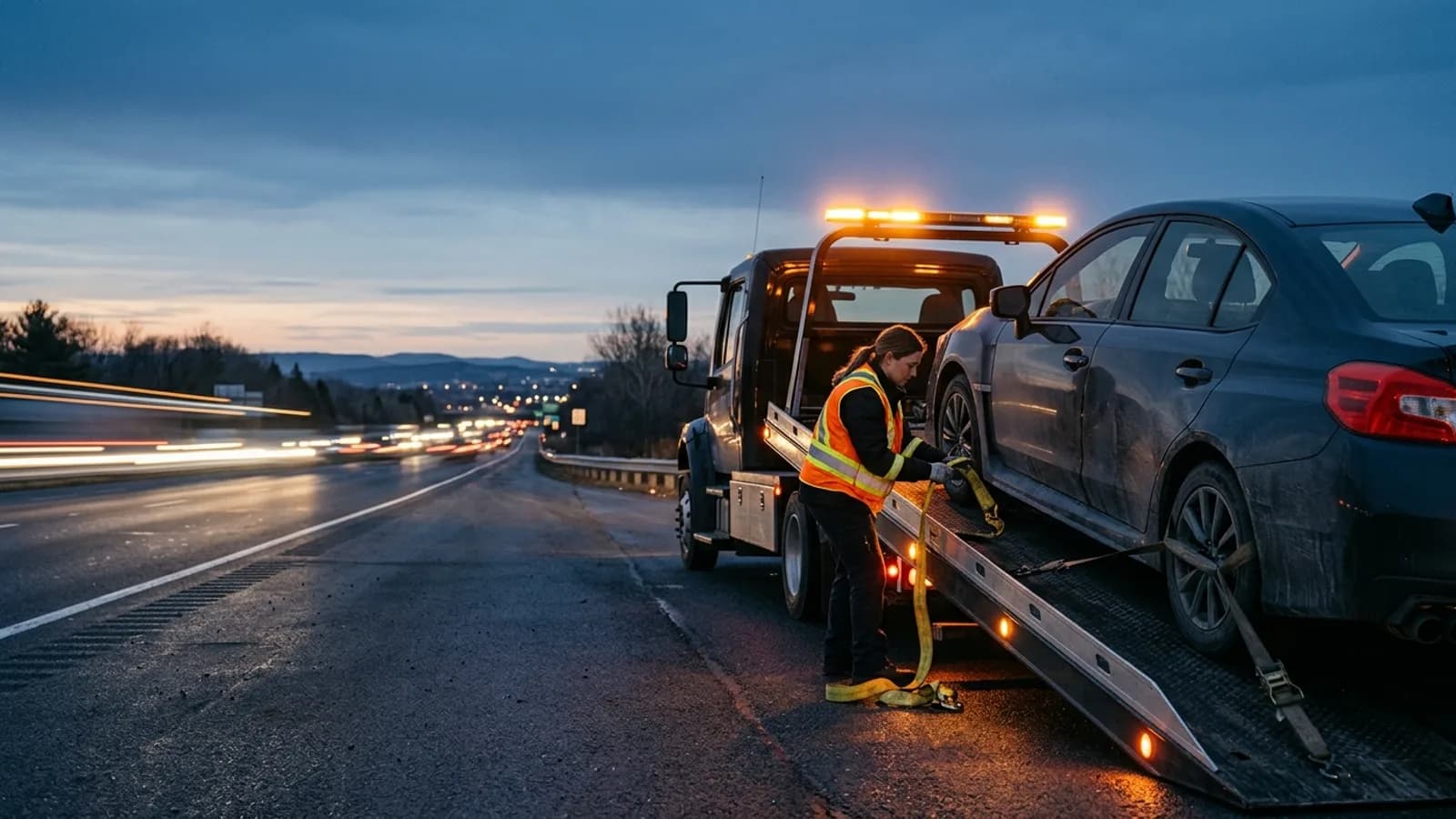
Towing is the only trade in this series where "after-hours coverage" is a meaningless phrase - there are no hours. The breakdown at 3 a.m. is not the exception to your business; it is your business, and the caller standing on a shoulder next to a dead car dials until somebody answers. A towing answering service is really a dispatch intake service, and that distinction drives everything about setting one up. We build the AI kind, so read this skeptically: here's what the intake has to capture, which calls must never touch a script, and where a human dispatcher still wins.
Our articles are still written by humans!
Get human written articles in your Google feed.
The short answer
A towing answering serviceanswers every call, around the clock, and runs a dispatcher's intake: where exactly the vehicle is, what it is, whether it rolls and steers, whether the caller is somewhere dangerous, and how to reach them. It quotes standard jobs from your configured rate card, sends the complete job to your on-duty driver by text or dispatch software, routes police and account calls straight to a human, and logs everything. Live operators, an AI receptionist, or a hybrid can run it; because towing volume is bursty, nocturnal, and simultaneous - three breakdowns in the same rainstorm - parallel AI answering with human judgment on top fits the shape of the work unusually well. For the general always-open problem this solves, see our 24 hour answering service guide; this one is about what makes towing different.
A business that is only after-hours
The scale of roadside demand is enormous - AAA alone reports responding to roughly 30 million roadside assistance calls a year - and none of it respects a business day. For an independent operator, that creates a brutal staffing equation:
- You're driving, so you can't answer.The hours you're busiest towing are the hours the next calls arrive, and hooking a car on a live shoulder is no place to take one. Every job you're on is a window where the phone loses.
- Calls cluster with weather and traffic.The first icy morning doesn't produce one slide-off; it produces twenty, simultaneously, while you're winching the first one.
- The caller redials instantly. Nobody stranded on a shoulder leaves a voicemail. The HBR research on lead decay measured contact odds collapsing within an hour; a stranded motorist's window is measured in rings. Second place in answering is last place in towing.
Cash calls, motor clubs, police rotation
Towing's inbound phone isn't one stream - it's three, with wildly different economics, and the service must treat them differently:
The three streams on a towing company's line
| Stream | Economics | Right handling |
|---|---|---|
| Cash / direct calls | Your highest-margin work - full rate card, no club fee schedule | Fast, complete intake and a dispatched driver; never on hold behind anything |
| Motor club members calling directly | Club jobs mostly arrive via digital dispatch; phone callers are often confused members | Route to the club's process politely - or capture the job if you take the work directly |
| Police rotation / law enforcement | Steady volume that depends on flawless response - a fumble risks the rotation spot | Recognition rule: skip all scripting, ring the driver/owner directly; AI is fallback intake only |
The strategic point: because club work flows through apps, the calls that actually ring your phone skew heavily toward the work you most want. That makes the phone line more valuable per call than almost any other trade's - and voicemail on it proportionally more expensive. The arithmetic is the same as in the cost of a missed call, with towing's margin structure sharpening it.
What it actually does, call by call
- Answers on the first ring, in parallel- the rainstorm's third simultaneous caller gets the same instant pickup as the first. (How parallel answering works: this answer.)
- Runs the dispatch intake: location (the section below), vehicle year/make/model and color, does it roll and steer, automatic or manual, anyone with the vehicle, keys available, callback number.
- Checks safety: if the caller is in a live lane or an unsafe spot, the script says what every dispatcher says - stay out of traffic, hazards on, wait behind the barrier - before anything else.
- Quotes standard jobs from your rate card and gives an honest ETA range you configured, not a fantasy one.
- Dispatches and confirms: complete job to your driver by text or dispatch software, confirmation text to the caller with the ETA and truck description, log entry for you.
The location problem (towing's hardest intake question)
Every trade needs an address. Towing needs a position- and the caller often doesn't know it. They're "on the highway past the mall, I think northbound." A good intake script works the problem like a dispatcher:
- Road and direction first - which highway or street, which way were you heading, what was the last exit or landmark you passed.
- Fixed references - mile markers, exit numbers, cross streets, business signs visible from the car.
- A pin when possible- the service texts a link and the caller shares their phone's location, which ends the guessing entirely. Configure this; it turns the worst intake question into the easiest.
- Read it back. A wrong-side-of-the-highway dispatch costs your driver a double crossing and twenty minutes. The script confirms position and direction before ending the call.
Quoting without negotiating
Towing callers ask the price up front more than any other trade's - they're standing next to the problem, comparing two phone quotes, and deciding in one call. The right configuration is strict:
- Rate card jobs get quoted exactly: hook fee, per-mile, after-hours surcharge, dollies. A firm, honest number wins against a competitor's "depends" more often than it loses.
- Non-standard jobs get captured, not priced: recoveries, winch-outs, accident scenes, heavy duty. The AI collects photos-by-text and details and gets you on the line or calls back with your number.
- No haggling."The other company said eighty" is a conversation for a human with authority - the script holds the card politely and offers the handoff.
Live agents vs AI vs hybrid
Answering service models for towing companies
| Model | Best fit | Watch out for |
|---|---|---|
| Live dispatch bureau | Multi-truck fleets wanting human judgment on every assignment | Per-minute/per-call costs at night-heavy volume; hold queues in storms - the moments the phone matters most |
| AI receptionist | Owner-operators and small fleets drowning in night calls and drive-time misses | Rate card, ETA ranges, and police-recognition rule must be configured; assignment judgment stays with you |
| Hybrid (AI intake, human assignment) | Most growing operations: AI captures every job completely, you or a dispatcher accept and assign | Define the always-human list: police, accounts, recoveries, disputes |
Costs across the market are in our answering service cost guide; our flat-rate plans are on the pricing page. Your number stays either way - forwarding handles it.
What good calls sound like
The 3 a.m. breakdown (intake + dispatch)
The rotation call (recognition, not scripting)
Where AI loses (keep a human here)
- Assignment judgment. Which truck and which driver for a recovery on a grade in the rain is experience, not intake. The AI hands over a complete picture; a human decides.
- Non-standard pricing.Recoveries and accident scenes are priced by someone who can see - or has seen - the situation. Photos by text narrow the gap; they don't close it.
- Distressed callers.Post-accident callers can be shaken; the script keeps it calm and brief, but anyone who needs a person gets one instantly - and anything involving injuries starts with "call 911 first."
- Account and commercial relationships. Fleet accounts, body shops, and property managers calling with standing arrangements expect recognition and flexibility - route known account numbers to a human or a tailored flow.
Setting it up
- Write the rate card and ETA ranges down. Hook, mileage, surcharges, and honest time ranges by zone. The intake is only as good as the card behind it.
- Configure the recognition rules. Police dispatch numbers, motor club lines, and account customers - each with its own routing before the general script.
- Set up driver handoff.Jobs to the on-duty driver's phone by text with everything attached; a rotation fallback if unacknowledged in minutes. Test it at night, when it matters.
- Run it on nights first. Nights are where the misses live and the risk of change is lowest. Read a week of transcripts, tighten the location script, then extend to drive-time overflow.
The decision test: you already know how many calls ring out while you're under a car or asleep - it's most of them. The question is only whether they reach your intake or your competitor's. See our 24 hour coverage guide for the always-on economics, check pricing, and test the intake against your own worst night.
Frequently asked questions
What is a towing answering service?
A towing answering service answers your line around the clock and runs the intake a dispatcher would: exact location (cross streets, highway direction, mile marker), vehicle details, whether it rolls and steers, whether anyone is in a dangerous spot, and a callback number. It quotes from the rate card you configured, dispatches to your on-duty driver by text or your dispatch software, and logs every call. It can be live operators, an AI receptionist, or a hybrid.
How much does a towing answering service cost?
AI-based services typically run about $30 to $300 a month flat with parallel call handling; live dispatch bureaus bill per minute - usually $1 to $3.50 - or per call, which lands at $500 to $1,000+ monthly for a busy operation. The comparison that matters: one hook fee plus mileage on a single captured cash call covers a month of the AI option, and towing misses calls all night by definition unless someone - or something - is always on the phone.
Can an AI actually dispatch a tow truck?
It can run the intake and hand your driver a complete job - location, vehicle, condition, photos of the situation via text link if you enable it - by text, call, or your dispatch software. What it shouldn't do is make judgment calls that belong to you: which driver takes a heavy recovery, whether to accept a winch-out sight unseen, or how to price a non-standard job. Good setups automate the intake completely and leave accept/assign decisions with a human where you want them.
How does it handle motor club calls versus cash calls?
Differently, which is the point. Motor club volume (AAA, Agero, and the like) mostly arrives through digital dispatch platforms, not your phone line - so the phone is disproportionately cash calls, your highest-margin work, plus club members calling directly in confusion. The service should fast-track cash intake, politely route misdirected club members to their club's process (or capture the job if you take it), and never leave a cash caller on hold behind anything.
What about police rotation calls?
Treat them as sacred. When dispatch or an officer calls for a rotation tow, response time is being measured and a fumbled call can cost you your rotation spot. Configure a recognition rule - known dispatch numbers or the caller identifying as law enforcement - that skips all scripting and rings straight through to your driver or owner, with the AI only as fallback intake if nobody picks up. This is a hard requirement, not a nice-to-have.
Can it quote towing prices?
From a rate card, yes - and only from a rate card. You configure the hook fee, per-mile rate, after-hours surcharge, and standard extras, and the service quotes exactly that. Anything non-standard - recovery, winching, heavy duty, accident scenes - gets captured in detail and passed to you for a price. An answering service that improvises towing prices will cost you money in both directions: quotes too low that you have to honor, and quotes too high that lose the call.