

Property management runs on one phone line doing four jobs: tenants calling about things that are broken, prospects calling about apartments they might rent, owners asking about their statements, and vendors chasing access or an invoice. The first two call at the worst possible times. A property management answering service exists so that none of those calls hits voicemail - the burst pipe gets triaged at 2 a.m. and the leasing lead gets a showing booked on Sunday afternoon. You can buy that from live operators or from an AI receptionist, and the AI products differ by an order of magnitude in what they actually save you. We build the AI kind, so read this skeptically: here is where each model wins, what "integrates with your PMS" really means, and how to set it up without regretting it.
Our articles are still written by humans!
Get human written articles in your Google feed.
The short answer
A property management answering serviceanswers tenant, prospect, owner and vendor calls when your office can't, sorts emergencies from routine requests, captures maintenance issues with the unit and details, and books leasing showings. It can be run by live operators, by an AI receptionist, or a hybrid of both. For most property managers the strongest setup is an AI service handling the high-volume routine calls around the clock, with hard rules for escalating genuine emergencies to on-call maintenance and handing sensitive conversations to a person.
If you are buying the AI version, one question separates the products: after the call ends, what has changed inside your software? The voice, the 24/7 coverage and the pleasant handling of an angry resident are table stakes now. The difference between a product that pays for itself and one that moves your admin from voicemail to email is whether a tour lands on a real calendar and a work order lands in your real PMS. If you want the product version of this article, our AI receptionist for property management page shows how we do it; this guide is the honest context around that pitch. If you run an on-site leasing office at a single community rather than a scattered portfolio, the sister guide to apartment answering services covers leasing-call handling in that setting.
The 2 a.m. burst-pipe problem
Every industry has a signature phone call. Property management's is the one at 2 a.m.: a tenant, water coming through the ceiling, and a phone tree that ends in voicemail. This single call type is why answering services exist in this industry, and it's worth being precise about what makes it hard. The problem isn't answering the phone. The problem is that the 2 a.m. caller is one of two very different people:
- The true emergency - active flooding, no heat in January, a gas smell, sewage backing up. This call needs a human with a wrench dispatched now, and every minute of delay is water damage, tenant risk, and liability.
- The can-wait-until-morning call- the dishwasher died, the bathroom faucet drips, a neighbor is noisy. This call needs to be heard, logged accurately, and answered with a credible "it's in the system, someone will follow up tomorrow" - and it absolutely should not wake your on-call plumber.
Sorting those two correctly, every time, at any hour, is the entire value of a property management answering service. Get the triage wrong in one direction and you pay emergency-callout rates for a dripping faucet; get it wrong in the other and you're explaining to an owner why a unit flooded for six hours. Voicemail, for the record, gets it wrong in both directions at once: the emergency waits till morning and the tenant feels ignored.

Four callers who dial the same number
A management company's line is unusual because four different businesses share it, and a script tuned for one is actively wrong for another. Front-desk staff switch between them without noticing; a live operator or an AI has to be told.
One number, four jobs
| Caller | What they want | What good handling looks like |
|---|---|---|
| Prospect | Is anything available, how much, can I see it | Availability and rent from your listings, two qualifying questions, a showing booked into the real calendar, a text with the address |
| Resident | Something is broken, or a question about rent, access, parking, notice | Triage against a written severity list, request captured with property, unit and category, on-call paged only for genuine emergencies |
| Owner | Why is my statement like that, is the unit leased, when am I paid | Identify them, never improvise about money, capture the question, route to the person who owns the account |
| Vendor or contractor | Access, a PO number, confirming a job, chasing an invoice | Confirm the scheduled work, capture the reference, hand anything financial to accounts |
The single highest-value design decision is what happens in the first fifteen seconds, because the branch chosen there determines everything after it. Getting a resident's emergency into the leasing script is the failure that makes the news; getting a prospect into the maintenance script just loses a lease quietly. Leasing calls also follow the same speed-to-lead logic we cover for real estate answering services: a prospect who reaches voicemail calls the next listing.
The output that matters is what lands on your desk afterwards: a structured record per call - property, unit, caller type, issue, urgency, action taken - rather than a row of voicemails to decode over coffee.
Live agents vs AI vs hybrid
Answering service models for property management
| Model | Best fit | Watch out for |
|---|---|---|
| Live human operators | Small portfolios with low call volume; owners who want a human voice on every call | Per-minute billing with night/weekend premiums - the exact hours you need coverage; operators read scripts and rarely book or log into your systems |
| AI receptionist | High call volume, heavy after-hours load, multi-property portfolios, routine-dominated call mix | No judgment on genuinely messy calls; needs explicit escalation rules and a tested on-call path before going live; most products only email a summary |
| Hybrid (AI first, human backup) | Most growing property managers: AI answers everything and finishes the routine majority, humans take what the rules escalate | More setup: you must actually write the handoff rules, and keep them current as properties and on-call staff change |
Why the call mix suits AI
We'd say this, but the structural argument is real. Some industries are awkward fits for an AI receptionist; property management is close to the ideal case:
- The volume is high and the intake is repetitive. Across a portfolio, most calls are variations on a small set: something's broken, is the unit still available, where do I pay rent. Predictable, structured intake is exactly what AI does reliably - and exactly what burns out office staff.
- The after-hours load is brutal and unavoidable. Maintenance doesn't respect office hours, and prospects call evenings and weekends because that's when they apartment-hunt. A human answering that load means an on-call rotation people resent or a per-minute bill at night rates; an AI answers at 2 a.m. for the same flat rate as 2 p.m. - the economics we walk through in our 24-hour answering service guide.
- Triage is rule-based, not judgment-based.Whether a call escalates isn't a matter of feel - it's a list you can write down. Rule-following without fatigue is the one thing software does better than a tired human at 3 a.m.
- Speed-to-lead applies to leasing. The classic Harvard Business Review research on lead response time found contact odds collapse within the first hour. A prospect calling about a listing is comparing several, and a vacant unit that sits an extra month because evening calls went to voicemail is an expensive way to save on answering.
For most property managers the honest recommendation is hybrid: the AI catches every call and fully handles the routine majority, on-call maintenance receives only what the triage rules escalate, and your office staff spend their hours on the disputes, renewals, and owner relationships that actually need them.
The four rungs of integration
Nearly every AI product sold to property managers promises the same three things: it answers 24/7, it books tours, it handles maintenance. The word doing the work is "handles". Handling a maintenance call can mean emailing you a tidy summary that somebody types into AppFolio in the morning, or a work order already sitting in AppFolio with the unit, category and priority filled in.
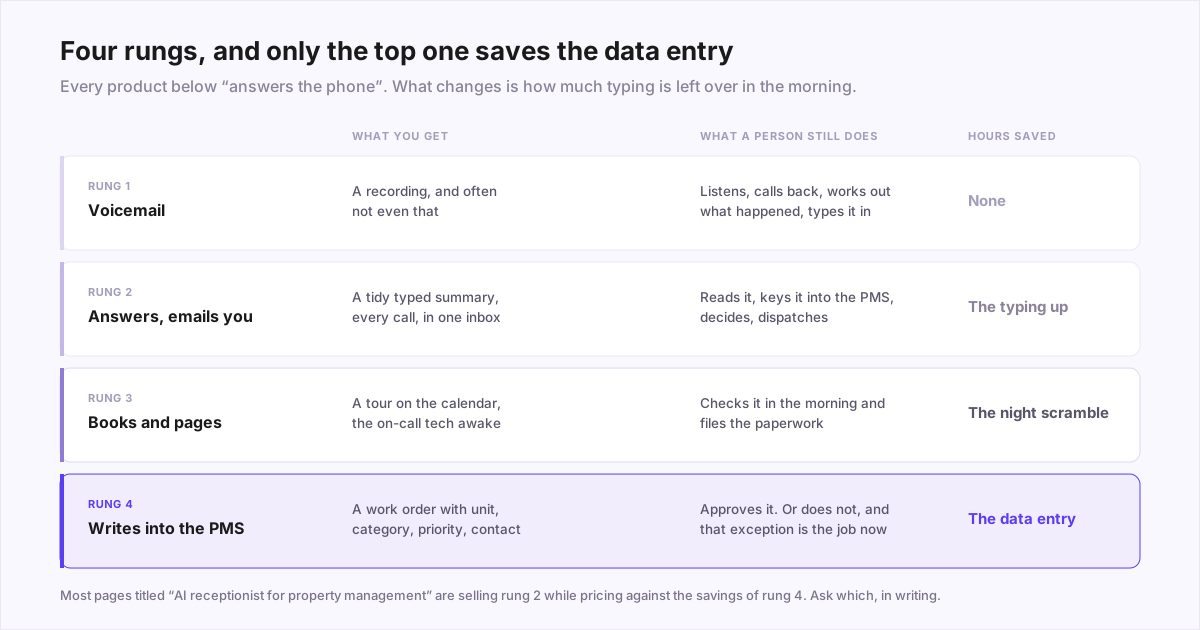
Most products marketed to property managers live on rung 2, and rung 2 is genuinely worth buying - a captured call beats a missed one, and a structured summary beats a voicemail nobody replays. The problem is that the marketing is written against rung 4 savings. A product that emails you a summary saves the minutes you would have spent listening to voicemail and reconstructing what happened; it does not save the data entry. If the answer to "what changed inside my software?" involves a person opening an email, you are on rung 2 and should price accordingly.
For transparency about our own product: we sit on rung 3. We book into Google Calendar, Outlook and Cal.com, transfer emergency calls to on-call by your rules, and can send each call's details to another system by webhook. We do not write work orders into AppFolio, Buildium, Yardi or any other PMS directly. If native write-back is essential to you, that rules us out, and you should know it before a demo.
Writing into your PMS: Buildium, AppFolio, Yardi
Why do so few vendors reach rung 4? It is rarely the AI vendor's fault. Property management software is a system of record for money, leases and legal notices, and the vendors guard write access accordingly. The three you are most likely to run behave quite differently.
Buildium: publicly documented
Buildium operates an Open API with a public developer portal and published endpoints. Any competent vendor can read the documentation before speaking to you, which is why Buildium integrations tend to be the first ones built. Access is tied to your subscription tier, so confirm your own plan includes it before assuming.
AppFolio: partner programme
AppFolio exposes its API to integration partners through AppFolio Stack. Its own become-a-partner page describes an application reviewed on several factors and a security compliance questionnaire, rather than published self-serve credentials. Practically: a vendor either is a Stack partner or is not, and that is a yes-or-no question you can ask in one email.
Yardi: an interface programme with a fee
Yardi is the most explicit about the shape of the deal, and its own page is worth reading before you ask a small vendor why they do not integrate.
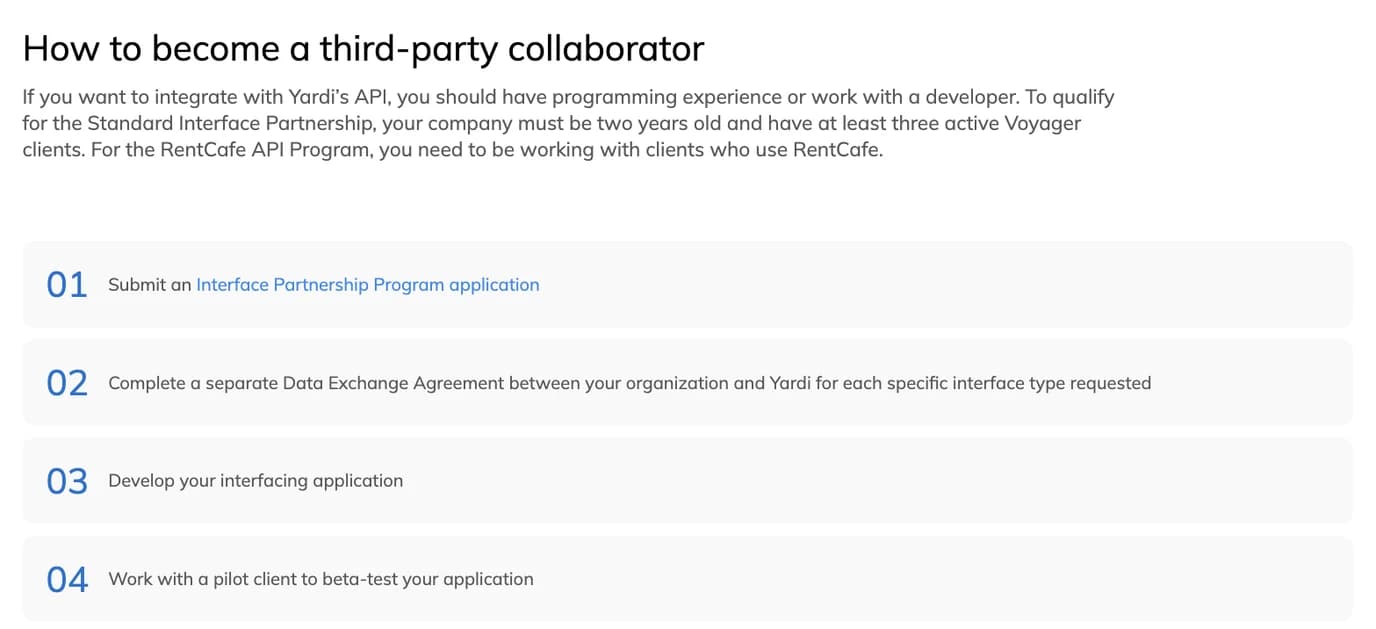
Two years of trading, three active Voyager clients, a separate data exchange agreement per interface type, and an annual licence fee. None of that is unreasonable for a system of record - but it explains, better than any competitive analysis, why deep write-integration in this industry clusters among vertical platforms with enterprise contracts, and why the generalists send you an email instead.
Features that matter (and what's noise)
Vendor feature lists blur together. Beyond integration depth, four things decide whether you'll be happy:
Emergency escalation rules you define
Not a generic "urgent calls are transferred" promise - an explicit, editable rulebook: which situations escalate, to whom, by transfer or page, and what happens if on-call doesn't pick up. Ask to see where the rules live and change one during the demo. The design principle worth insisting on: when a call is ambiguous, fail toward escalation. A false alarm costs minutes; the opposite mistake costs a ceiling.
Structured work-order capture
Property, unit, caller, issue, access permission, callback number - captured as structured fields, not prose, and pushed to wherever your maintenance queue lives. A transcript someone has to retype into your system is work created, not removed; how far the push can go is the integration question above.
Multi-property routing
If you manage more than one building, the service must know which property the call concerns and apply that property's playbook - its on-call contact, its vendors, its owner's preferences. One number, many properties, zero "which building are you again?" confusion in the morning summary.
Bilingual handling
Tenant populations are multilingual, and a maintenance emergency described in a caller's second language is where details get lost. An AI receptionist that switches to the caller's language logs the request correctly instead of approximately; live services vary widely in the hours they staff Spanish. We compare the options in our bilingual answering service guide.
Vertical platform or general AI receptionist?
Two genuinely different AI products are sold into this market, and the deciding variable is portfolio size rather than preference.
Two products, two different buyers
| Vertical multifamily AI | General AI receptionist | |
|---|---|---|
| Examples | EliseAI and its peers, sold to enterprise operators | Packaged AI receptionists sold to any small business |
| Integration | Deep, into the industry's systems of record, partner programmes cleared | Mainstream calendars and CRMs; PMS write access is the exception |
| Scope | Leasing, renewals, delinquency, resident comms across channels | The phone line, plus booking and escalation |
| Pricing | Quoted enterprise contract, sized to the portfolio | Flat monthly fee per line, cancellable |
| Time to live | A procurement cycle and an implementation | An afternoon |
| Fits | Thousands of doors, a dedicated ops team, an evaluation budget | A few hundred doors or fewer, or a single site with nobody at the desk |
The failure mode in both directions is expensive. A large operator buying a packaged line gets calls answered and no integration into the systems their staff live in, so the admin remains. A small manager buying vertical software gets a capability set they have no volume to consume, plus a procurement cycle. We wrote up the wider version of this trade in the platform comparison.
What good calls sound like
The quality of any answering service lives in the call itself, so here are the three calls that matter most, kept short on purpose - because long scripts are where both AI and tired humans go wrong.
Emergency maintenance: the leak
Notice the shape: disclosure up front, unit captured, severity confirmed with one question, one safe universal instruction, and an immediate live transfer - contact details come after, while the technician is already being reached. If the setup pages rather than transfers, the caller should hear that someone has been paged and, once it is acknowledged, roughly when to expect contact. What they must not hear is an arrival time nobody has agreed to.
Leasing inquiry: booking the showing
The call answers the two questions every prospect asks, then pushes to a booked showing instead of "check the website." Two qualifying questions are worth asking every time - when they are looking to move, and whether they have seen the listing - and the script answers questions about the property, never about who lives there or who the building would suit.
The owner at 4 p.m.
"Why was my distribution short this month?" The correct behaviour is almost entirely restraint. Identify the owner, take the question precisely, promise a callback from the person who actually knows, and say nothing about the number. An answering service that speculates about an owner statement has created a conversation the accounts team now has to unwind.
The verification problem
A leasing agent knows the residents by voice. An operator in a call centre does not, and neither does software - and this creates a security surface the marketing never discusses. On a property management line, three requests are far more sensitive than they sound:
- Access.Gate codes, door codes, key release, buzzer entry, letting a "contractor" into a building. A caller who can name a resident and a unit number is not thereby entitled to any of it. The rule has to be verification against the record, and a polite, scripted refusal when it fails - at 10 p.m., under social pressure, without apology.
- Personal and financial detail.Balances, payment history, whether someone still lives there, when they moved out. "I'm her son" is not authentication. Neither is knowing the address, which is on a public listing.
- Anything touching a notice or a legal process. Late fees, cure periods, eviction filings, lease terminations. The served notice is the operative document, and an improvised sentence on the phone about dates or amounts is the sort of thing that shows up in a filing later. The script reads what is on record and escalates.
There is an upside worth naming honestly. With an AI line every one of these calls is transcribed and timestamped, so what a resident was told, and when, stops being a memory contest. That is a materially better evidence position than most management companies have today.
Where AI loses, and what it must refuse
Against our own commercial interest, here is where an AI answering service is the wrong tool for a property manager:
- Angry tenants. A tenant on their third call about the same unfixed issue does not want a pleasant intake flow - they want a human who can own the problem. A polite AI at that moment reads as stonewalling. Configure frustration as an escalation trigger, not something to smooth over.
- Complex disputes.Deposit disagreements, neighbor-vs-neighbor conflicts, lease interpretation - these are negotiations with context and history. The AI's only correct move is capturing the facts and routing to a person who can decide.
- Trust and disclosure. Some tenants will resent discovering mid-call that they were talking to software. A short disclosure up front costs nothing and is consistent with the spirit of the FTC's guidance on clear disclosures. Tenant relationships are years long; don't spend trust to hide a robot.
And five things any answering service - live or AI - should be configured to refuse:
- Give out an access code on an unverified call. Ever, at any hour, to anyone with a good story.
- Say whether someone lives there.Not to a caller, not to a "relative", not to someone who sounds official.
- Negotiate money. Payment plans, fee waivers, rent adjustments and settlement of a balance are manager decisions, made deliberately and recorded.
- Interpret a notice or a legal deadline. Rent demands, lease violations, eviction-adjacent conversations: it restates what was served, takes a message, and a human with authority calls back.
- Characterise the building or its residents.Anything in the shape of "it's mostly..." or "you'd fit in well here" is a Fair Housing problem in written form. The script describes the unit, the terms and the process. Nothing else.
The habitability question: why after-hours response is a legal matter
One reason emergency triage deserves this much attention: responding to serious maintenance problems isn't just customer service. In general, landlords are legally obligated to keep rental housing habitable - and conditions like no heat, no water, flooding, or gas leaks are the kinds of problems that trigger a duty to respond promptly, not at the office's convenience. The specifics vary significantly by state and city, so treat this as orientation rather than legal advice; HUD's tenant rights pages link out to each state's rules, and your local landlord-tenant counsel knows your exact obligations.
Two practical implications for your answering setup. First, a phone line where habitability emergencies can sit unheard in voicemail overnight is a liability shaped like a convenience. Second, a good answering service produces something voicemail never does: a timestamped record - when the tenant called, what they reported, when it was escalated, to whom. If a dispute ever arises about whether you responded promptly, that log is the difference between a documented response and a shrug.
How to set it up: a two-week pilot
- Count what you are missing first.Pull last month's call log and count calls outside office hours, and how many of those numbers never called back. That number is the entire business case, and it costs nothing to produce.
- Write the emergency list.With your maintenance lead, define exactly what escalates (flooding, no heat in cold weather, gas, sewage, security failures, lockouts if you cover them), what is next-business-day, where each goes, and the fallback if on-call doesn't answer. Your existing on-call policy is the source. This document is the product; everything else is plumbing.
- Load per-property knowledge. Addresses, units, on-call contacts, approved vendors, rent payment instructions, pet and guest policies, parking, application fee and process, income requirements as you state them publicly, utilities included, current listings with rents. The service is only as useful as the briefing you give it.
- Connect the calendar and the maintenance queue. Showings should book into a synced calendar; work orders should land in your ticketing system, not an inbox someone forwards. Send the vendor the integration question from the PMS section and get the answer in writing.
- Have counsel read the leasing script.Twenty minutes of a lawyer's time against a written script is the cheapest Fair Housing exposure you will ever buy down.
- Start with after-hours only. Conditional forwarding on no-answer and after-hours takes minutes and risks nothing - those calls were going to voicemail anyway, and your team keeps every call it was already handling. Expand to daytime overflow once you trust it.
- Test the triage yourself, at night. Call your own line and report a fake leak, a fake dead dishwasher, and a leasing inquiry; ask for a gate code you should not get. Confirm each lands where it should, and that the on-call ladder works when the first person does not answer - the setup we spell out in the 24-hour answering service guide. Repeat after any change to properties or on-call staff.
- Read every transcript for two weeks. Not the dashboard. You will find questions your script fumbles that your leasing agent answers without thinking; tighten the rules and treat it like a new hire in training.
- Measure one thing. Showings booked from after-hours calls, and emergencies dispatched before morning. If neither moved, stop paying.
None of this is legal advice, and your counsel and your state's landlord-tenant law govern. If your call mix is mostly routine intake and your after-hours coverage is currently a prayer, see how our AI receptionist handles property management calls, check the flat monthly pricing (month to month, billed in euros), and then judge it the only way that counts: call it yourself and report a burst pipe.
Frequently asked questions
What is a property management answering service?
It's a service that answers a property manager's phone when the office can't - after hours, weekends, or when staff are on site. It takes tenant maintenance calls, sorts emergencies from routine requests, logs work orders with unit and details, answers leasing inquiries, books showings, and routes owner and vendor calls to the right person. It can be staffed by live operators, by an AI receptionist, or a hybrid, and its core job is making sure a 2 a.m. burst pipe never lands in voicemail.
Is an AI receptionist for property management different from an AI answering service?
In practice the two phrases are used for the same thing, and any distinction is about packaging rather than technology. Historically an answering service meant a call centre that took messages, while a receptionist implied someone who handled the call - booked the tour, dispatched the plumber. When both are AI, the question stops being what it is called and becomes what it is allowed to write into. Ask any vendor using either phrase which systems it can create a record in.
Should I choose a live answering service or AI?
Live operators suit a small portfolio with low call volume, or an owner who wants a human voice on every call; watch for per-minute billing with premiums on nights and weekends, which is when tenant emergencies happen. AI suits high volume, heavy after-hours load and multiple properties, provided the escalation rules and on-call path are written and tested first. For most growing managers the answer is a hybrid: AI answers everything and handles the routine calls, and people take what the rules escalate.
Can an AI receptionist create a work order in AppFolio, Buildium or Yardi?
Sometimes, and it depends more on the property management software than on the AI. Buildium publishes an Open API with public developer documentation. AppFolio exposes its API through the Stack partner programme, which is an application and security review rather than a self-serve key. Yardi runs an Interface Partner programme with an annual licence fee per interface and eligibility requirements. So the honest answer from a vendor is either 'yes, here is the integration' or 'no, we send you a structured summary'. We are in the second group: we book into Google Calendar, Outlook and Cal.com and can send call data to another system by webhook, but we do not write into a PMS directly.
Can an AI answering service handle maintenance emergencies?
It can triage them - which is the actual job. You define what counts as an emergency and where those calls go, and the AI applies the rules identically on every call, then transfers to on-call maintenance or pages immediately. It never makes the repair judgment itself, and when a call is ambiguous a well-configured setup fails toward escalation. The step people skip is confirming that a human actually acknowledged the page: an unread page is a missed call with extra paperwork.
What counts as an after-hours maintenance emergency?
The usual short list: active water leaks or flooding, no heat in cold weather, gas smell, sewage backup, no electricity, a security failure like a broken exterior door, and lockouts if your policy covers them. Everything else - a dripping faucet, a broken dishwasher, a noise complaint - is logged as a ticket for the morning. Whatever your exact list is, write it down explicitly, because it becomes the answering service's triage rulebook.
Can it route calls differently per property?
Yes, and for anyone managing more than one building this is the feature to verify before buying. A good service recognizes which property the tenant is calling about, applies that property's rules - its on-call contact, its approved vendors, its owner's escalation preferences - and logs the request against the right unit. One phone number, many properties, each handled by its own playbook rather than a generic script.
Will an AI leasing script break Fair Housing rules?
It can, and this risk deserves more attention than any feature. The Fair Housing Act restricts statements that indicate a preference or limitation based on a protected class, and a leasing script that improvises about who the building suits is exactly the kind of statement that gets quoted back. The mitigating point is that an AI is consistent and fully transcribed - every caller hears the same answer and you can show it. Have your counsel read the leasing script before it goes live, and again when you change it.
How much does a property management answering service cost?
Live answering services typically bill per minute or per call, often with surcharges for nights, weekends and holidays - exactly when tenant emergencies happen. AI services usually charge a flat monthly subscription with no after-hours premium; ours is 99 euros a month including 1,000 talk minutes. Vertical multifamily AI platforms are quoted as enterprise contracts sized to a portfolio. The comparison that matters is against one lost lease and one after-hours flood that nobody dispatched.
Will tenants know they're talking to an AI, and will they mind?
Some will notice and a few will dislike it, but tenants mind waiting far more. The honest configuration is a brief disclosure up front. The reactions worth designing around are narrower: a tenant in a real emergency must hear within seconds how they reach a person, and a tenant calling for the fourth time about an unresolved issue will be angry at anything that sounds like a fresh start. Both are handled by fast escalation, not by hiding what answered.
Sources
- Buildium: Open API developer documentation
- AppFolio Stack: become a partner (application and security review)
- Yardi: Become an Interface Partner - programme fees and eligibility requirements
- 42 U.S.C. § 3604 - Discrimination in the sale or rental of housing (Cornell LII)
- Harvard Business Review: The Short Life of Online Sales Leads (lead response-time research)
- HUD: Tenant Rights, Laws, and Protections by state
- FTC .com Disclosures: how to make effective disclosures in digital advertising