
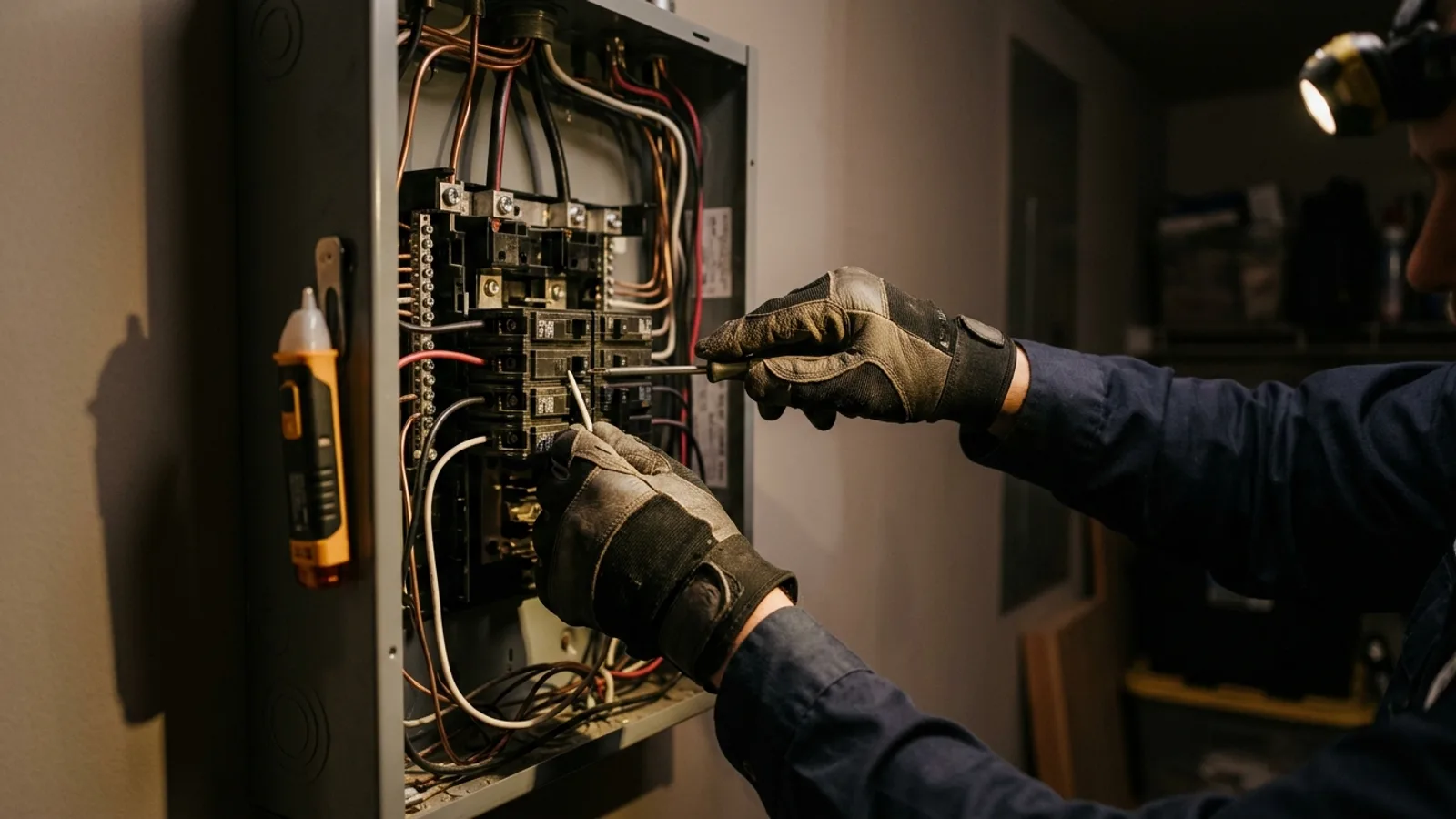
Electrical work punishes a ringing phone twice. Once because the work itself demands total attention - nobody should take a call with their hands in a live panel - and again because the missed caller might be describing something genuinely dangerous. An electrician answering service has to do more than take messages: it has to run safety triage, sort a utility outage from a wiring fault, and still book the panel-upgrade lead before she calls the next shop. We build the AI kind, so read this skeptically - here's what it does well, the safety rules that are non-negotiable, and where a human still wins.
Our articles are still written by humans!
Get human written articles in your Google feed.
The short answer
An electrician answering serviceanswers your calls when you can't - mid-job, after hours, or when two calls hit at once. It runs a safety check first on every call, sorts emergencies (burning smells, hot outlets, single-house outages) from routine work (dead circuits, fixture installs) and new-work leads (panels, chargers, remodels), books the bookable ones into your calendar, pages your on-call electrician for the rest, and texts you a summary. Live operators, an AI receptionist, or a hybrid can staff it; for most residential shops the hybrid shape wins, with strict, explicit safety rules configured before anything else. This guide is part of our trades series - see the home-services overview and the companion plumbing and HVAC guides.
Why electricians miss calls
- The work forbids the phone.Panel work, attic runs, live troubleshooting - the safest and best electrical work is done by someone who is not also managing a phone call. This isn't discipline failure; it's the job done right.
- Solo and small shops dominate the trade.Most residential electrical businesses are one to five people, all billable, none at a desk. Every hour someone answers phones is an hour of the shop's scarcest resource - licensed labor - not producing.
- Demand is outrunning the trade. The Bureau of Labor Statistics projects employment of electricians to grow much faster than average through 2034, with roughly 81,000 openings a year and a median wage over $62,000 - electrification, EVs, and aging housing stock are pushing more calls at the same number of licensed hands.
- Callers don't wait, and the urgent ones shouldn't.Someone staring at a scorched outlet isn't leaving a voicemail; per the HBR lead-response research, even calm shoppers slip away within the hour.
Safety triage comes first (this is the whole point)
For most trades, an answering service's worst failure is a lost lead. In electrical, it's a mishandled danger call. Before any booking logic, the script needs three hard rules, in this order:
- Fire signs → 911, immediately.Flames, smoke, or a burning smell that's getting worse: the caller is told to hang up and call 911, and - only if safely reachable - to shut off the main breaker. The call does not continue into scheduling. Ever.
- Danger signs → breaker off, on-call paged.Hot or discolored outlets, buzzing from the panel, a faint electrical smell, sparks when something was plugged in: kill the circuit at the breaker, don't touch the device, on-call electrician paged now.
- Ambiguity → escalate.If the AI can't confidently classify the risk, it pages a human. A false alarm costs minutes; the opposite error is the one nobody gets to apologize for.
The full triage table
A starting triage rule set for electrical calls
| Caller says | Classification | What the service does |
|---|---|---|
| Flames, smoke, burning smell getting worse | 911 | Hang up and call 911; main breaker off only if safely reachable. No booking. |
| Hot/scorched outlet, buzzing panel, sparks | Emergency | Circuit off at the breaker, don't touch it; page on-call electrician now |
| Whole house dark - and the neighbors too | Utility | Refer to the utility's outage line; offer follow-up if problems persist after restoration |
| Whole house or half the house dark - neighbors fine | Urgent | Page on-call or book first slot today; capture panel/breaker observations |
| One dead outlet or circuit, breaker keeps tripping | Same-day / next-day | Book promptly; capture what's on the circuit and what trips it |
| Panel upgrade, EV charger, fan/fixture install, remodel wiring | Sales | Qualify the job, book the estimate visit, tag as a new-work lead |
The utility fork deserves its own sentence, because it's the rule that pays for itself fastest: "Are your neighbors out too?"Whole-street darkness is the power company's job, and a script that says so - politely, with the outage-line number - saves your on-call electrician from unpaid night drives and makes your shop the one that gave honest advice at 10 p.m. That caller remembers you when the panel actually needs work.
What it actually does, call by call
- Answers instantly, every time - including simultaneous calls that would ring busy on a one-line shop.
- Runs the safety forkbefore anything else, then qualifies: name, address, callback, what's happening, what the caller has already tried.
- Applies your triage table identically at 2 p.m. and 2 a.m. - the consistency is the feature; it never gets tired and books a danger call out of politeness.
- Books into your real calendar or field-service software (Housecall Pro, Jobber, ServiceTitan, or a shared Google Calendar), offering actual slots and confirming by text.
- Texts you an actionable summary: "Breaker trips when dryer runs, 118 Cole Ave, booked Wed 8-10" or "Hot outlet, circuit off, on-call paged - urgent."
The new-work gold rush: panels and chargers
The emergency script protects your reputation; the new-work script grows the business. EV chargers, panel and service upgrades, heat pump circuits, hot tubs, remodels - these are four-figure, comparison-shopped, evening-researched jobs. The caller has three tabs open and is dialing down the list; she books with the first shop that answers, sounds competent, and puts a real estimate slot on the calendar. Configure the service to qualify just enough - charger location, panel age if known, rough timeline - and book the visit in the same call. This is the same first-responder dynamic we cover in the cost of a missed call, with the friendliest economics in the trade.
Live agents vs AI vs hybrid
Answering service models for electrical shops
| Model | Best fit | Watch out for |
|---|---|---|
| Live human operators | Shops wanting a person on every call, steady volume | Per-minute pricing; generic operators improvising on safety calls is the real risk - audit their electrical script hard |
| AI receptionist | Solo and small shops with after-hours and mid-job leakage | Safety rules must be explicitly configured and tested; ambiguous calls must fail toward a human |
| Hybrid (AI first, human backup) | Most growing shops: AI answers 100%, books routine and new work, pages humans for danger and judgment calls | Define handoff triggers precisely; test the fire rule yourself with a roleplay call |
Whatever the model, your number stays - forwarding handles it in about eight minutes. Market-wide pricing is in our answering service cost guide; ours is on the pricing page.
What good calls sound like
The 9 p.m. danger call (escalation)
The EV charger lead (booking)
Where AI loses (configure around it)
- Phone diagnostics. Whether that tripping breaker is an overloaded circuit, a failing GFCI, or a neutral problem is a licensed judgment. The AI captures symptoms precisely; it never plays electrician.
- Pricing beyond the rate card.Trip fee and honest ranges only. "What would a whole rewire cost?" books an estimate; it doesn't get a number invented on the phone.
- Code and permit questions. Real answers depend on jurisdiction and specifics. Capture the question for the electrician; a confidently wrong code answer is worse than none.
- Frightened callers who need a human.Some danger calls want a person's voice even after the breaker is off. Escalation on request should be instant and unconditional - more on how handoffs work in this answer on transfers, and on wiring the on-call ladder behind them in how to set up emergency call escalation.
Setting it up
- Configure and test the safety fork first. Before calendars, before greetings: roleplay a burning-smell call against the service and verify it does exactly what the table says.
- Forward after-hours and mid-job overflow. No-answer and out-of-hours forwarding only touches calls that were dying in voicemail. Keep answering yourself when your hands are free.
- Load the utility outage line and your rate card basics. The outage referral script needs the actual number; the booking script needs your trip fee and estimate policy.
- Connect the calendar, then audit week one. Book a fake fan install against your own number and confirm it lands. Read the first week of transcripts; tighten wording where the AI hedged or over-asked.
The decision test: count last month's voicemails and add the callers who didn't leave one. If any of them said the word "burning," you don't have a phone problem - you have a liability problem with a phone attached. See how our AI receptionist works for trade businesses, check pricing, and test it against your own worst call.
Frequently asked questions
What is an electrician answering service?
An electrician answering service answers your line when you can't - in a panel, in an attic, or after hours. It runs a safety-first script on every call (anything that smells like fire goes to 911 and the breaker, not a booking flow), sorts genuine electrical emergencies from routine and new-installation work, books jobs into your calendar, pages your on-call electrician for the urgent ones, and texts you a summary. It can be live operators, an AI receptionist, or a hybrid.
How much does an electrician answering service cost?
AI-based services generally run about $30 to $300 a month flat. Live operator bureaus bill per minute - typically $1 to $3.50 - which usually lands at several hundred dollars monthly. Set that against the work: a panel upgrade or EV charger install is a four-figure job, and service calls compound into repeat customers. One captured job most months covers the fee either way.
How should an answering service handle a possible electrical fire?
By refusing to be an answering service for that call. The script must be: if there are flames, smoke, or a burning smell that's getting worse, hang up and call 911 - and if it's safe to reach the panel, turn off the main breaker. No booking, no message-taking, no cleverness. A vendor that can't show you this rule configured word for word shouldn't be answering an electrician's phone.
Can it tell a utility outage from a problem with my customer's wiring?
Yes - with one question: are your neighbors out too? Whole-street darkness is the utility company's problem, and a good script says so, gives the caller the utility's outage line, and offers a follow-up if power returns but something's still wrong. Single-house or partial outages are your work and get triaged as urgent. That one fork saves your on-call electrician from driving to outages the utility will fix from a substation.
Can it book estimates for panel upgrades and EV charger installs?
A good one can, and this is quietly the highest-value configuration: new-work callers are comparison shopping, and the first electrician with a firm estimate slot on the calendar usually wins. Connected to your real calendar or field-service software, the service qualifies the job - panel size, service amperage if known, garage location for chargers - and books the visit during the call, with a text confirmation.
Do electricians really need after-hours answering?
Electrical emergencies are rarer than plumbing ones, but they're scarier and more urgent when they happen - a hot outlet or a repeatedly tripping main isn't a morning problem to the person calling. And the routine side leaks too: homeowners call about fans, panels, and chargers in the evening after work. Most shops start with after-hours and overflow forwarding, which only touches calls that were going to voicemail anyway.