

The pages that sell chiropractic answering services all promise the same thing: no more missed new patients. That part is easy. The part nobody writes about is the caller who says her foot has gone numb, or asks whether Medicare will pay, or wants to know if it is safe to wait until Monday - and gets an answer from someone who is not a chiropractor. This guide is built around those calls. We make an AI receptionist, so we have a stake in the outcome; the rules and clinical sources below are linked so you can read them without us.
Our articles are still written by humans!
Get human written articles in your Google feed.
The short answer
A chiropractic answering service answers your line when your front desk cannot, books and moves appointments, takes messages and answers factual questions. It should do nothing clinical: no opinion on what a symptom is, no advice on what to do about it, no reassurance that it can wait. For most calls that boundary never comes up. For the few where it does, the service needs a written list from you of what counts as an emergency, what must reach you before a routine visit is booked, and what it may say about insurance and price.
A general medical practice has the same problem on a larger scale; our medical answering service guide covers that. Chiropractic has its own shape - a very small team, a large self-pay share, and a set of musculoskeletal symptoms where the dangerous version and the routine version sound alike on the phone.
Why the phone goes unanswered
Because there is usually nobody free to answer it. In the National Board of Chiropractic Examiners' 2025 Practice Analysis, a survey of 3,876 chiropractors, 49% worked in a single-doctor office, and the average was 100 patient visits per chiropractor per week. The smaller Chiropractic Economics salary and expense survey (107 self-selected respondents, so treat it as indicative) describes the typical practice as seeing 138 patients a week and attracting seven new patients a week, with solo practices reporting two employees.
Put those together and the arithmetic is plain. One or two people run the desk, the therapy bay, check-in and check-out for a hundred-plus visits a week, and the phone rings while both of them have their hands full. Those seven new patients a week mostly start as a phone call or a web form. We are not going to quote a statistic for how many chiropractic calls go unanswered, because we could not find one that does not come from a company selling the cure. Your phone system's call log will give you your own number in five minutes, and it is the only one that matters.

What it should handle
- New patient calls. Name, phone number, what brings them in in their own words, how they heard of you, whether they plan to use insurance, and a booked first visit or a firm callback time.
- Reschedules and cancellations. The bulk of call volume in a practice built on repeat visits. Offer the next opening rather than just deleting the slot.
- Factual questions. Hours, address, parking, what to bring, whether you see children, whether you take a named insurance plan - from a sheet you wrote, not from inference.
- Messages for the doctor. Existing patients with a question about their care. Captured verbatim, not answered.
- Accident and injury intake. A caller after a car accident or a work injury is both a higher-value case and a clinical flag. Capture the date, what happened and who is paying, and route it to the doctor rather than into the next free slot.
- After-hours coverage. Evenings and Saturdays are when working patients call. See our after-hours answering guide for the coverage patterns.
- Calls in Spanish. If your community needs it, check how the service actually delivers it (what "bilingual" means in practice).
Seven sentences it must never say
Each of these is something a friendly, well-meaning person on the phone says naturally. Each has a rule or a primary source behind why it does not belong in the script.
What the script must not say, and what it says instead
| Never | Why | Instead |
|---|---|---|
| "That sounds like sciatica." | Naming a condition is diagnosis. California's rule says unlicensed individuals "are not permitted to diagnose, analyze, or perform a chiropractic adjustment" | “I'll note exactly what you've described so the doctor sees it before your visit.” |
| "Try ice and some gentle stretching until then." | That is a treatment recommendation. Texas rules say a licensee "may not delegate responsibility to render a diagnosis, prescribe a treatment plan, or perform adjustments" | “I'm not able to advise on that, but I can get your question to the doctor today.” |
| "You should be fine to wait until Monday." | The most dangerous of the seven. It is a triage decision made without an examination, by someone not licensed to make it | Follow the red-flag list in the next section. If nothing on it applies, book the earliest slot and say nothing about safety |
| "Yes, Medicare covers that." | Medicare covers only spinal manipulation to correct a subluxation, and states it does not cover other services or tests a chiropractor orders | State the facts from your sheet; offer a billing callback for anything specific |
| "Your first visit will be $75." - and nothing else | For an uninsured or self-pay caller, federal rules require telling them a good faith estimate is available, orally, when scheduling or when cost comes up | Quote your written fee if you publish one, and add the good faith estimate sentence |
| "The doctor can definitely fix that." | An outcome promise made on your behalf by someone who has not examined the patient. It is also the sentence a complaint quotes back | “The doctor will examine you and go through the options at your first visit.” |
| "Hi, this is Dr. Lee's office about your adjustment for your lower back..." on a voicemail | HHS guidance allows messages but advises limiting what is disclosed - for example the practice name, number and what is needed to confirm an appointment | Practice name, callback number, appointment time. No condition, no treatment |
New York's Office of the Professions puts the general principle in one sentence in its practice alert on unlicensed individuals: they may do general office work and collect and record patient data, but may not perform "tasks that require professional or clinical judgment". Rules differ by state and the three quoted here are examples, not a survey - your own board's rules are the ones that apply. The point for a phone script is the same everywhere: it records, it books, it routes. Whoever answers is, for this purpose, the least clinically qualified member of your team, whether that is a call-centre agent in another state or a language model.
Red flags are not a booking
Back and neck pain are almost always what they appear to be. A small number of callers describing the same pain have something that should not wait for an appointment, and a script that cheerfully offers them Thursday at 2:30 has failed. The service does not need clinical skill to avoid that. It needs a list, and an instruction to stop.
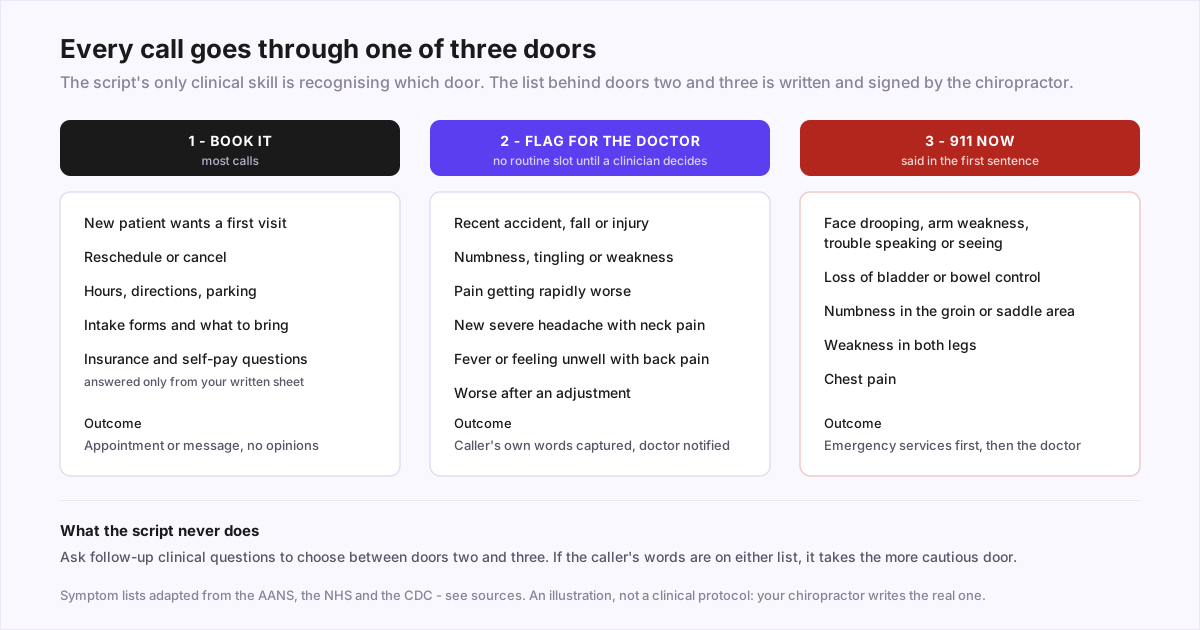
Emergency: tell the caller to call 911
- Stroke signs. The CDC's list is sudden numbness or weakness in the face, arm or leg, especially on one side; sudden confusion or trouble speaking; sudden trouble seeing; sudden trouble walking, dizziness or loss of balance; and sudden severe headache with no known cause. Its instruction is to call 911 right away.
- Signs of cauda equina syndrome. The American Association of Neurological Surgeons lists red flag symptoms including urinary retention, urinary or fecal incontinence, saddle numbness and weakness in the legs, and states that "immediate medical attention is required" for any of them. It adds that treatment within 48 hours of onset gives a significant advantage in recovery - which is exactly the window a Friday-evening "see you Monday" uses up.
- Back pain with chest pain, or after a serious accident. Both are on the NHS's call-emergency-services list for back pain, alongside numbness or weakness in both legs and loss of feeling around the genitals. The NHS is a UK source; the equivalent in the US is 911 or the emergency department.
Not routine: the chiropractor decides before anything is booked
- A recent accident, fall or other trauma.
- New numbness, tingling or weakness in an arm or leg.
- Pain that is getting rapidly worse, or with fever.
- A new, severe or unusual headache with neck pain. The 2014 American Heart Association and American Stroke Association scientific statement on cervical artery dissection notes that patients with a dissection may present with one-sided headache or pain at the back of the neck, and concludes that "practitioners should strongly consider the possibility of CD as a presenting symptom". The same statement is careful about causation: it says the evidence is insufficient to establish that manipulation causes dissection, while reporting a statistical association. For a phone script the implication is narrow and practical - this caller is the doctor's to assess, not the scheduler's to slot in.
- A patient who feels markedly worse after a visit. Always to the doctor, the same day.
Chiropractors already do this screening in person - in the NBCE survey 82% reported assessing risk factors and possible contraindications to care daily. The answering service's job is simply not to get in the way of it. The mechanics of wiring a call to reach you, then a backup, are in our emergency call escalation guide.
Medicare, insurance and price questions
After "can I get in today", the most common question a new caller asks is some version of "what will it cost me". This is where an untrained answer creates a billing dispute three weeks later.
Medicare
Medicare's coverage is narrower than most patients assume, and the script should be able to say so accurately. Medicare.gov states that Part B covers adjustments of the spine by a chiropractor "to correct a subluxation", that it "doesn't cover other services or tests a chiropractor orders, including X-rays, massage therapy, and acupuncture", and that after the Part B deductible the patient pays 20% of the Medicare-approved amount. The Medicare Benefit Policy Manual adds that chiropractic maintenance therapy "is not considered to be medically reasonable or necessary, and is therefore not payable".
That last line is why a script must never tell a Medicare patient that a visit "is covered". Whether a given visit is active treatment or maintenance is a clinical and documentation question, and it is one Medicare audits: a CMS guidance document for chiropractors reports that a 2024 review found errors in 33.6% of chiropractic claims. The phone is not the place to add to that.
Self-pay and the good faith estimate
Chiropractic has an unusually large cash side - in the NBCE survey, private pay and cash accounted for 41% of reimbursements. That makes one federal rule more relevant here than in most specialties. Under 45 CFR 149.610, providers must inform uninsured or self-pay individuals that a good faith estimate of expected charges is available, and the regulation says that information must be "orally provided when scheduling an item or service or when questions about the cost of items or services occur". Scheduling by phone is exactly that moment, and it is usually your answering service's moment rather than yours.
The timing rules, as CMS summarises them: care scheduled three to nine business days ahead gets an estimate within one business day; care scheduled ten or more business days ahead gets one within three business days; and a patient can ask for one before scheduling. The script does not produce the estimate. It asks whether the caller will be using insurance, says the sentence, and flags the booking so your office sends the document on time.
HIPAA, messages and reminders
- Are you a covered entity? Under 45 CFR 160.103, a health care provider is a covered entity if it "transmits any health information in electronic form in connection with a transaction covered by this subchapter" - in practice, electronic insurance billing. Most chiropractic offices do. A purely cash practice that never bills electronically should ask counsel rather than assume either way.
- The BAA. If you are covered, a service that receives patient names, numbers and reasons for visiting on your behalf fits the definition of a business associate, and 45 CFR 164.502(e) requires the arrangement to be documented in a written contract. Get it before the first forwarded call, and read what it says about recordings and transcripts. Many answering-service pages say "HIPAA compliant" and stop there; the agreement is the thing to ask for.
- Minimum necessary.The same section requires reasonable efforts to limit information to the minimum needed. For a message that means "new patient, low back pain since Saturday, wants this week" - not a medical history.
- Reminder calls and texts.If the service sends reminders for you, the FCC's healthcare exemption at 47 CFR 64.1200(a)(9)(iv) comes with conditions: sent only to the number the patient provided, limited to purposes such as "appointment and exam confirmations and reminders", no telemarketing or billing content, 160 characters or less for a text, at most one message a day and three a week, and an opt-out in every message. A "we miss you - 20% off your next adjustment" text is marketing, and is outside it.
The integration claim to check
Several answering services list ChiroTouch and Jane among their integrations. The software vendors' own pages are more cautious, and where the two disagree the software vendor is the one that controls access.
- Jane. Its integrations FAQ answers the question directly: "No, Jane doesn't currently have an open API or provide API keys." Jane describes an approval-based partner program instead, so an integration is possible only for vendors it has admitted.
- ChiroTouch. Its marketplace page listed the "Scheduling & Intake" category as "Coming Soon!" when we read it on October 1, 2026.
That does not mean every integration claim is false - a vendor may have a private arrangement, or may mean something looser, such as emailing a message that your staff type in. It means the claim needs a demonstration. Ask to watch an appointment appear in your own schedule during the trial. For transparency about our own product: we book into Google Calendar, Outlook and Cal.com, and can send the booking to another system by webhook. We do not write into ChiroTouch, Jane or any other chiropractic practice management system, so with us the appointment reaches your schedule through a synced calendar or through your front desk. If direct write-back is essential, that rules us out and you should know it before the demo. How calendar booking works is in our appointment booking guide.
Live agents vs AI vs hybrid
Answering models for a chiropractic office
| Model | Best fit | Watch out for |
|---|---|---|
| Live answering service | Offices that want a human voice on every call and have modest, predictable volume | Per-minute billing and rounding; agents covering many industries who improvise helpfully on clinical questions unless the script forbids it |
| AI receptionist | Offices losing calls during adjustments and after hours, with mostly routine scheduling calls | The BAA and data handling in writing; the red-flag lists configured as hard stops and tested; calendar-level booking rather than write-back to your practice software |
| Hybrid | Most multi-doctor offices: software takes routine scheduling, a person takes anything flagged | Decide who the person is at 7 p.m. on a Friday. If it is you, the escalation has to reach you reliably |
| Voicemail | Nobody, for new patients | A new patient in pain calls the next office on the list. An existing patient with a red-flag symptom leaves a message that is heard on Monday |
On cost, live services publish plans from about $149 to $395 a month for 100 minutes, and the invoice depends on how they round call time - we went through the published rate cards in the medical answering service pricing guide. Our own plans are flat and listed on the pricing page. You keep your existing number either way (how call forwarding works).
What good calls sound like
A new patient at 12:40, while the desk is at lunch
The Medicare question
The call that is not a booking
Setting it up
- Write the two lists first. Emergency, and not-routine. One page, in plain words a caller would use, signed by the chiropractor. Everything else in the setup is secondary to this.
- Write the fact sheet. Insurance plans accepted, the Medicare paragraph, new-patient fee if you publish one, the good faith estimate sentence, what to bring. The script may say what is on the sheet and nothing beyond it.
- Add the seven sentences as explicit prohibitions. With a live service, put them in the account instructions. With an AI agent, put them in the prompt as hard rules (how to write receptionist prompts).
- Sign the BAA before forwarding a single call, if you are a covered entity.
- Decide where bookings land and prove it. Watch a test appointment arrive in your schedule.
- Test the three calls above yourself. Especially the third. Call your own line after hours, describe a red-flag symptom in ordinary language, and see what happens. Then check that the alert reached your phone.
- Read a week of transcripts or listen to recordings. You are looking for one thing: a sentence that sounds like advice.
Frequently asked questions
What is a chiropractic answering service?
It answers a chiropractic office's phone when the front desk cannot - during adjustments, at lunch, in the evening and at weekends. It books and reschedules appointments, takes messages, answers factual questions about hours, location and intake, and passes anything clinical to the chiropractor. It can be a live answering bureau, an AI receptionist, or a combination. What separates a good one from a generic one is a written list of what the service may not say, and a tested route for calls that are not routine.
Can an answering service give advice about back or neck pain?
No. State rules reserve diagnosis and treatment decisions for the licensed chiropractor. California's regulation states that unlicensed individuals are not permitted to diagnose or analyze and may not render a conclusion about a patient's physical condition. Texas rules say a licensee may not delegate responsibility to render a diagnosis or prescribe a treatment plan. A phone script, human or AI, records what the caller says in the caller's own words and routes it. It does not suggest ice, heat, stretches, or that something can wait.
What should happen when a caller describes an emergency symptom?
The script should stop booking. Sudden numbness or weakness on one side, trouble speaking or seeing, loss of bladder or bowel control, numbness in the groin or saddle area, weakness in both legs, or chest pain are emergency signs, and the caller should be told to call 911. Other warning signs, such as a recent accident, pain getting rapidly worse, or a new severe headache with neck pain, should be flagged to the chiropractor before any routine appointment is offered. The chiropractor writes and signs this list; the service follows it.
Can it tell a caller whether Medicare covers chiropractic?
Only by reading what you have written down, and only the facts. Medicare Part B covers manual manipulation of the spine by a chiropractor to correct a subluxation, and Medicare's own page states it does not cover other services or tests a chiropractor orders, including X-rays, massage therapy and acupuncture. Maintenance therapy is not payable. A script should state that much, never say that a particular visit will be covered, and offer a callback from whoever handles billing.
Does a chiropractor need a BAA with an answering service?
If the practice is a HIPAA covered entity, yes. A chiropractor who transmits health information electronically in connection with a standard transaction, such as billing an insurer, is a covered entity, and a service that receives patient information on the practice's behalf fits the regulatory definition of a business associate. That relationship has to be documented in a written agreement. Ask for the BAA before the first call is forwarded, and ask where recordings and transcripts are stored and for how long.
Can an answering service book straight into ChiroTouch or Jane?
Check before you believe it. As of October 2026 Jane states that it does not have an open API and runs an approval-based partner program instead, and ChiroTouch's own marketplace page lists its Scheduling and Intake category as coming soon. Some answering services advertise integrations with both. Ask the vendor to show a live appointment being written into your system during the demo. If it cannot, the realistic options are a shared calendar, a booking link, or a message your front desk enters in the morning.
How much does a chiropractic answering service cost?
Live answering services publish plans from about $149 to $395 a month for 100 minutes, with overage from roughly $1.20 to $3 a minute, and the bill depends heavily on how each service rounds call time. AI receptionists are usually flat-rate; ours is 99 euros a month including 1,000 minutes. A solo office mostly needs lunch, adjustment-time and evening coverage, which is a few hundred minutes a month. Our medical answering service pricing guide walks through the published rate cards line by line.
Sources
- National Board of Chiropractic Examiners: Practice Analysis of Chiropractic 2025
- Chiropractic Economics: 28th Annual Salary and Expense Survey (2025, 107 respondents)
- American Chiropractic Association: Key Facts
- American Association of Neurological Surgeons: Cauda Equina Syndrome (red flag symptoms)
- NHS: Back pain - when to call emergency services
- CDC: Signs and Symptoms of Stroke
- Biller et al., Cervical Arterial Dissections and Association With Cervical Manipulative Therapy: AHA/ASA scientific statement, Stroke 2014;45(10):3155-74
- California Code of Regulations, title 16, section 312 - Illegal Practice (Cornell Legal Information Institute)
- Texas Administrative Code, title 22, section 78.3 - General Delegation of Responsibility (Cornell LII)
- New York State Education Department, Office of the Professions: Chiropractic practice alert - Use of Unlicensed Individuals
- Medicare.gov: Chiropractic services coverage
- CMS Medicare Benefit Policy Manual, Chapter 15 (sections 30.5 and 240 - chiropractic coverage, AT modifier, maintenance therapy)
- CMS: Medicare documentation checklist and guidelines for chiropractic doctors (MLN1232664, April 2025)
- 45 CFR 149.610 - Good faith estimates for uninsured (or self-pay) individuals (eCFR)
- CMS: What is a good faith estimate? (timing rules)
- 45 CFR 160.103 - definitions of covered entity and business associate (eCFR)
- 45 CFR 164.502 - minimum necessary and business associate contracts (eCFR)
- HHS: May health care providers leave messages for patients? (HIPAA FAQ 198)
- 47 CFR 64.1200(a)(9)(iv) - conditions for exempt healthcare calls and texts under the TCPA (eCFR)
- Jane: Integrations Hub FAQ (no open API)
- ChiroTouch: Marketplace (integration categories)