
Self storage is a business where the customer decides in about four minutes and never thinks about you again for two years. They are sitting in a rented truck with a phone in one hand and a map of three facilities on the screen, and they are renting from whoever picks up and can tell them a 10x10 is available today. Meanwhile the same number is being dialled by a tenant locked out at the gate and by someone sixty days delinquent who wants to argue about an auction. We build the AI kind of answering service, so read this sceptically: here is what each of those calls actually needs, and the two places where a well-meaning script can cost you real money.
Our articles are still written by humans!
Get human written articles in your Google feed.
The short answer
A self storage answering service covers the facility phone when the office is closed, when the manager is on the property doing lock checks, or - increasingly - when the site has no on-site staff at all. It answers immediately, checks live availability in your management software, quotes current rates, reserves or rents the unit, handles access problems and payment questions, and escalates anything involving the lien process, a security incident or a dispute to a person.
If you manage residential doors rather than storage doors, our property management answering service guide covers that call mix instead. Storage is its own animal: the sales call is unusually short, the service calls are unusually procedural, and one category of call sits on top of a state statute.

Six callers, one number
The call mix on a self storage facility's line
| Caller | What they need | Right handling |
|---|---|---|
| Prospect renting today | Is a unit that size available, what does it cost, can I move in this afternoon | Live availability, current rate, reserve or complete the rental, send the link and directions - in one call |
| Prospect shopping for next month | Sizes, climate control, access hours, vehicle parking rules | Answer, capture the move date, reserve if they will, follow up before the date |
| Tenant with an access problem | Gate code not working, locked out, arrived after access hours, overlock on the door | Verify identity against the record first, then resolve or escalate - never guess |
| Tenant paying or asking about a balance | The number, and how to pay it right now | Read the ledger, take the payment through your compliant channel or send the payment link, log it |
| Delinquent tenant facing lien action | To stop something that is already in motion | Balance from the ledger, restate the notice as written, escalate to the manager - no negotiation |
| Vendors, auction buyers, sales calls | Not your revenue | Captured and filtered; auction-buyer questions go to whoever runs your sales, in business hours |
Only the first two make you money, and they are the ones most likely to hang up. Everything else is an operations call that a script can handle well - as long as the boundaries in the next three sections are drawn properly.
Why a storage call is worth more than it looks
A missed call in most trades costs one job. In storage it costs a tenancy. The tenant who rents on Saturday is likely to still be paying many months later, through at least one rate increase, and the marginal cost of that occupancy to you is close to nothing. That is why the arithmetic is so unforgiving:
- The caller is not going to call back. They are working a map, in a truck, on a deadline. The classic Harvard Business Review research on lead response found contact odds collapsing within the first hour; a storage prospect is faster than that, because the alternative is two miles away and also open.
- You already paid for the call. Paid search in storage markets is expensive, and every ringing phone is an ad you have already bought. The general version of this is in the cost of a missed call, and the calculator will run it with your own numbers.
- Occupancy is the whole business. A unit rented on Saturday instead of sitting empty until the next inquiry is not a small win - it is the difference between the physical asset earning and not earning, and it compounds every month the tenant stays.
- Evenings and weekends are peak. People move on Saturdays and decide on Sunday evenings, which is precisely when a typical office is closed. Our after-hours guide covers the general shape of that; storage sits at the extreme end.
Quoting units: the rule that protects you
The single most common failure in storage phone answering is a confident answer about a unit that is not there. Generic answering bureaus do it constantly because they are reading a laminated sheet from 2023. The rule is simple: the script quotes only what the management software currently says, and it says so out loud.
- Availability comes from live data or not at all.If the integration is not there, the correct sentence is "let me confirm that's still available and text you within the hour" - not a guess that produces an angry caller at the counter.
- Rates move, and the script must not fossilise them. Operators run dynamic pricing and promotions. A rate quoted from a static script is a rate you will be arguing about, and one the tenant will reasonably feel they were promised.
- Size questions are really volume questions."Will a two-bedroom apartment fit in a 10x10?" is the most-asked question in the industry. A good script answers with the standard rough guidance and then defers to the manager for anything unusual - pianos, vehicles, business inventory, anything with a height problem.
- Prohibited items and rules get a straight answer. No living in units, no hazardous or flammable materials, no food that attracts pests, vehicle storage only where your lease and local rules allow, insurance or protection-plan requirements as your lease states. These are lease facts, not judgement calls, and they belong in the script verbatim.
- Access hours and gate hours are not the same thing. Say both, every time, because the tenant who arrives at 9:45 p.m. to a closed gate becomes tomorrow's complaint call.
Delinquency calls and the lien you can break
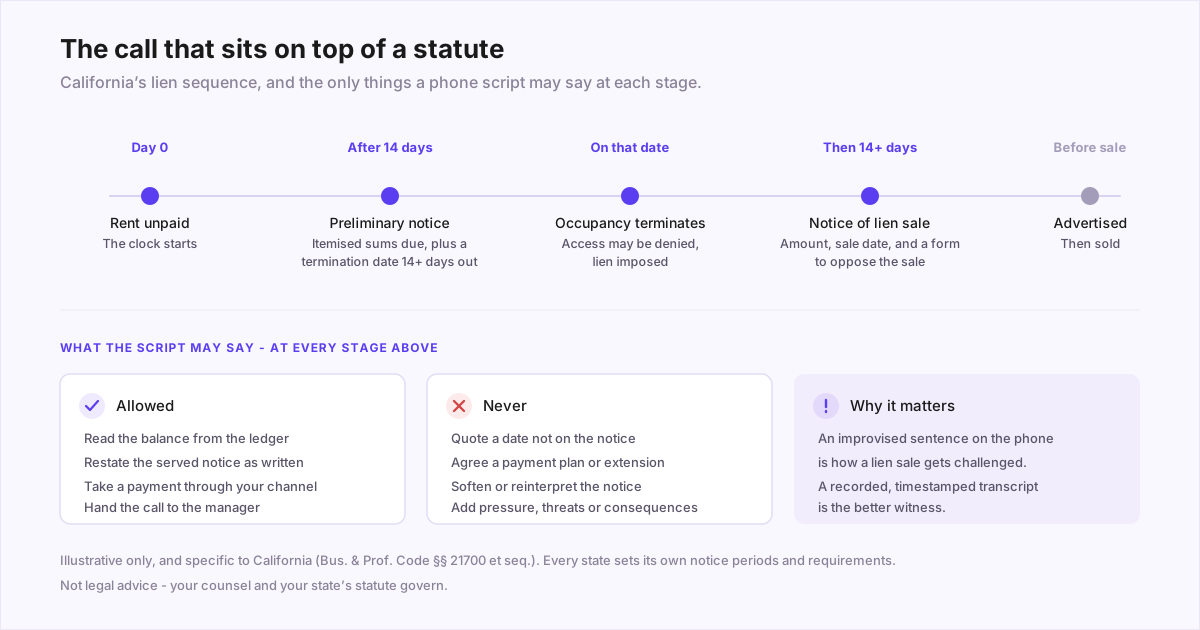
This is the section that should decide which service you buy, and almost no vendor page mentions it. Self storage operators have a statutory lien on the contents of a delinquent unit, and every state sets out its own sequence of notices and waiting periods before a sale. California's Self-Service Storage Facility Act is a fair illustration: an owner may terminate the right to use the space when rent has been unpaid for 14 consecutive days, by sending a notice to the occupant's last known address containing an itemised statement of the sums due and a termination date, and a lien sale then requires a further notice stating the amount and the sale date, with its own minimum waiting period and a form the occupant can use to oppose the sale. Your state's sequence will differ; that it exists will not.
What follows for anyone answering your phone:
- The written notice is the truth.The script restates what the notice says and what the ledger shows. It does not reinterpret, soften, or explain what the operator "probably" will do.
- No payment plans invented on the phone. Partial payments and extensions can affect where you stand in the process. That is a manager decision, made deliberately and recorded.
- No new dates."The auction is on the 14th" is safe only if it matches the served notice exactly. Anything else the script should decline and escalate.
- No pressure, no threats, no improvised consequences. Beyond the legal exposure, this is a call that ends up on social media and in reviews. A calm, factual, recorded script is a much better witness than a frustrated manager at the end of a long month.
- Everything is logged. A transcript and timestamp of exactly what a tenant was told, and when, is genuinely useful evidence if a sale is later challenged - and it is one of the honest advantages of automating this call rather than leaving it to memory.
Gate codes, lockouts and the security problem
The access call is the one where being helpful is the failure mode. A caller who knows a tenant's name and unit number is not thereby the tenant, and a gate code handed over at 10 p.m. is access to a hundred other people's property.

Access calls: what the script may and may not do
| Situation | Script behaviour |
|---|---|
| Tenant says their code is not working | Verify identity against the record, then check the account - most failures are an overlock or a delinquency block, not a broken keypad |
| Verification fails or is partial | No code, no account details. Offer a callback to the number on file, or a message for the manager - politely, and without apology |
| Caller wants a code for a spouse, relative or mover | Only if they are on the account as authorised. Otherwise it is a manager decision, in business hours |
| Locked in behind the gate after access hours | This is a safety call, not an admin call - escalate to a human immediately, whatever the hour |
| Cut lock, open door, missing property, or signs of a break-in | Straight to the manager and to police if warranted. Never handled as a message; never discussed with other callers |
| Fire, injury, or someone living in a unit | 911 and the manager. The script does not investigate |
Two of those rows are genuine emergencies and should be wired into a real escalation chain rather than an inbox - our guide to emergency call escalation covers how to build one that still works at 2 a.m.
Live agents vs AI vs hybrid
Answering models for self storage operators
| Model | Best fit | Watch out for |
|---|---|---|
| Storage-specialist call center | Multi-site operators wanting trained rental agents on every call | Per-call or commission pricing that scales with the volume you wanted; hold times on Saturdays; sales scripts that oversell unit sizes |
| Generalist answering bureau | Very small operators wanting a human voice and message-taking only | They will not have your inventory, will not know a drive-up from a climate unit, and will take a message where a rental was available |
| AI receptionist | Operators with unstaffed or roving-manager sites, and anyone losing evening and Sunday rentals | The software integration is the whole value - without live inventory it is a message service; the delinquency and gate-code boundaries must be explicit |
| Hybrid (AI first, human escalation) | Most operators: AI takes rentals, access and payment calls, humans take liens, incidents and disputes | Write the always-human list first - lien process, break-ins, injury, anything a lawyer would want to read |
Cross-market pricing is in our answering service cost guide and our own flat plans are on the pricing page. You keep the number on your signage and your listings - forwarding takes about eight minutes.
What good calls sound like
Saturday 4:20 p.m., prospect in a truck
9:50 p.m., tenant at the gate
The sentence that stops the script
Where AI loses (keep a human here)
- Anything inside the lien process. Covered above and worth repeating: capture, restate, escalate. Never negotiate.
- Break-ins, damage claims and insurance disputes. These become documents. They deserve a person from the first sentence.
- Identity edge cases. A death in the family, a divorce, a business partner, an estate - all of them produce a caller with a legitimate need and no authority on the account. The script should be kind, unhelpful and quick to escalate.
- Anyone living in a unit, or a welfare concern. Not a storage problem. Manager, and where warranted 911.
- Rate negotiation and retention saves. A tenant calling about a rate increase is a retention conversation with a number attached. Let a person own it rather than having a script give away margin - or refuse and lose the tenancy.
Setting it up
- Connect the management software first. Availability, rates and the ledger. Without these the service is a message-taker and most of the value in this article does not exist.
- Write the verification rule. Exactly which fields must match before anything about an account is discussed, and the exact wording when they do not. This is the script line most likely to be tested by someone who should not have access.
- Write the delinquency boundary with your counsel. What the script may say about balances and notices, and the sentence where it stops. Ten minutes of legal review against the cost of a challenged lien sale is not a close call.
- Load the facts a caller actually asks for. Unit sizes and what fits, climate control, drive-up availability, access hours versus office hours, vehicle rules, prohibited items, protection plan, current promotions, directions and what the entrance looks like from the road.
- Decide what a rental means. Full online move-in, or reservation plus callback. Either is fine; leaving it ambiguous is not, because the caller will act on whatever they heard.
- Run evenings and weekends first, then read the transcripts. That is where the lost rentals are. A week of reading will show you the two questions your script fumbles, and both will be things a manager answers without thinking.
The way to size this before spending anything: take last month's call log and count the calls that came in outside office hours. Then count how many of those were first-time callers. Each one was somebody with a truck and a list, and the facility that answered got the tenancy. If you want to hear the rental script yourself, our plans are month-to-month, and the property management page covers the wider portfolio use case.
Frequently asked questions
What is a self storage answering service?
It answers a storage facility's phone when the office is unstaffed, closed, or the manager is out on a lock check. It quotes availability and rates from your management software rather than from memory, reserves or rents units, handles gate and access problems, takes payment and delinquency calls by pointing at the ledger and the notices you have already sent, and routes anything that involves the lien process, a break-in or a dispute to a human. It can be a live call center, an AI receptionist, or a hybrid.
Can an answering service actually rent a unit?
It can do everything up to the lease. Connected to your management software it checks real availability, quotes the current rate for that unit type, holds or reserves the unit, and sends the prospect the link to complete the rental and sign online - which most operators now support. Where online move-in is not enabled, the job of the call is a firm reservation plus a callback commitment, because a storage prospect with a truck rented for Saturday will not wait for Monday.
How much does a self storage answering service cost?
Live call centers that specialise in storage typically bill per call or per minute, and multi-facility operators often see $300 to $1,000 a month per site, sometimes with a commission on rentals booked. Generalist answering bureaus are cheaper but do not know a 10x10 from a drive-up. AI answering is usually flat, in the $30 to $300 a month range per line. The comparison that matters is against tenancy value: one rental held for the industry-typical stretch of months is worth more than a year of any of these options.
Should an answering service give out gate codes?
Not on an unverified call, ever. A gate code is access to other people's property, and a caller who can name a tenant is not the tenant. Verification should be against the record in your software - identity details, the account, the unit - and anything that does not match becomes a callback to the number on file or a message for the manager. The right answer to social pressure at 10 p.m. is a polite, scripted no.
Can it handle a tenant calling about a lien sale or auction?
It should capture and escalate, not negotiate. Lien procedure is set by state statute - California, for example, requires a specific notice sequence with defined waiting periods before a sale can happen - and the notices you served are the operative documents. A friendly improvisation on the phone about dates, amounts or whether the sale will be cancelled is exactly how a lien sale gets challenged. The script reads the balance from the ledger, restates the written notice, and hands the call to the manager.
Do unstaffed and remote-managed facilities need this more?
Yes - it is the whole point. As more operators run sites with roving managers or no on-site staff at all, the phone becomes the front desk. A facility with a great website and an unanswered phone converts worse than an ugly one that picks up, because the storage caller is usually mid-move, in a truck, and calling the next facility on the map within a minute.
Sources
- California Business and Professions Code § 21703 - termination of occupancy for unpaid rent (California Legislative Information)
- California Business and Professions Code § 21705 - notice of lien sale (California Legislative Information)
- Harvard Business Review: The Short Life of Online Sales Leads (lead response-time research)