
In dentistry, the practice that picks up first usually wins the patient. A new patient with a cracked tooth finds three offices on their phone, calls the top one, gets voicemail at lunch, hangs up, and dials the next number before you ever hear the message. A dental answering service exists to close that gap. We build the AI kind, so read this skeptically: below is an honest look at what it does well, where the front desk and a clinician still have to take the call, and how to deploy it without breaking HIPAA or mishandling an emergency.
Our articles are still written by humans!
Get human written articles in your Google feed.
The short answer
A dental answering serviceanswers your calls when the front desk can't, captures the patient, books the visit, and flags anything urgent. It can be run by live operators, by an AI receptionist, or a hybrid of the two (we've compared AI receptionists, virtual receptionists, and answering services head to head if you're weighing the models). For most general and specialty practices, an AI service handles the high-volume routine calls around the clock for a flat monthly fee: new-patient inquiries, recall and reactivation, rescheduling, insurance questions, and directions, then escalates a real emergency or a sensitive call to a person. It is not there to replace your front desk or your clinical judgment. It exists to stop leaking calls to voicemail during the exact windows, lunch, evenings, weekends, and the mid-morning rush, when no one can reach the phone.
What a missed dental call actually costs
Most businesses can call a lead back in an hour. A dental practice usually can't afford to, because the caller is already scrolling a list of offices. A large share of calls to dental offices go unanswered during business hours, and a missed call in dentistry is rarely a missed conversation. The classic Harvard Business Review research on lead response time found the odds of even reaching a lead collapse within the first hour and fall off a cliff after that. A would-be patient who hits your voicemail does not wait. They call the practice that answers.
Now put a number on it. A new patient is not one cleaning. Over the life of the relationship they are exams, hygiene visits, fillings, the crown or implant down the road, and the family members they refer, which adds up to thousands of dollars per patient. Lose a handful of new-patient calls a month to a busy line and you have lost more revenue than a year of any answering service costs. The service that simply answers the phone pays for itself on the first patient it keeps.
What a dental answering service actually does
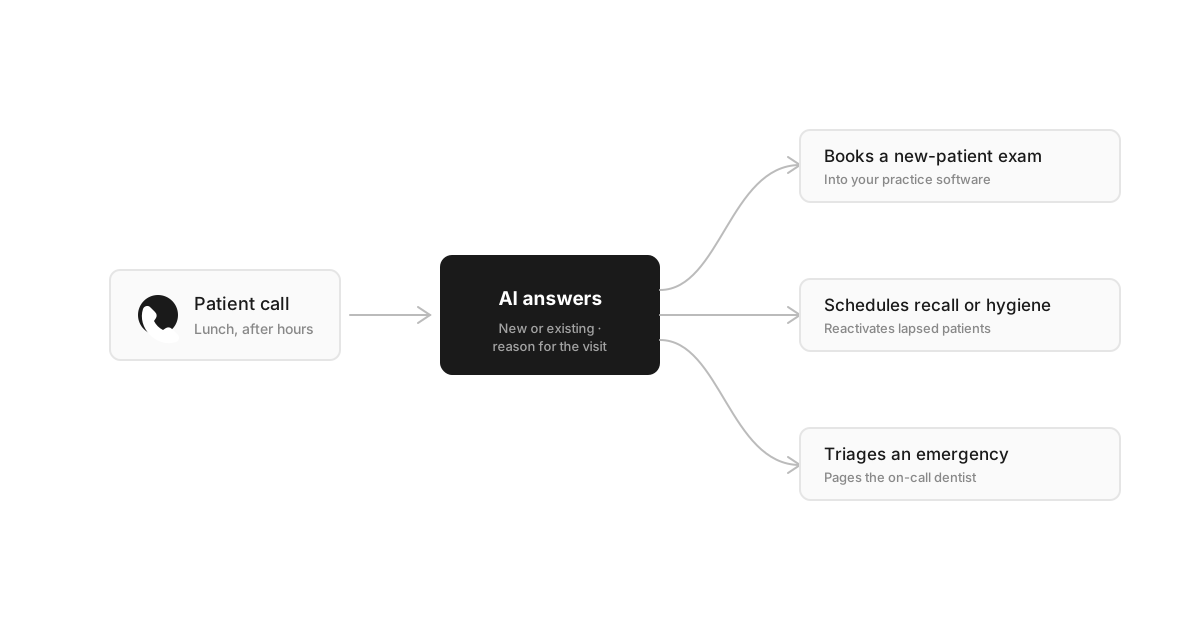
Strip away the marketing and a good service does five concrete things on a call:
- Answers every call instantly, including the ones that land at lunch, after hours, and while both team members are gloved up and seating patients.
- Captures the patient cleanly: name, callback number, new or existing, the reason for the visit, and the insurance they want on file, so the front desk inherits a complete record instead of a name on a sticky note.
- Sorts urgency by your rules: separates "my crown fell off" and "I'd like a cleaning" from "my tooth was knocked out an hour ago," and routes each the way you decided in advance.
- Books or routes: drops a routine visit into your real schedule, handles recall and rescheduling, or, for a real emergency, pages the on-call dentist instead of leaving it until morning.
- Hands you a usable summary, texted or written into your practice software the moment the call ends, so the morning huddle works from a clean record rather than a garbled voicemail.
Why a dental practice is a natural fit for AI
Some businesses are awkward for an AI receptionist. A dental front desk is one of the more natural fits, for structural reasons:
- The front desk is physically away from the phone. Your team is checking in patients, processing payments, and walking people back to the chair. The phone rings straight through those moments, and an AI answers without anyone stepping away.
- So many calls land in dead zones.Lunch, the first hour of the morning, evenings, and weekends are when patients are free to call and your office often isn't. A service that owns those windows captures the calls you were already losing.
- The intake is repetitive. New patient or existing, reason for the visit, insurance carrier, preferred times. That predictable core is exactly what AI handles well, which frees your coordinator for the conversations that need a person.
- Recall is pure upside. Reactivating lapsed hygiene patients and filling last-minute cancellations is high-value work that a busy desk never gets to. An assistant that works that list around the clock keeps the schedule full.
Features that actually matter (and what's noise)
Every vendor lists a dozen features. For a dental office specifically, these are the ones that decide whether you'll be glad you bought it:
Emergency triage you can trust
The highest-stakes feature. The service must reliably separate a true emergency from a routine ache using your definitions, give only safe first-aid pointers, page the on-call dentist, and hard-stop to 911 or the ER for any airway, uncontrolled-bleeding, or trauma situation. Get this rule right before you touch anything else.
Real booking into your practice software, not message-taking
It should read your live schedule, offer genuine open slots, and write the appointment into the system you already run on, Dentrix, Eaglesoft, Open Dental, Curve, or whatever you use. "We'll pass along the request" is not booking, and it rebuilds the voicemail you were trying to escape.
New-patient capture done properly
A new patient is the most valuable call you get. The service should recognize one, collect the details that let you verify benefits and prepare the chart, send the intake forms, and book the longer new-patient slot rather than squeezing them into a checkup. Done well, the patient arrives ready and the visit runs on time.
Insurance handling that doesn't overpromise
Callers ask "do you take my insurance" and "what will this cost." The right behavior is to record the plan and have a human verify benefits, never to quote coverage on the call. An assistant that confidently promises what a policy covers creates disputes you will be cleaning up at the front desk for weeks.
HIPAA-grade handling and a signed agreement
The service hears names and health information, so it is a business associate under HIPAA. You need a signed agreement, encryption in transit and at rest, and a vendor that won't train external models on your patients' data. This isn't a nice-to-have; it is the price of letting anyone answer your phone.
Live agents vs AI vs hybrid
There are three ways to staff a dental answering service, and the right one depends on your call mix and how often the front desk is genuinely underwater. Be honest about how many calls you miss in a normal week.
Answering service models for dental practices
| Model | Best fit | Watch out for |
|---|---|---|
| Live human operators | Practices that want a person on every call and have steady, predictable volume | Cost (often per-minute), hold times when several calls hit at once, operators who don't know dental triage or your software |
| AI receptionist | Heavy lunch, after-hours, and overflow volume; routine booking, recall, and reactivation; small front desks | Must be configured for emergency triage, insurance honesty, and HIPAA; needs a clean handoff for anything clinical or sensitive |
| Hybrid (AI first, human backup) | Most growing practices: AI catches 100% of calls, a person takes the ones that need one | Slightly more setup; you must define exactly what triggers a handoff and where it goes |
For most general and specialty practices, hybrid is the sweet spot: let the AI catch every call and handle the routine majority, page the on-call dentist for a real emergency, and route the rare delicate call to a person.
What good call handling actually sounds like
The quality of an answering service lives in the script. Here is the shape of three calls worth modeling, kept short on purpose, because long scripts are where AI and tired humans both go wrong. (If you'd rather start from a template, our AI receptionist prompts include a dental intake module you can copy.)
New-patient booking
The emergency call (triage and escalate, never diagnose)
The insurance question (capture, don't promise)
The moment a routine call ends, the front desk should get a one-line summary they can act on: "New patient, cracked molar, Delta Dental, booked Thu 2pm, forms sent" or "Recall, existing patient, hygiene, booked next Tue 9am." That summary is the actual product. Everything before it is plumbing.
Where an AI service still loses (and you should know it)
Against our own commercial interest, here is where an AI answering service is the wrong tool, or a dangerous one if you're careless:
- Clinical judgment and diagnosis.An AI must never decide whether a patient's pain is serious, recommend treatment, or advise on medication. Its only job on a symptom call is to triage urgency by your rules and book or escalate. Let it stay in that lane.
- True medical emergencies. Facial swelling that affects breathing or swallowing, uncontrolled bleeding, or trauma is not a booking. The correct move is to direct the caller to 911 or the ER and escalate to a person, never to schedule it for tomorrow. This is the one boundary you cannot get wrong.
- Insurance promises. Coverage depends on the individual policy, so the AI should capture the plan and route verification to a human, never quote what is covered. A confident wrong answer here turns into a billing dispute and a lost patient.
- HIPAA, taken seriously. The service handles protected health information, so under HHS rules on business associates you need a signed business associate agreement before it takes a live call, and the ADA's own guidance spells out the same point for answering services. Compliance is yours as the covered entity, not the vendor's to promise away.
- Anxious and sensitive callers. Dental anxiety is real, and a frightened or upset patient often wants to hear a person. A polite AI is not the same thing, and they can tell. Route these to a human early.
- Disclosure and trust.A short "this is an AI assistant" up front is the honest default, and in line with the spirit of the FTC's guidance on clear disclosure. In a care setting, trust is the whole relationship; don't spend it to hide a robot.
How to set it up without regret
- Sign the business associate agreement first.Before a single live patient call, get the HIPAA agreement in place and confirm the vendor encrypts call data and won't train external models on it. This is step one, not paperwork to chase later.
- Start with lunch, after-hours, and overflow.Forward only the calls you're already missing to the service first. It is pure upside, those were going to voicemail, and it lets you judge quality on real calls before you hand it the main line.
- Write the emergency triage rules. Define exactly what counts as urgent, what pages the on-call dentist, and the hard-stop 911 script for airway, bleeding, and trauma. This is the most important configuration step in the whole setup.
- Wire up booking before you trust it. Confirm two-way sync with your practice software and test it by calling your own number and booking a fake new-patient exam. Make sure it lands on the schedule and the forms go out.
- Read the first two weeks of transcripts. Check that it captured new patients cleanly, stayed honest on insurance, and triaged emergencies correctly, then tighten the script. Treat it like a new coordinator in training, not a set-and-forget box.
If most of your calls are routine booking and recall and you're losing new patients at lunch and after hours, the decision is straightforward. You're not replacing your front desk or your clinical judgment; you're making sure the phone is always answered so you get the chance to win the patient. For how to evaluate any provider, see our AI receptionist buyer's guide, compare the cost of the options, and, since trust on the phone is everything in care, read whether AI voices actually sound human. If you also run a professional-services book, the same playbook for the legal world is in our law firm answering service guide, and the broader healthcare version - HIPAA, the BAA, and clinical triage rules - is in our medical answering service guide. Then see how our AI receptionist works, check the setup and pricing, and judge it on your own calls.
Frequently asked questions
What is a dental answering service?
A dental answering service answers calls for a practice when the front desk can't: at lunch, after hours, or when both staff are with patients and the phone keeps ringing. It captures the new patient, takes insurance details, books the appointment, handles recall and rescheduling, and flags a true emergency. It can be run by live operators, by an AI receptionist, or a hybrid. Because those calls carry patient information, the provider must sign a HIPAA business associate agreement. The goal is simple: stop sending new-patient and recall calls to voicemail, where most callers just dial the next practice.
How much does a dental answering service cost?
AI-based services typically run from roughly $30 to $300 a month depending on call volume; live human answering services usually cost more, often $1 to $3.50 per minute or several hundred dollars a month. For a dental office the honest comparison isn't the monthly fee. The lifetime value of a single new patient runs into the thousands once you count exams, hygiene, restorative work, and family referrals, so catching even one extra new patient a month usually covers a year of the service.
Is a dental answering service HIPAA-compliant?
It can be, but only if you set it up correctly. Any service that hears a caller's name and reason for visit is handling protected health information, so it becomes a HIPAA business associate and you must have a signed business associate agreement before it takes a live call. Choose a vendor that encrypts call data in transit and at rest and won't use it to train external AI models. Compliance is your responsibility as the covered entity, not something the vendor's marketing can grant you.
Can an AI receptionist book appointments into my dental software?
A good one can. It reads your live availability, offers real open slots, books the visit straight into your practice management software (Dentrix, Eaglesoft, Open Dental, Curve and similar), and texts the patient a confirmation and new-patient forms. Confirm two-way sync before you buy. A service that only takes a message and asks the front desk to schedule it later is a glorified voicemail, not a booking tool.
Should an AI handle a dental emergency call?
Only to triage and route, never to diagnose. A knocked-out tooth, uncontrolled bleeding, or facial swelling that affects breathing or swallowing is time-critical. The AI's correct job is to recognize urgency by your rules, give safe first-aid pointers, page your on-call dentist, and direct any airway, bleeding, or trauma emergency to 911 or the ER. It must never decide whether pain is serious or recommend treatment. Configure that boundary first; it matters more than any booking feature.
Sources
- Harvard Business Review: The Short Life of Online Sales Leads (lead response time research)
- HHS: Business Associates under HIPAA (business associate agreement requirements, 45 CFR 164.504(e))
- American Dental Association: FAQ on HIPAA Business Associates
- FTC .com Disclosures: how to make effective disclosures in digital advertising