

An outsourced receptionist is a service outside your company that answers your phone in your company's name, usually through call forwarding, and bills by the minute, the call or the month. The question behind most searches for one is simpler: is it cheaper than hiring? We worked it out from US government wage data and eight published rate cards, read on October 29, 2026. We sell an AI receptionist, so we compete with every service below; each price links to the provider's own page so you can check it.
Our articles are still written by humans!
Get human written articles in your Google feed.
What an outsourced receptionist is (and is not)
You forward your business number to the service. Its receptionists, or its software, answer with your greeting, follow a script you agree on, and send you the message, book the appointment or transfer the call. There are three ways to buy it:
Three outsourced receptionist models
| Model | How it bills | Examples (prices below) | Best for |
|---|---|---|---|
| Shared live receptionists | Per minute or per call, in monthly bundles | PATLive, Moneypenny US, Smith.ai, Ruby, Abby Connect, Davinci, ReceptionHQ | Calls that need a person's judgement |
| AI receptionist | Per call or a monthly minute allowance | Moneypenny AI, Smith.ai AI, ours | Routine bookings, messages, after hours |
| Dedicated remote assistant | Hourly, through a staffing or VA agency | Not priced here: we found no rate card we could verify | One person who learns your business |
What none of them do is sit at your desk. Visitors, deliveries, mail, the coffee machine and the printer stay with you. If those are a real part of the job, the honest comparison is not "hire versus outsource" but "one hire versus one hire plus a service for the calls they miss". We come back to that below.
What a hire really costs
The median US receptionist earned $18.27 an hour, or $38,010 a year, in May 2025 (Bureau of Labor Statistics). Wages are not the whole cost. In June 2026, wages were 68.7% of what private employers spent per hour on office and administrative support staff; the other 31.3% was paid leave, insurance, retirement and legally required payments such as Social Security and unemployment insurance (BLS ECEC, table 4).
A full-time receptionist at the US median, with benefits (our calculation from BLS data)
| Item | Per year | Per month |
|---|---|---|
| Median wage (2,080 hours) | $38,010 | $3,168 |
| Benefits and legally required costs (31.3% of total) | $17,318 | $1,443 |
| Total employer cost | $55,328 | $4,611 |
Three things this number does not show:
- It may be a little high. The 31.3% is an average for all office and administrative support staff. A receptionist at a small business may get fewer benefits; the legally required part alone was 7.0% of compensation.
- It leaves out real costs. Recruiting, training, a desk, a phone line and cover for holidays and sick days are not in it.
- It buys 40 hours a week. That is 24% of the week. The other 128 hours, plus lunch, go to voicemail unless someone else picks up. And one receptionist answers one call at a time; the second caller waits or hangs up.
What outsourcing costs at 100, 300 and 600 calls
We modelled three small businesses: 100, 300 and 600 calls a month, roughly 5, 14 and 28 calls each weekday. Each call is 2 minutes 10 seconds of talk. For every provider we picked the cheapest published plan for that volume, added its published overage rate and applied its own rounding rule. Prices are monthly, in US dollars, before tax.
Monthly cost on published plans, October 29, 2026 (our calculation)
| Provider | Bills by | 100 calls | 300 calls | 600 calls |
|---|---|---|---|---|
| PATLive | Minute: first minute in full, then 6 s | $388.80 | $1,045.40 | $2,039.80 |
| Moneypenny US | Minute: 30 s, plus wrap-up | $541.50+ | $1,507.50+ | $3,075.00+ |
| Smith.ai | Call (spam not charged) | $915.00 | $2,100.00 | $4,650.00 |
| Moneypenny US, AI plan | Call | $199.00 | $529.50 | $944.00 |
| Full-time hire (median) | Salary + benefits | $4,611 | $4,611 | $4,611 |
The "+" on Moneypenny is wrap-up time: its terms bill the time an operator spends finishing your message after the caller hangs up, capped at 180 seconds a call, and round the total up to 30 seconds (Moneypenny US terms). We could not know how much wrap-up your calls would carry, so we left it out. PATLive bills "the first minute in full, and then each 10th of a minute thereafter" (PATLive FAQ), which makes our 2 minute 10 second call 2.2 billed minutes.
Four more services we could not model fully
These publish a monthly price but not everything needed to price a real month, so they are not in the table. We would rather leave them out than guess.
- Ruby: $250 for 50 minutes, $395 for 100, $720 for 200, $1,725 for 500. No overage rate or rounding rule on the page.
- Abby Connect: $164 for 50 minutes, $329 for 100, $599 for 200, $1,380 for 500. Overage is "billed at your plan's Abby Minute rate" with no dollar figure; AI minutes count half.
- Davinci Virtual: $129 for 50 minutes up to $319 for 100 on its Premium plan. No overage rate or billing increment published.
- ReceptionHQ (US): plans "from $25" a month, plus $1.99 per call on its message-taking plan; included calls per tier are not stated.
Where they break even
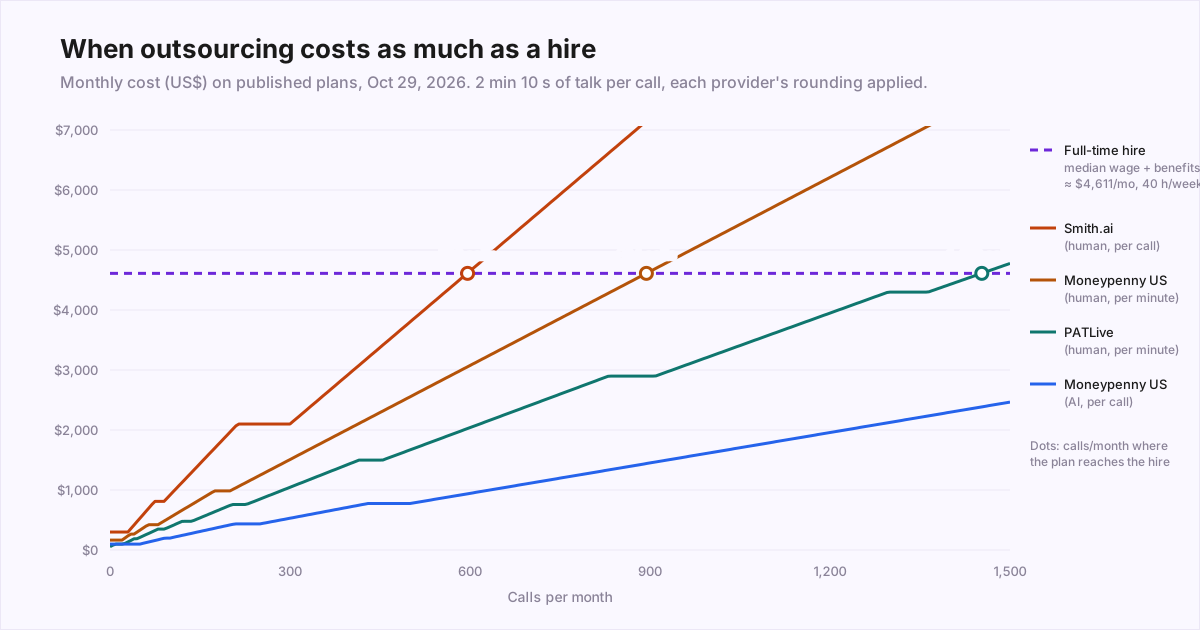
Raising the call count until each outsourced plan costs as much as the $4,611 hire gives three break-even points:
- Smith.ai (per call): about 596 calls a month, or 27 per weekday.
- Moneypenny US (per minute): about 894 calls, or 41 per weekday, before wrap-up time, which pulls it earlier.
- PATLive (per minute): about 1,453 calls, or 67 per weekday.
Two things move these points a lot. Call length: per-minute plans get more expensive as calls get longer, per-call plans do not, so for long calls Smith.ai's model catches up. What else the hire does: if the receptionist spends half the day on admin, only half the $4,611 is the cost of answering the phone, and the break-even points halve too.
What you give up, what you gain
Hire versus outsourced receptionist, beyond the price
| Your own hire | Outsourced service | |
|---|---|---|
| Hours covered | 40 a week, minus lunch, leave and sick days | Up to 24/7, depending on plan |
| Two calls at once | Second caller waits or hits voicemail | Handled by the next free agent or line |
| Knows your business | Learns it in weeks; remembers regulars | Only what is in the script and notes |
| Visitors, mail, admin | Yes | No |
| Fixing a wrong answer | A conversation | A script change, applied by the provider |
| Leaving | Notice period, then rehiring | Cancel: 30 days' notice at Moneypenny, end of cycle at Smith.ai |
The biggest risk in outsourcing is not cost but fit: a receptionist who answers for dozens of companies knows only what you wrote down. The first month will show every gap in your script. Read the messages daily during that month and fix the script weekly.
Eight things to check in the contract
- Rounding. Per second, per 6 seconds, per 30 seconds or per minute? On a 2 minute 10 second call that is the difference between 130 and 180 billed seconds.
- Wrap-up and hold. Is time after the caller hangs up billed? Moneypenny US says yes, up to 180 seconds.
- Overage rate. Ruby, Abby and Davinci do not publish one; ask before you need it.
- Spam and wrong numbers. Smith.ai does not charge for them if your caller ID passes through; ask everyone else.
- Notice and refunds. Smith.ai offers a 30-day refund on its human plans up to $1,000, overage excluded.
- Where the agents sit. PATLive says all its receptionists are in the US. If it matters, put it in writing.
- Is any call answered by AI? Several live services now sell AI as well. If you are paying for a person, say so in the contract.
- Who owns recordings and messages when you leave, and how you export them.
For a longer list of how live services differ on answer speed and hold, see what 13 live answering services promise; for every rate card side by side, our answering service cost comparison.
The setup most small offices end up with
Outright replacement is rarer than people expect. What works for most small offices that already have a receptionist is to keep them and outsource the calls they cannot take:
- Overflow: if the desk does not pick up in 3 or 4 rings, the call forwards to the service.
- Lunch and breaks: the receptionist turns on forwarding when they step away.
- After hours and weekends: forwarding on a schedule.
All three use the call forwarding your phone system already has (how to set it up). At low overflow volume this costs a fraction of the table above, because you only pay for the calls that would otherwise have been missed.
Where an AI receptionist fits
We sell one, so weigh this accordingly. An AI receptionist is the cheapest way to cover availability: it answers every call at once, around the clock, and costs the same whether a call comes at 2 p.m. or 2 a.m. Moneypenny's AI plan is $199 for 100 calls; Smith.ai has a free AI tier of 25 calls and a $150 paid plan (Smith.ai AI pricing). Ours is 99 euros a month for 1,000 minutes on one line, or 299 euros for 3,000 minutes and three calls at once (pricing). We bill in euros, so we left ourselves out of the dollar table rather than pick an exchange rate.
Where it is the wrong choice: calls that need judgement or comfort that a script cannot hold, callers who expect a person, and calls you want patched through live while the caller waits, which our product does not do; it takes the message, texts it to you and can ring you for an urgent one. If most of your calls are bookings, hours, prices and messages, it covers them. For the detail, see can an AI receptionist replace a human one and AI vs virtual receptionist vs answering service.
How we calculated this
- Hire: BLS median annual wage for occupation 43-4171 (May 2025) divided by 0.687, the wage share of employer costs for private-industry office and administrative support workers in June 2026.
- Outsourcing: plans read on each provider's own pricing page on October 29, 2026. For each volume, the cheapest published plan plus published overage. Taxes, setup fees and add-ons left out.
- Calls: 2 minutes 10 seconds of talk each, an assumption. Your call log will give you your own number; rerun the table with it.
- Not verified: we did not place test calls, and we did not negotiate. Larger plans are often quoted privately, and prices change; check the linked pages before you decide.
Frequently asked questions
What is an outsourced receptionist?
An outsourced receptionist is a person or service outside your company that answers your business phone calls in your company's name, usually through call forwarding. They greet callers, take messages, book appointments or transfer calls, and bill by the minute, by the call or by the month. They do not work at your front desk, so they cannot greet visitors or handle mail.
How much does an outsourced receptionist cost?
On plans published on October 29, 2026, 100 calls a month of 2 minutes 10 seconds each cost about $389 (PATLive), $542 (Moneypenny US) or $915 (Smith.ai) with live people, and $199 on Moneypenny's AI plan. Entry plans start at $25 to $300 a month, but overage rates, rounding and wrap-up time decide the real bill.
Is it cheaper to outsource a receptionist or hire one?
For phone answering alone, outsourcing is cheaper at most small-business volumes. A full-time receptionist at the US median wage costs about $4,611 a month including benefits. In our model, Smith.ai's per-call plans reach that cost at about 596 calls a month, Moneypenny US at about 894 and PATLive at about 1,453. A hire who also does admin or greets visitors is a different comparison.
Can an outsourced receptionist work at my front desk?
No. Outsourced receptionist services answer phones, chats and sometimes email remotely. If you need someone physically at the desk, the options are a hire, a part-time hire or a temp from a staffing agency; many offices keep one person on site and outsource the overflow, lunch hour and after-hours calls.
What should I check before signing with an outsourced receptionist service?
How each call is rounded, whether wrap-up or hold time is billed, the overage rate once your plan runs out, whether spam calls are charged, the notice period, the refund terms, where the agents are based, and whether some calls are answered by AI. Moneypenny US, for example, bills up to 180 seconds of wrap-up per call and rounds to 30 seconds.
Sources
- BLS Occupational Outlook Handbook: Receptionists (median pay, May 2025)
- BLS: Employer Costs for Employee Compensation, June 2026 (released September 9, 2026)
- BLS: ECEC Table 4 - private industry by occupational group, June 2026
- PATLive: pricing
- PATLive: FAQ (billing increments, US-based)
- Moneypenny US: pricing (receptionist and AI plans)
- Moneypenny US: terms and conditions (wrap-up time, 30-second rounding)
- Smith.ai: receptionist pricing
- Smith.ai: AI receptionist pricing
- Ruby: pricing
- Abby Connect: pricing
- Davinci Virtual: live receptionist plans
- ReceptionHQ (US): pricing