
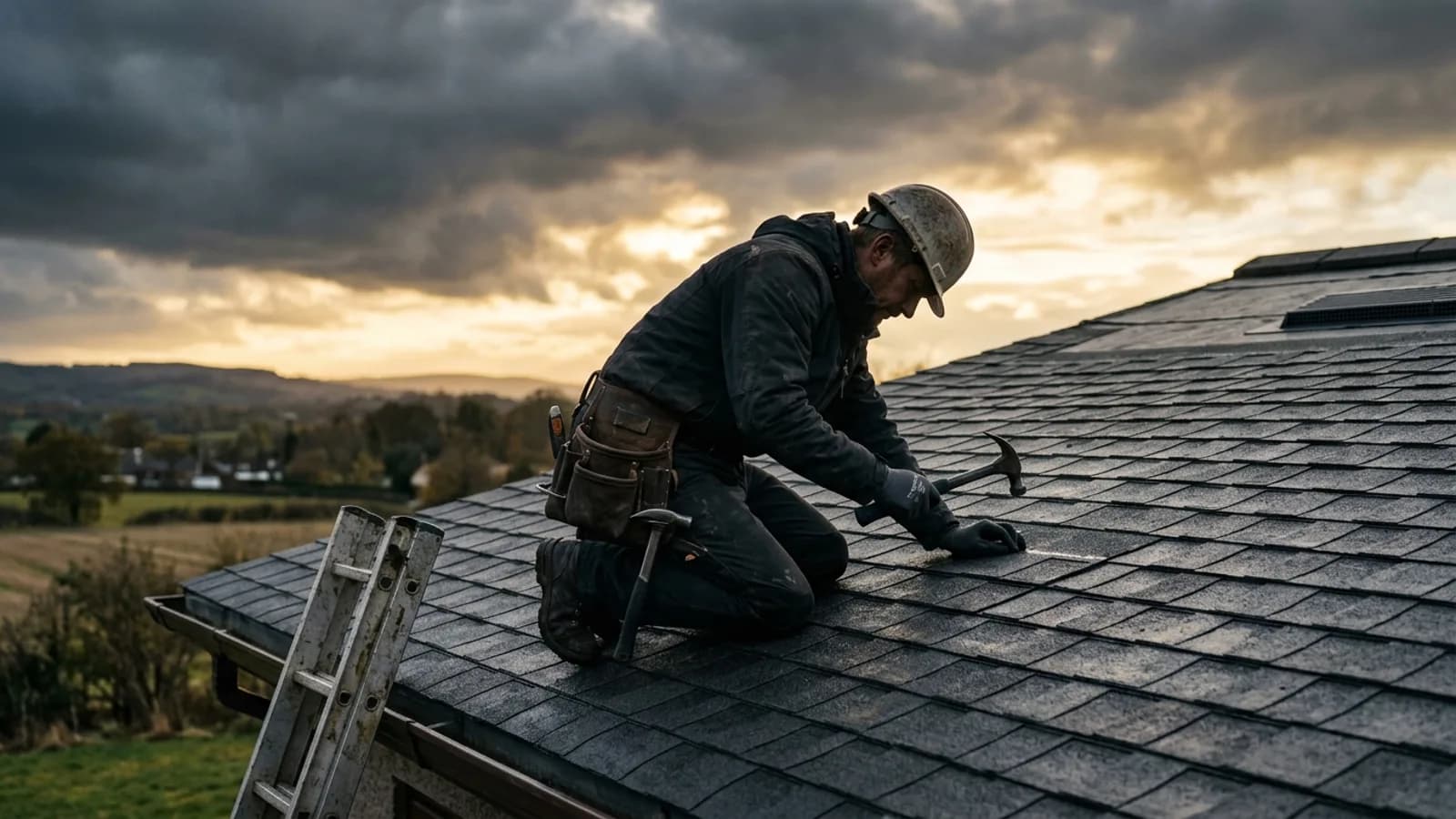
Roofing has the most violent demand curve in the trades. For months your phone rings at a manageable pace - then one hailstorm drops a year's worth of leads on your line in a week, at the exact moment every crew you have is on a roof and every competitor's canvasser is walking the same streets. A roofing answering service exists for that week, and for the quieter leak calls in between. We build the AI kind, so read this skeptically: here's what it genuinely fixes, where it loses to a person, and how to set it up so the storm surge lands in your calendar instead of your voicemail.
Our articles are still written by humans!
Get human written articles in your Google feed.
The short answer
A roofing answering serviceanswers your calls when you can't - mid-tear-off, after hours, and during the storm weeks when three calls hit at once. It captures the caller and the property, sorts an active leak from a routine estimate request, books inspections straight into your calendar, escalates real emergencies to you or the on-call lead, and texts a summary after every call. It can be run by live operators, an AI receptionist, or a hybrid. For most roofing companies the math favors AI or hybrid, because roofing's defining problem - the storm surge - is the one thing per-minute human services handle worst. This guide is part of our trades series: the AI receptionist for home services overview covers the field side by side, and the HVAC and plumbing guides are the companion pieces for the other weather-driven trades. When the storm call turns into water inside the building, the restoration answering service guide picks up where this one stops.
The storm-week problem
Every trade misses calls; roofing misses them in catastrophic bursts. The structure of the business works against your phone:
- Demand arrives in spikes you can't staff for. A single hail or wind event damages hundreds of roofs in your service area on the same afternoon. No office setup that makes sense in February can answer the phone in the week after a June storm.
- The spike hits when you're least available. The same storm that floods your line fills your schedule. Your best people are on roofs, running crews, or meeting adjusters - not at a desk.
- You physically cannot answer on a roof. Two-hand work, fall protection, nail guns, and forty feet of ladder between you and a callback. Even a rung-by-rung climb to return a call costs you twenty minutes of production.
- The caller has alternatives on her porch.After a storm, homeowners don't need to search for roofers - roofers find them. If your reputation earned the inbound call and nobody answers it, the canvasser knocking that afternoon gets the contract your review profile earned.
Wind and hail are the single most frequent cause of homeowners insurance claims in the United States, per the Insurance Information Institute's claims data - which is another way of saying the storm-week phone surge is not an edge case in this business. It is the business.
What a missed roofing call costs
Roofing has the highest cost-per-missed-call in the trades, for a simple reason: the average ticket is enormous. A repair runs hundreds to a few thousand dollars; a full replacement is a five-figure job, and an insurance-funded storm restoration often more. One missed storm-week call is not a missed appointment - it's a missed roof.
The misses are also invisible. The Harvard Business Review lead-response research found the odds of contacting a lead collapse within the first hour; storm-season callers are faster still, because they are working down a list while the damage is fresh and the tarps are blue. A caller who hits voicemail leaves no trace - most owners discover the leak only when they compare a storm map to their booked-jobs list and wonder where the rest of the neighborhood went. We've put fuller numbers on this in the cost of a missed call; for roofing, multiply everything by your average ticket.
What a roofing answering service actually does
Strip the marketing and a good one does five things per call:
- Answers instantly, in parallel. The fortieth caller on the day after the hailstorm gets the same first-ring answer as the first. This is the roofing-specific requirement; everything else is shared with the other trades.
- Qualifies the lead: name, property address, callback number, what happened (storm, leak, age), roof type if known, whether water is actively coming in, and whether an insurance claim is in play.
- Triages by urgency using rules you wrote - active interior leak versus post-storm inspection versus new-roof quote. More on the rules below.
- Books the inspection into your real calendar or CRM, offering actual slots and confirming by text during the call - not a message asking you to call back and negotiate times.
- Texts you a summary: "Hail damage, 42 Birch Ln, no active leak, State Farm claim planned, inspection booked Thu 10-12". During a surge week these summaries are effectively your CRM intake queue.
Triage rules for roofing calls
Roofing triage is different from plumbing or HVAC: true drop-everything emergencies are rarer, and the money is in sorting sales-ready leads fast. A sane starting rule set:
A starting triage rule set for roofing calls
| Caller says | Classification | What the service does |
|---|---|---|
| Water actively coming in - ceiling bulging, dripping into rooms | Emergency | Advise moving valuables and containing water; page the on-call lead for same-day tarp/dry-in |
| Tree or debris through the roof | Emergency | Confirm everyone is safe; page on-call now - structural exposure compounds with the next rain |
| Storm just hit - shingles in the yard, possible hail damage | Hot lead, same-week | Capture damage details and insurance intent; book the earliest inspection slot |
| Slow stain on ceiling, leak only when it rains hard | Routine repair | Book the next open inspection; capture where and when it shows |
| Roof is 20+ years old, wants replacement quote | Sales | Qualify (age, size, timeline, decision-maker), book the estimate, tag for follow-up |
| Insurance/adjuster questions - deductible, claim process | Human handoff | Capture the details, book the inspection, flag for the owner to call back on the claim |
Two design rules carry over from every trade. First, fail toward escalation: an ambiguous call pages a human - a false alarm costs minutes, a genuinely flooding living room left until morning costs a customer and a review. Second, make the service ask the money question early: "Is water coming inside right now?" That single answer routes the call correctly nine times out of ten.
Beating the door-knockers
The competitive reality of storm work is that your rival isn't just other phone numbers - it's canvassers on the street offering a free inspection on the spot. You can't out-knock a storm chaser, but you can out-answer one:
- Speed is the whole game.The homeowner who calls you and gets an inspection booked in ninety seconds has no reason to sign the canvasser's clipboard. The homeowner who hits your voicemail does.
- An answered phone is a trust signal. Storm-hit homeowners are warned - by their insurer, their neighbors, and the local news - about fly-by-night contractors. A local company that answers instantly, confirms by text, and shows up when booked reads as the safe choice.
- Book the inspection, not the pitch.Configure the service to get a firm slot on the calendar. A promised "we'll call you back to schedule" is an open door for the next knock.
Live agents vs AI vs hybrid
Answering service models for roofing companies
| Model | Best fit | Watch out for |
|---|---|---|
| Live human operators | Low, steady call volume; owners who want a person on every call | Hold queues and per-minute bills explode in surge weeks - the exact weeks the service must earn its keep; generic operators can't qualify a roofing lead |
| AI receptionist | Storm-driven volume, after-hours and overflow coverage, inspection booking at scale | Needs your triage rules and insurance-handoff script configured; must disclose itself and escalate cleanly |
| Hybrid (AI first, human backup) | Most growing roofing companies: AI absorbs the surge and books, humans take claims talk and emergencies | Define exactly what triggers the handoff - insurance questions, angry callers, active leaks - and who gets paged |
Surge capacity is the deciding question, and it's worth asking any vendor directly: how many of my calls can you answer at the same time, and what does my bill look like the week after a hailstorm? We've covered how parallel answering works in can an AI receptionist handle multiple calls at once, and you can compare flat-rate costs on our pricing page or against the market in our answering service cost guide.
What good calls sound like
The storm-week lead (booking under pressure)
Ninety seconds, disclosed as AI, lead qualified, inspection on the calendar, insurance question captured but not answered - that conversation is saved for a human.
The active leak (escalation)
Where AI loses (know it going in)
- Insurance claim conversations.What a policy covers, whether to file, how to talk to an adjuster - these are judgment calls with legal edges. The AI's job ends at capturing the facts and booking the inspection. Configure it to say so plainly and flag the call.
- Scope and price negotiation."The other company quoted eighteen" is a negotiation, and negotiations need authority. Honest ranges and a booked estimate, nothing more.
- Judging damage from a description. Whether that stain is flashing, fastener back-out, or condensation takes eyes on a roof. The AI captures symptoms; the estimator makes the call.
- Upset customers mid-project. A homeowner with a crew on her roof and a concern wants a person immediately. Route existing-project calls to a human by rule.
Setting it up
- Start with overflow and after-hours.Forward on no-answer and outside office hours. Those calls were going to voicemail; the change is pure upside, and you can judge the service on transcripts before it fronts your main line. Your number doesn't change - call forwarding handles it.
- Write the triage rules.The table above is the template. Add your insurance-handoff line word for word - it's the rule most worth getting exactly right.
- Connect the calendar your estimators actually run on. JobNimbus, AccuLynx, Jobber, or Google Calendar. Then test it: call your own number, book a fake inspection, and confirm it lands where your estimator will see it.
- Rehearse the surge before the storm. Ask the vendor what happens at ten simultaneous calls. Read your first storm-week transcripts and tighten the script - fifteen minutes that pays for itself the next hail season.
The decision test: pull up your call log for the week after your last big storm and count the calls you know you missed - then remember the misses that never even registered. See how our AI receptionist works for home-services businesses, check pricing, and judge it on your own storm week.
Frequently asked questions
What is a roofing answering service?
A roofing answering service answers your company's phone when you can't - on a roof, in a storm week when calls triple, or after hours. It captures the caller's details, sorts an active leak from an inspection request, books estimate appointments into your calendar, escalates genuine emergencies to you or your crew, and texts you a summary of every call. It can be staffed by live operators, an AI receptionist, or a hybrid of both.
How much does a roofing answering service cost?
AI-based services generally run about $30 to $300 a month flat. Live operator services bill per minute - typically $1 to $3.50 - which gets expensive in exactly the weeks you need them most, because a hailstorm can multiply your call volume for a month. Compare either number to the job: a single roof replacement is a five-figure ticket, so one captured storm lead typically pays for years of the service.
Can an answering service handle the call surge after a hailstorm?
This is the question that separates the models. A live operator bureau puts surge callers in a hold queue, and per-minute billing climbs with the surge. An AI answering service takes simultaneous calls in parallel - the fortieth caller on the day after the storm gets the same instant answer as the first. If storms drive your business, ask any vendor specifically how many concurrent calls they handle and what surge weeks cost.
Can it book roof inspections into my calendar?
A good one can, and for roofing this is the core feature - most of your inbound calls are estimate and inspection requests, not emergencies. Connected to your calendar or CRM (JobNimbus, AccuLynx, Jobber, or a plain shared calendar), it reads real availability, offers the caller actual slots, books the inspection during the call, and sends a confirmation text. A service that only takes messages leaves you doing callback rounds every evening.
Should storm damage insurance questions go to an AI?
No - and a well-configured one won't try. Whether a claim is worth filing, how a deductible works on this policy, or what an adjuster will accept are conversations for you, not a robot. The right setup has the AI capture the damage details, the insurance carrier if the homeowner knows it, and an inspection booking - then flags the call so a human handles the claim conversation. Anything more is practicing insurance without a license.
Do roofers really need 24/7 call answering?
Less for midnight emergencies than plumbers - but storm damage doesn't respect business hours, and neither do homeowners comparing contractors. People discover leaks during the Saturday storm and call from their kitchen at 9 p.m. If nobody answers, they call the next roofer on the list or sign with the door-knocker on Monday. After-hours answering isn't about tarping at 2 a.m.; it's about being the first roofer who responded.